Top 10: Logistics Companies
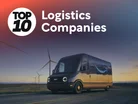
Logistics companies around the world have been faced by constant pressures to shift and adapt to ongoing geopolitical turbulence.
This has led to businesses investing in supply chain automation, AI tools and other digital tools that can help them increase speed without sacrificing efficiency.
Moreover, as businesses examine their decarbonisation strategies, logistics firms are beginning to reduce their emissions and make a positive environmental impact - whether through the move to EVs or switching to recyclable materials.
Here, Supply Chain Digital takes a look into the Top 10 Logistics Companies which are helping businesses around the world meet demand.
10. GXO
Revenue: US$13.2bn
Employees: ~152,000
CEO: Patrick Kelleher
Founded: 2021

GXO is one of the world's largest pure-play contract logistics providers, working hard to grow across ecommerce, automation and outsourcing. The company uses technologically advanced supply chain solutions to solve complex logistics challenges at scale and with speed.
Its latest venture included the deployment of its first autonomous industrial truck, powered by KION. GXO is integrating next-generation AI in order to demonstrate how automation can deliver measurable improvements across operational scalability, cost-savings, productivity and safety.
9. C.H. Robinson
Revenue: US$17.7bn
Employees: ~14,000
CEO: Dave Bozeman
Founded: 1905
C.H. Robinson utilises its network of more than 450,000 carriers in order to meet clients needs and offer reliable capacity at scale. It offers a range of multimodal solutions, including truckload, LTL, ocean and air.
The company has recently expanded its in-house Lean AI operating system, using hundreds of AI agents to automate tasks, such as routing, appointments and orders. This is driving more reliable and more efficient operations, demonstrating how AI can be utilised in supply chain workflows.
8. CEVA Logistics
Revenue: ~US$18.7bn
Employees: ~110,000
CEO: Mathieu Friedberg
Founded: 2007
CEVA uses a state-of-the-art IT system to ensure optimal orchestration across its workflow, working to meet demand at a consistent and reliable rate. It can navigate across the supply chain, with strategically positioned teams working to aid global operations.
CEVA is utilising its reverse logistics capabilities to safely transfer batteries to recycling or second-life centres. The company's work to maintain sustainable and responsible operations shows that it is utilising its network to make a positive impact.
7. Maersk
Revenue: US$55.5bn
Employees: ~110,000
CEO: Vincent Clerc
Founded: 1904
Maersk uses its 54 terminals across 29 countries to operate across 130 countries around the world. It can offer more than 8.8 million square metres of warehousing capacity, making it a significant player in the logistics game.
Over the years, the company has invested in technology and automation in order to drive efficiency across operations. It has recently opened a 1.1 million square feet, fully automated global and regional distribution centre in Singapore in order to expand its capabilities in the region.
6. Kuehne+Nagel
Revenue: CHF 27.4bn (US$28.2bn)
Employees: 80,000+
CEO: Stefan Paul
Founded: 1890
Kuehne + Nagel connects 100 countries and helps more than 400,000 customers with their logistics operations, operating out of almost 1,300 locations around the world. It utilises its One Global System web-based tool to provide real-time visibility and supply chain control to its customers.
It utilises a 3D model simulator to optimise operational design. The company is investing in cloud migration and AI to meet its efficiency roadmap, working towards a more standardised and faster operating timeline.
5. FedEx
Revenue: US$87.7bn
Employees: 500,000+
CEO: Raj Subramaniam
Founded: 1971

FedEx connects more than 220 countries and territories around the world, with ownership of more than 5,000 facilities. It offers simplified delivery experiences for customers with the Network 2.0 platform and has an average daily shipment volume of more than 16 million items.
For its B2B shippers, FedEx has launched a reusable packaging system, allowing customers to switch from corrugated packaging without additional fees. As consumer habits lean towards the sustainable, FedEx is showing that it is listening to its customer demands.
4. UPS
Revenue: US$91.1bn
Employees: ~490,000
CEO: Carol B. Tomé
Founded: 1907
UPS is consistently working to meet the ever-changing needs of clients, utilising its global network, wealth of resources and flexibility. The company offers scalable shipping solutions and industry expertise to transform the fulfilment processes of its clients.
It stays aware of country-specific regulations and tariff impacts in order to help customers navigate the changes and gain a thorough understanding of delivery times and costs. It offers mobile tracking and shipping to ensure visibility across the chain.
3. DHL
Revenue: ~€84.2bn (US$90.9bn)
Employees: 600,000+
CEO: Tobias Meyer
Founded: 1969
DHL's world-class IT system means that it allows for easy integration of fulfilment services across ERP systems and web shops. This ensures it can meet the rising demand of e-commerce, ensuring growing investments into new technology and AI services.
DHL can offer both local and global services, meeting the demands of organisations of any size. Through its selection of modern digital tools, it helps clients grow quickly with full control and sustainability.
2. DSV
Revenue: DKK 167.1bn (US$24.23bn)
Employees: ~160,000
CEO: Jens H. Lund
Founded: 1976
DSV offers a range of logistics services to clients around the world, using its various locations to meet individual consumer demand. It has the capabilities to increase orders and storage, due to its agility and flexibility. DSV provides supply chain solutions for thousands of companies every day, developing tailored solutions to clients of every size.
The logistics company has a global network across 80 countries, utilising its modern warehouses and deep carrier relationships in order to nurture its network. It uses a blend of optimised solutions, visibility tools, secure IT infrastructure and sustainability in order to offer specific services to each client.
It is one of the world's biggest logistics firms, covering everything from air freight to last-mile delivery in order to ensure end-to-end service.
1. Amazon
Revenue: US$716.9bn
Employees: 1.5m
CEO: Andy Jassy
Founded: 1994
Amazon is constantly investing into its logistics operations in order to give its customers the best possible solutions. It is always striving for technological and logistical innovation to ensure it remains a leading brand and can meet the growing demand of consumers.
Amazon has 175 fulfilment centres around the world and is working towards ensuring the optimal efficiency in every one. Supply Chain by Amazon is a fully automated set of supply chain services, relying on advanced capabilities to ensure the speed expected of the company. In 2025, Amazon had its fasted year to date, having delivered more than 13 billion items around the world on the same or next-day.
Its end-to-end supply chain management, with services like Amazon Global Logistics, Amazon Warehousing and Distribution and Multi-Channel Fulfillment, ensures that its customers are supported in every step of their buying or selling journey.
Company portals







Executives
Andy Jassy
President and CEO
Carol B. Tomé
Chief Executive Officer

David Bozeman
Chief Executive Officer

Jens Lund
Group Chief Executive Officer

Mathieu Friedberg
CEO
Patrick Kelleher
CEO
Raj Subramaniam
President, CEO, and member of the Board of Directors
Stefan Paul
CEO
Tobias Meyer
CEO
Vincent Clerc
Chief Executive Officer