
Ep. 12 | Why an AI-Ready Workforce Is Your Secret Weapon
Related Podcasts
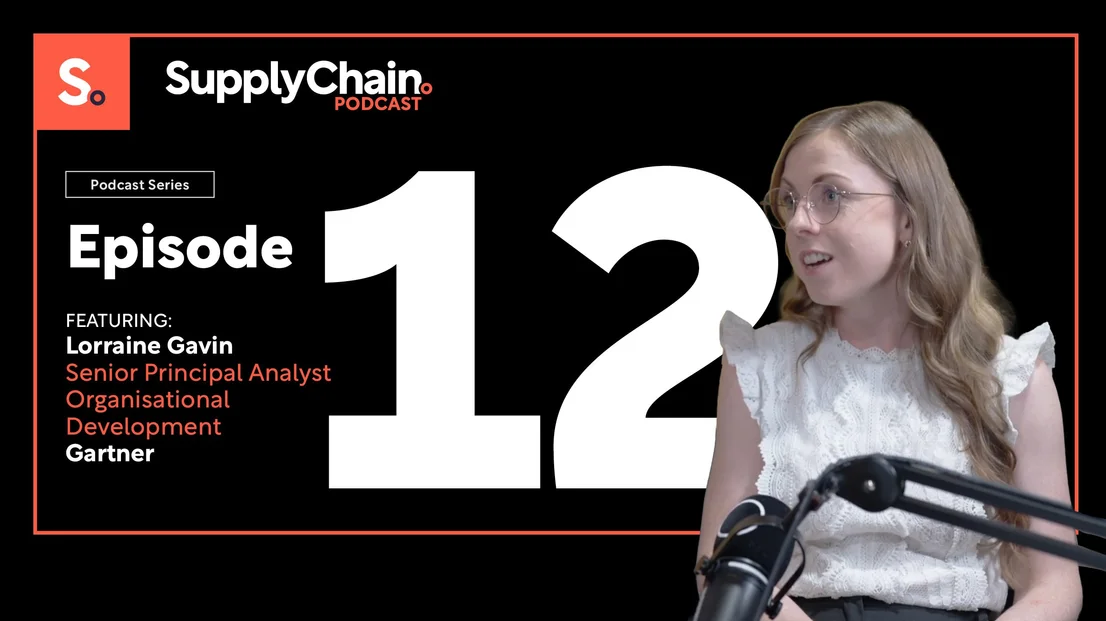
Lorraine Gavin believes supply chain leaders have become so focused on technology that they've overlooked the people who make transformation successful. The reality is simple: as AI accelerates across every part of the enterprise, organisations need to prepare not just for AI readiness, but for human readiness too.
In this episode of the Supply Chain Digital Podcast, host Aaron McMillan sits down with Lorraine, Senior Principal Analyst – Organisational Development at Gartner, live from Gartner's Supply Chain Symposium in Barcelona.
Drawing on experience spanning frontline operations, PPE supply chain leadership during the pandemic and advising global Chief Supply Chain Officers, Lorraine brings a perspective that's both analytical and deeply human to a conversation about where supply chain leadership needs to go next.
🎧 Listen and subscribe on Spotify here
🎧Listen now on Apple Podcasts here
▶️ Watch and subscribe on YouTube here
In this episode we explore:
- Why AI readiness means nothing without human readiness
- How supply chain leaders can position themselves as business enablers rather than operators
- Why storytelling is becoming one of the most valuable leadership skills
- The risks AI-generated misinformation poses to global supply chains
- How organisations can build an AI-ready workforce without losing critical talent
AI readiness starts with people
While organisations continue investing heavily in AI, Lorraine's argument is straightforward: technology is only half the challenge.
Leaders expect employees to adapt at the pace of innovation, but people don't change that quickly. The biggest barrier to adoption isn't technology, it's that organisations haven't painted a picture people can see themselves in.
Employees hear about productivity gains and time savings, but nobody is answering the question that actually matters: what does my job look like in five years? Who is the CSO of 2040? Until leaders answer that, asking people to embrace AI is asking them to invest in a future they can't visualise.
Supply chain must change its story
Supply chain, Lorraine says, is a diamond that delivers under pressure. But when it delivers, the response is too often "great, carry on" rather than genuine recognition. The function is expected to be exceptional every time, and when it is, it goes unnoticed.
Part of fixing that starts with how supply chain leaders talk about their own work. Stop leading with operational KPIs and, instead, start connecting supply chain outcomes to the enterprise metrics that matter to the board: customer experience, profitability, growth and resilience.
An innovative product is only as good as the ability to manufacture it. A commercial sale only matters if the product is delivered. The supply chain is the enabler of the organisation, and it needs to start saying so.
Storytelling creates stronger leadership
Data remains essential, but data alone rarely changes minds or gets budgets approved. Lorraine is direct about this, explaining that the most effective supply chain leaders combine analytical rigour with storytelling – put a customer or patient at the centre of the narrative, walk through their experience, then back it up with the numbers.
The two aren't in conflict, but are actually most powerful together. If you leave a room having made a case purely through metrics, people will have forgotten it by the next meeting. If you've told a story, they'll still be talking about it a year later.
Preparing for the next generation of AI
Lorraine's view on AI and jobs is measured and worth hearing clearly. Roles will change, she says – bookkeepers became accountants when the calculator arrived; the calculator didn't kill the profession, it just changed what it looked like and the same will likely happen with supply chain roles.
But organisations that cut their workforce aggressively in pursuit of AI efficiency risk losing something they can't buy back easily: institutional knowledge. They also risk having no pipeline of future talent when they need it.
Lorraine’s advice, borrowed from a Harvard Business Review piece she mentions, is that you won't be replaced by AI, you'll be replaced by a human who's using AI.
Why misinformation could become the next major supply chain risk
Lorraine's concern isn't just automation, it's misinformation. AI-generated video, fabricated communications and false reports are already capable of manipulating behaviour at scale and she summarises the outcome succinctly: imagine logging on in the morning to see news of a political coup in a country where you have a warehouse. Maybe it didn't happen. But 500 people don't show up to your facility that day. That's a disruption no risk management framework is currently designed to handle.
Her closing advice to avoid this kind of disruption? Start talking to your CIO and cybersecurity teams now, not after it happens.
Subscribe and listen
Catch up on previous episodes of the Supply Chain Podcast, where industry leaders discuss the biggest trends shaping procurement, logistics, AI and supply chain transformation.
We've got a hoist of great shows available for you, but why not start with our recent episode: “Is Your Supply Chain AI Delivering Real Outcomes?” With Fabienne Cêtre, EVP EMEA at Kinaxis.
Company portals

Executives

Lorraine M. Gavin, SHRM-CP
Senior Principal Analyst - Organizational Development