
Ep.10 | Gabriel Werner: Is AI Solving the Right Problems?
Related Podcasts
AI may be dominating nearly every conversation in supply chain right now but the question Gabriel Werner keeps asking is whether it's actually solving any real problems.
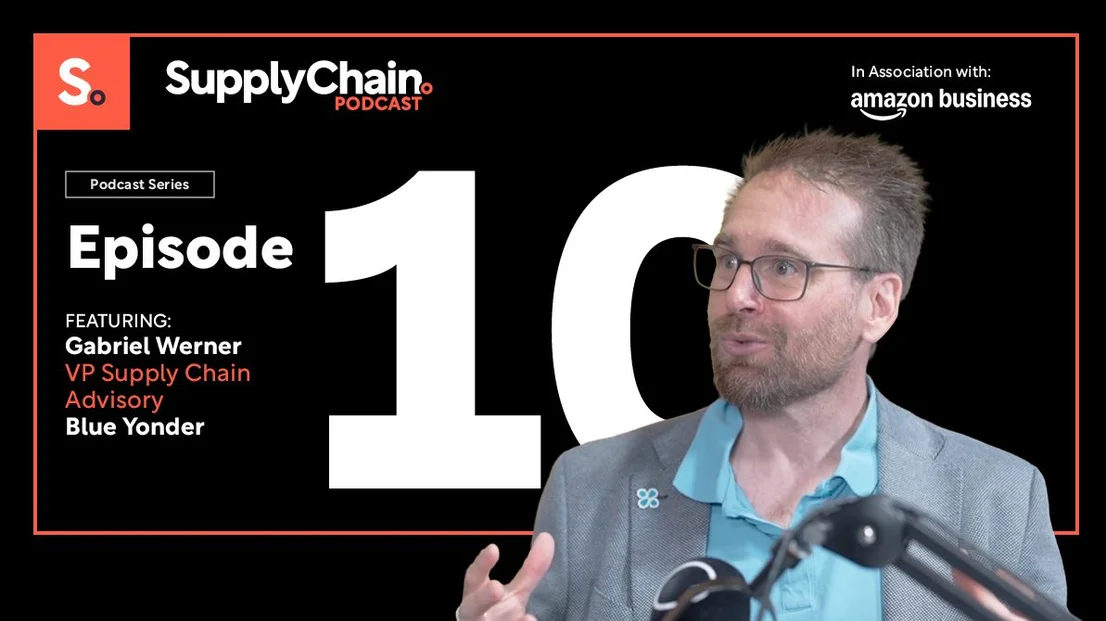
In this episode of The Supply Chain Podcast, host Aaron McMillan sits down with Gabriel Werner, Vice President of Supply Chain Advisory at Blue Yonder, live from Gartner's Supply Chain Symposium in Barcelona. Gabriel has spent more than a decade at Blue Yonder working with some of the world's most complex supply chains, and he brings a grounded, practical perspective to a conversation that spans many of the key themes around AI today, including why business should stop chasing AI for AI’s sake, why generic enterprise models won’t dominate the future, and the need for solving measurable problems.
🎧 To listen and subscribe on Spotify click here
▶️ To listen and watch on YouTube click here
In this episode we explore:
- Why supply chain AI requires specialised intelligence, not generic enterprise tools
- Blue Yonder's new NVIDIA partnership and what an AI Agent Factory actually means
- Why AI should solve business problems, not become the objective
- How AI agents are beginning to transform planning, warehousing and decision-making
- Why context matters as much as data quality for AI to work in supply chain
- What human and AI collaboration actually looks like in practice
AI built for supply chains
Gabriel's central argument is that supply chain operations are too complex, too precise and too consequential for generic AI to handle well. Large general-purpose models are useful, but they don't understand the nuance of how a specific business runs, what its constraints are or what a good decision looks like in context. That's why Blue Yonder is working with NVIDIA to develop what they're calling an AI Agent Factory – a capability that allows organisations to build AI agents trained on their own business data and operational context, rather than relying on models built for the broadest possible use case.
Start with the business problem
Gabriel is direct on this point: AI should never be implemented because it's available. The organisations getting the most value from AI in supply chain are the ones that started with a clear operational challenge, defined what success looks like in business terms and then worked out whether AI was the right tool to get there. Measuring success by the number of models deployed, he argues, is exactly the wrong way to think about it. Measure it by what changes in the business.
Why context matters
Data quality has always been foundational – there’s nothing new there. But Gabriel makes a point that's easy to overlook: context matters just as much. An AI agent that has access to good data but doesn't understand the operational situation it's operating in will still make decisions that don't hold up in practice. Governance, guardrails and transparency are what allow organisations to trust AI-driven decisions enough to act on them. And on the question of whether to wait for perfect data before experimenting, Gabriel says no, explaining that responsible experimentation builds supply chain maturity faster than waiting for conditions that may never arrive.
The future of AI-powered supply chains
Gabriel is specific about where the future is heading: AI agents will increasingly show up as active participants in day-to-day supply chain operations, providing planners with personalised operational briefings, flagging issues before they escalate, recommending actions and handling routine decisions autonomously. The point he keeps returning to is that this isn't about replacing supply chain professionals. It's about giving them better information at the moment they need it, so the decisions they make are faster and better informed. The expertise stays human. The workload shifts.
Subscribe and listen
Episode 9 is brought to you by Amazon Business, the one-stop destination for everything your organisation needs.
Catch up on Episode 9, featuring Megha Gupta, SVP of Manufacturing Strategy and Transformation at o9 Solutions, discussing AI, scenario planning and the foundations of modern supply chain transformation
Company portals


Executives

Gabriel Werner
VP of Supply Chain Advisory