Top 10: Automated Warehouses
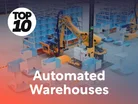
The demand supply chains are facing has increased significantly in recent years, largely due to the increase in online shopping.
As a result, managers are eager to maintain operations without putting physical and mental strain on its workforce.
To do so, warehouses are implementing more automation, particularly as a rising skills gap emerges.
The sector is facing an ageing workforce and a growing gap, resulting in the need to turn to AI and robotics to meet demand.
Supply Chain Digital takes a look at the Top 10 Automated Warehouses.
10. Nike
Revenue: ~US$44.71bn
Employees: ~77,800
CEO: Elliott Hill
Founded: 1964

Nike is targeting long-term profitable growth with its accelerated use of advanced technology and automation. It is reducing complexity and building a more efficient operation through its integration of automation across its distribution centre operations.
Nike uses advanced 3D design software and robotic arms to cut materials and process thousands of shoe parts, enhancing quality control with AI cameras. By utilising automation, the company is sharpening its supply chain and developing speed across its operations.
9. Ocado
Revenue: £1.36bn (US$1.8bn)
Employees: ~20,000
CEO: Tim Steiner
Founded: 2000
Ocado is tackling grocery fulfilment issues with its deployment of AI-powered systems to handle the picking and packing process. The automated tech runs on On-Grid Robotic Pick (OGRP), which combines machine learning, smart sensors and computer vision.
The robots adapt to different types of groceries, implementing flexible and data-led intelligence to make grocery fulfillment more efficient. The use of these automated systems allows for increased picking accuracy, 24/7 operation and improved labour productivity.
8. IKEA
Revenue: EUR 26.3bn (US$30.2bn)
Employees: 200,000
CEO: Jakub Jankowski
Founded: 1943
By teaming up with Verity, IKEA implemented autonomous drone systems throughout its warehouses in order to improve warehouse inventory checks. The drones go from pallet to pallet, collecting images, videos and 3D depth scan data before flying back to the charging station.
There, the drones download the data they collected in order to extract actionable insights for the workforce to act on. IKEA is also working with Rebl Industries to deploy next-generation robots-as-a-service (RaaS) solutions.
7. Lineage
Revenue: US$5.4bn
Employees: ~26,000
CEO: Greg Lehmkuhl
Founded: 2012
Lineage utilises its automated warehouse solution, combining next-generation technology, applied sciences and innovative thinking. Its automated solutions can be used for all temperature-controlled warehousing needs.
Its Automated Storage and Retrieval Systems technology seamlessly moves products through multi-level and high-bay locations, reducing service times significantly. Through the integration of Warehouse Management Systems, machine learning capabilities and automated warehouse designs, Lineage’s algorithm, Sybil, navigates warehouse complexities.
Its specific automation across temperature controlled warehouses is vital for the maintenance of cold chain logistics.
6. GXO
Revenue: US$13.2bn
Employees: ~150,000
CEO: Patrick Kelleher
Founded: 2021
GXO recognises the need for reliable operations and customised solutions for optimal and efficient workings. As a result, it utilises collaborative robots, vertical lift modules, advanced sorting systems and other automation capabilities.
It utilises it to balance labour-market challenges, as well as to drive continuous improvements and increase job satisfaction across workers.
It uses AI, data-driven processes, intelligent automation and machine learning in order to improve accuracy, reduce costs and meet complex global supply chain needs.
5. FedEx
Revenue: US$90.1bn
Employees: ~440,000
CEO: Raj Subramaniam
Founded: 1971

FedEx is consistently implementing new autonomous robotic systems, paying attention to AI trends and tools. In a multi-year collaboration between FedEx and Berkshire Grey, they created physical AI for smarter and safer logistics, bringing into existence the Scoop robotic package unloader.
This system is specifically engineered for automated trailer unloading, helping operations be safer and more efficient. The company has also used robotic arms to help with AI-powered sorting, with capabilities of sorting up to 1,000 packages per hour.
4. UPS
Revenue: ~US$90.96bn
Employees: ~460,000
CEO: Carol Tomé
Founded: 1907
UPS has a range of innovative supply chain automation and AI solutions to more efficiently manage everyday tasks and anticipate future supply chain needs. UPS Velocity features smart automation, machine learning and AI that ensures the best possible service for its customers.
It has more than 700 bots, as well as rack-to-person technology which optimises storage by 30%. The blend of skilled team members and modern technology allows it to process more than 350,000 items every day.
3. DHL
Revenue: EUR 84.2bn (US$96.7bn)
Employees: ~584,000
CEO: Tobias Meyer
Founded: 1969
DHL Robotics Hub acts as a collaboration platform to orchestrate robotics and digital automation technologies. The company has a range of automation and robotics across its warehouse operations, including a selection of assisted picking robots – which help minimise worker fatigue and error rate – and wrapping robots, which decrease product damage and optimise stretch-wrapping.
It also implements wearable devices that support core warehouse processes with hands-free operations in order to make picking processes more efficient.
2. Walmart
Revenue: ~US$713.2bn
Employees: ~2.2bn
CEO: John Furner
Founded: 1962
Walmart has reached a US$1tn valuation since it began rolling out automation and working on its digital business. The company is planning to invest US$330m to modernise its regional distribution centre in Opelousas, Louisiana, with the aim of doubling its shipping capacity.
Today, more than 60% of Walmart US stores accept freight which has come from automated distribution centres and more than 50% of the company’s eCommerce fulfilment centre is automated.
The company is seeing major decreases in shipping costs due to its implementation of automation. It is also seeing significant productivity transformation across automated fulfilment centres, which are increasingly entering Walmart’s supply chains. The automation process will take place to support its staff, rather than replace them, aiming to upskill its workforce in order to work collaboratively with the automation.
1. Amazon
Revenue: ~US$716.9bn
Employees: ~1.5m
CEO: Andy Jassy
Founded: 1994
Amazon uses its end-to-end, fully automated set of supply chain services that were introduced in 2023. By introducing Supply Chain by Amazon, the company began implementing a range of automated solutions to meet demands for advanced logistics, warehousing, distribution, fulfilment and transportation capabilities.
Its various services allow customers to gain access to optimised inventory placement, automated replenishment and reduced shipping and storage costs. Its AI-powered fulfilment network helps the company ensure faster delivery times every year, with 2025 being its fastest year to date.
Through Amazon Warehousing and Distribution, sellers can store inventory bulk cost-effectively, with it being automatically replenished throughout the fulfillment network, providing sellers with end-to-end supply chain support.
Amazon has also brought automation to its UK fulfilment centers, blending large workforces with robotics. Through this, the company is seeing controlled and organised workflows, even when demand is exceptionally high.
Company portals







Executives
Andy Jassy
President and CEO
Carol B. Tomé
Chief Executive Officer
Elliott Hill
President and Chief Executive Officer
Greg Lehmkuhl
Chief Executive Officer

Jakub Jankowski
John Furner
President and Chief Executive Officer, Walmart U.S.
Patrick Kelleher
CEO
Raj Subramaniam
President, CEO, and member of the Board of Directors

Tim Steiner
CEO
Tobias Meyer
CEO