Supply Chain by Amazon: The Rise of Fully-Automated Services
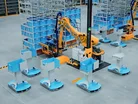
Supply chains around the world are becoming more automated in order to maintain efficiency and meet demand.
As volatility strikes and consumer interest grows, automation has proven itself the tool to build supply chain resilience and efficiency.
At the forefront of this is Supply Chain by Amazon, an end-to-end, fully automated set of supply chain services that were introduced in 2023.

Supply Chain by Amazon
Since its early beginnings in 1994, Amazon has helped optimise and simplify fulfilment needs of selling partners and consumers. Taking this one step further, the company introduced Supply Chain by Amazon in 2023, delivering an end-to-end, fully automated selection of supply chain services. This was implemented to provide sellers with a quick and reliable solution for moving products from point A to point B.
Through this scheme, sellers on Amazon rely on the company's advanced logistics, warehousing, distribution, fulfilment and transportation capabilities. Due to its global network and wealth of resources, sellers can maintain stock levels, ship faster and more reliably at much lower costs than if they were to manage this themselves.
Using the combined services of Amazon Global Logistics (AGL), Amazon Global Selling SEND (Seller Export & Delivery), the Partner Carrier Program (PCP), Amazon Warehousing and Distribution (AWD), Fulfillment by Amazon (FBA), Multi-Channel Fulfillment (MCF) and Buy with Prime, sellers can gain access to optimised inventory placement, automated replenishment and reduced shipping and storage costs.
Its advanced and fully automated capabilities are behind the success and delivery-speed of Amazon as it works to oversee end-to-end supply chain efficiency. In 2025, Amazon had its fastest year to date, with more than 13 billion items delivered to Prime members around the globe on the same or next-day.
"A key part of the magic of we have achieved these super fast speeds is our AI-powered fulfillment network which continued to get better and better," say Dharmesh Mehta, Vice President, Selling Partner Services at Amazon.
"It drives how we partner with sellers to ensure we have the right quantities of their products and that we have placed inventory closer to customers, providing faster delivery speeds for a broader selection of products while reducing shipping distances and costs.
"When customers can get what they want faster, they shop more often in our store, and more and more independent sellers win. That's why I love our commitment to speed, selection, and savings - it delights customers and helps more and more sellers thrive."
All supply chain, sustainability, Scope 3 and net zero leaders should attend:
- Procurement and Supply Chain LIVE: The Net Zero Summit - QEII Centre, London, March 4-5
- Procurement and Supply Chain LIVE: The US Summit - Navy Pier, Chicago, April 21-22
Co-located with Sustainability LIVE, these events brings together CSCOs, CSOs and senior decision-makers at a moment when sustainability, supply chains and commercial performance are increasingly interconnected.
Tickets can be booked online today for The Net Zero Summit and The US Summit. Group discounts available.
Meeting demand
Through Supply Chain by Amazon, the company has established itself as a leading 3PL service, but its digitisation challenges other logistics providers to compete through data integration capabilities as well as physical transport.
Supply Chain by Amazon offers the complete end-to-end operational ease and visibility that global SMBs require to stay competitive. The complete integration of global ocean freight, warehousing and last-mile delivery into a single dashboard can be costly and relies on a strong network. Amazon offers its services up to SMBs, making it a reliable and affordable partner.
Sellers can ship inventory in bulk to Amazon Warehousing and Distribution, where it can be stored cost-effectively. As soon as the distribution centres receive the products, they become buyable, but they can be stored as long as needed.
The bulk inventory stored by AWD automatically replenishes products in the Amazon fulfilment network. Whether the consumer buys on Amazon or via Buy With Prime, Amazon handles the delivery, either through Fulfilment by Amazon or Multi-Channel Fulfilment.
By utilising AWD auto-replenishment, businesses can undergo end-to-end supply chain support, gaining efficiency boosts and cost savings.
Trends in supply chain automation
Logistics companies and supply chains around the world have increasingly become automated, in order to stay afloat with geopolitical turbulence and meet consumer demand. Labour shortages have also proven disruptive to supply chains, with an ageing workforce, growing skills gaps and a lack of clear career progression.
Now, distribution centres and warehouses are looking towards automation and robotics in order to meet fulfilment demand, or implementing AI solutions across manual tasks so humans can work on the more important processes.

Through Walmart's automation across the supply chain, it has seen a reduction in shipping costs by 30%, as well as significant increases in productivity transformation.
Big brands around the world have been partnering with technology companies to manage their supply chains, with platforms like Kinaxis, SAP, Oracle, o9 and Blue Yonder helping with the automation process. These solutions aid with planning, transportation management, returns, real-time visibility and scenario modelling.
Recent years have demonstrated that if companies do not invest in automating their supply chains, they risk fragmentation, delays and extra expenditure.
Company portals







Executives
Dharmesh Mehta
Vice President, Selling Partner Services