What Does Maersk Predict for the Future of Global Trade?
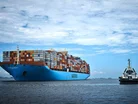
2025 proved a volatile year for global trade, with the ongoing Russia-Ukraine conflict, US President Donald Trump's 'War on Tariffs' and cyber attacks across retailers and manufacturers making trade uncertain.
As we enter a new year of trade, Maersk has released its winter edition of the Maersk Global Market Update, exploring some of the key events that could impact global supply chains.
With these upcoming events in mind, Maersk explores how it is preparing to ensure its customers receive a seamless logistics experience.

Return to the Red Sea
As trade routes and supply chains around the world have been looking to re-shape the logistics industry, talks have focused on a possible return to the Red Sea, utilising the Suez Canal as a Asia-Europe gateway. In December 2025, Maersk's MECL service acted as a major step towards reviving this route, though the Red Sea return relies on the continuation of safe and sustainable conditions.
Trans-Suez shipping will be a highly positive step for the logistics industry, and although total avoidance of disruption seems unlikely, past incidents will prove vital in ensuring ongoing disruption can be avoided, while protecting the safety of Maersk's customers' supply chains.
"There is no doubt that there will be added volatility to supply chains once container liners begin the shift back to East-West transits through the Red Sea, just as we saw when the industry started sailing via the Cape of Good Hope," says Johan Sigsgaard, Chief Product Officer for Ocean at Maersk.
"While this shift can be planned to a certain extent, changes of this size introduce considerable disruption to the networks and the scale of the impact will depend on how fast the transition will happen."
When operational constraints were lifted after the Covid-19 pandemic, with finished goods inventories rising, the inventory whiplash led to infrastructure strain and congestion across the ports. The first vessels sailing via the Suez Canal and the final vessels sailing via the Cape of Good Hope could arrive at the same tie, driving Europe's inventory-to-sales ratio up.
The acceleration of this creates the risk of overstocking, but Maersk is working to better understand these concerns and focus on collaboration with customers in order to determine the best strategy moving forward. As the route re-opens, businesses should prepare for short-term volatility within inventory levels and cargo flows, with the need to adjust ordering patterns.
Congestion concerns
Maersk explores port utilisation data from across Europe, noting that ports have not been using their full capacity, and thus have been lacking in efficiency. Recent figures from Drewry's show that some of Europe's main terminals - such as Rotterdam, Hamburg, and Algeciras - operated at 80% efficiency throughout the summer of 2025.
Ports that are operating at this high of a level are nearing a high-risk zone once an influx of vessels from the Cape of Good Hope and the Red Sea arrive at the ports. Port congestion needs to be considered within a businesses' scenario planning, with the need to cater for longer lead times, find alternative transport routes and adjusting delivery windows in coordination with carriers.
"Tying up capital in high inventories has historically proven challenging for businesses during supply chain shifts," explains Karsten Kildahl, Chief Commercial Officer at Maersk.
"Considering that flexibility is currently constrained from high utilisation in European terminals and coupled with the generally high levels of inventories in Europe, a sharp focus on avoiding unintended build-up of inventory will be a priority for many customers ahead of a full trans-Suez return. We will work closely with them to support these efforts."
Maersk is mitigating issues by ensuring flexibility is built into its Gemini network, allowing for the adjustments of services without large-scale disruptions. Through this, it can reroute vessels and adjust schedules when needed. Moreover, the use of its own vessels and terminals lowers the reliance on third parties, providing critical infrastructure which ensures faster decision-making and more agility.
De minimis removal
As the EU moves to remove the de minimis tax exemption for low-value imports, European supply chains are going to shift dramatically. Previously, shipments of up to €150 (US$175) did not have to pay customs duties. From July 1 2026, low-value parcels arriving into the EU will be charged €3 (US$3.50) per item.
"What we observed in the US after the de minimis exemption was removed back in the summer was more e-commerce companies storing inventory in North America to get closer to the end consumer and avoid tariffs," adds Lars Karlsson, Maersk Global Head of Trade and Customs Consulting.
"We expect more of the same to happen in Europe in the build-up to the new 3 EUR charge being implemented in July, which will of course cause ripple effects on inventory levels and indeed trade flows. To make this move a reality, the EU relies on complicated customs procedures being implemented in a short space of time across all member states.
"Some nations are more prepared than others with independent customs declarations on low-value e-commerce already existing. To avoid EU entry point loopholes from further complicating the situation, we need all countries to meet the July deadline."
With these changes in mind, Maersk is preparing itself to ensure the ease of shipping for its customers, amid potential volatility. As the year progresses, these changes should become more manageable, but the logistics sector may see some turbulence as the year begins.
Company portals

Executives
Johan Sigsgaard
EVP, Chief Product Officer - Ocean
Karsten Kildahl
EVP, CCO

Lars Karlsson
Global Head of Trade and Customs Consulting Maersk