
The Supply Chain Interview: Frank McKay, CSCO at Jabil

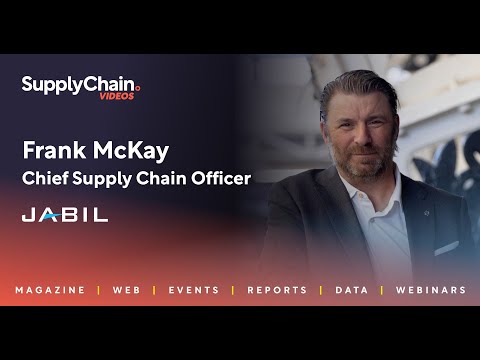
Frank McKay has spent the best part of three decades at Jabil, the global manufacturing solutions provider serving approximately 450 of the world's leading brands.
Now, as Chief Supply Chain Officer, he leads the company's supply chain organisation and services division across a truly global operation.
Frank’s journey into the profession began in the 1990s when, fresh out of college, he accepted his first role as a buyer. It came at a pivotal moment in the industry's evolution as technology was just beginning to reshape the procurement landscape.
"I got the procurement bug and decided this was an area that would continue to evolve," reflects Frank. “It was a time when technology was just starting to become part of the ecosystem of procurement and supply chain.”
That technological revolution has only accelerated in the ensuing decades, transforming how companies manage complex global supply networks. Today, Frank oversees supply chain operations for a company generating approximately US$30bn in annual revenue and operating around 100 facilities across 30 countries.
Jabil’s global footprint spans Asia, Europe and the Americas, positioning it as what Frank describes as "an engineering-led, supply chain-enabled company" that helps bring products to life for manufacturing partners. This scale and geographic diversity have become crucial advantages in an era of unprecedented supply chain disruption.
Negotiating the tariff challenge
The events of recent years have tested supply chain professionals like never before, delivering an unprecedented succession of crises and challenges.
For Frank, one challenge stands out above all others in terms of its complexity and daily impact: tariffs and the ever-changing landscape of international trade restrictions.
So testing is the situation that Frank has found himself operating in territory he never would have anticipated as a young professional.
Highlighting the difficulties tariffs have brought to publicly-traded organisations like Jabil, he says: “Who’d have thought I’d be in Washington, D.C. meeting with Congress and House representatives to put the Jabil position forward?
"We've had to really shift our supply chain to avoid and minimise the disruption tariffs are bringing. We’ve done it because we've got to try and keep our customers as competitive as possible – but that’s not easy.”
A big issue, Frank reveals, lies in replacing suppliers who are long-tenured partners with capabilities built over decades, as opposed to months or years. In many cases, Jabil's existing suppliers have the resources and willingness to relocate operations to remain within the supply chain.
He explains: "We're fortunate in many cases that suppliers have the wherewithal and means to shift with us, so they can move from China, for example, to somewhere else.”
The greater challenge arises when seeking entirely new suppliers which can meet Jabil's exacting standards and customer requirements.
Frank continues: “It’s the auditing; it’s asking, ‘are they capable enough? Do we trust them enough?’ That takes a huge amount of time, effort and energy, but the good news for Jabil and our customers is that we’re really good at it.”
Navigating perpetual turbulence
Beyond tariffs, the past five years have delivered what Frank describes as “probably the most disruptive period in supply chain history”.
The COVID-19 pandemic, geopolitical tensions, wars, floods, earthquakes and the Suez Canal blockage have all tested the resilience of even the most sophisticated operations.
Yet, Jabil's sheer presence provides a unique advantage.
"When there's a bad day in one location, there's also a good day somewhere else due to the fact Jabil is a global organisation, sitting in more than 30 countries,” says Frank.
“We need to have solutions for our customers that allow us to navigate and be agile; we need to be ready for the next crisis, the next COVID, the next constraint, the next shortage, the next tariffs; we need to build supply chains that can react and adapt.”
This approach combines significant investment in technology with robust processes and a highly skilled, experienced workforce across multiple continents.
"We’re been able to navigate our way through the turbulence to the extent that customers are happy and they continue to trust us to manage those super-complex supply chains,” adds Frank, attributing this success to "a nice mix of investments around technology and, of course, people and processes as well”.
From reactive to proactive
Transforming supply chains from a policy of reactive firefighting to proactive risk management requires careful prioritisation of limited resources and attention.
From Frank’s perspective, the formula is straightforward but deliberate: “I hate being the cliché guy, but it is people, process, technology – in that order.
“At Jabil, we already have the people – and investing in them is our number-one priority. We have 60 years of history behind us, so we’ve got the processes pretty much nailed. Now, we are doubling down on technology.
"It's a case of building out an end-to-end ecosystem that allows you to understand your data and make intelligent, informed decisions.”
Customer communication has evolved accordingly, moving from periodic reports to continuous visibility into supply chain status. Jabil can now inform customers about potential supply chain risks in real time, providing an unprecedented view of complex global supply networks.
Frank goes on to note that the vast majority of Jabil's procurement and supply chain team are long-serving professionals who bring decades of practical experience to complex problems.
“They've lived through what you and I have lived through over the past five years, which is probably the most disruptive time procurement and supply chain has ever faced,” he adds, emphasising that experience combined with tech is crucial to creating resilient operations.
Real-time visibility through technology
Jabil's digital transformation journey spans approximately a decade, though Frank is adamant this transformation will never truly end. Technology continues to evolve at a rapid pace – and supply chain systems must evolve with it to maintain competitive advantage and operational resilience.
The company's primary focus is achieving end-to-end supply chain ecosystem visibility that provides actionable intelligence rather than mere data.
This capability enables rapid reaction to disruptions anywhere in the world. Given Jabil’s global footprint spanning multiple continents, speed is absolutely essential to maintaining customer production schedules.
"If there's an earthquake in Japan, for example, we have the ability to understand in real time the impacts of that earthquake and how many suppliers could potentially be affected,” explains Frank.
“We can then take steps to go and readdress that supply chain. Once we’ve checked the supplier and made sure everybody’s okay, we can then make decisions around ensuring we keep our customers in production.”
Ultimately, the goal is to maintain production, even during significant disruptions that would previously have caused major interruptions.
Sustainability as a shared responsibility
Sustainability has become central to Jabil's operations as environmental considerations become increasingly important to customers and regulators alike.
The company serves a host of technologically-advanced OEMs which have their own environmental commitments and targets.
"They're looking for Jabil to help them with their own sustainability goals," Frank continues. “Pretty much every boardroom – certainly those at publicly-traded businesses – has goals these days. And we play a large part in understanding carbon footprint, for example."
Of course, truly understanding carbon footprints is a matter that extends deep into multi-tier supply networks – essential to customers pursuing ambitious targets.
"We play a very active part in understanding not just the tier one supply chain, but tier two, tier three and beyond,” says Frank, “and helping our customers get to their Scope 3 goals as well.”
Scope 3 emissions include all indirect emissions in a company's value chain, encompassing everything from raw material extraction to end-of-life disposal.
These are often the most challenging to measure and reduce because they involve multiple parties, but Jabil's position in the supply chain makes it uniquely placed to provide relevant insight.
The company also pursues its own environmental commitments beyond what customers require or regulators mandate, as Frank explains: “We've got our own goals, as well as commitments to the communities we serve, to make sure we cause minimal impact from an environmental standpoint.”
Adding value
Frank’s priorities for the coming years centre on leveraging Jabil's supply chain capabilities in ways that create additional value.
The company already excels in this area based on demonstrated performance during challenging times. Now, the focus is on monetising those strengths while maintaining customer trust.
"We're looking to further monetise what we believe we’re really good at from a supply chain standpoint," says Frank. “But before we do that, I need to make sure our net promoter score with customers remains high, that they continue to trust Jabil and that we can continue to grow our revenue as a result of that trust.”
Frank’s confidence stems from proven resilience demonstrated during the most challenging period in modern supply chain history. Jabil has continued growing amid disruptions that severely impacted competitors, harnessing a combination of experience, mature processes and advanced technology to create an operation that is genuinely agile under fire.
He concludes: “We're going to be around for a while because our customers trust that Jabil has a supply chain that’s agile and nimble enough to deal with anything the world throws at us.”
Company portals
Executives
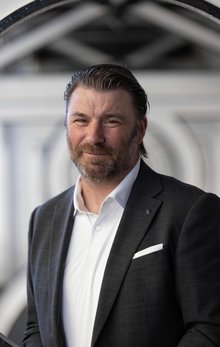
Frank McKay
Chief Supply Chain Officer