Predictive Supply Chains: AI-Driven Logistics is Evolving
Global supply chains are facing many challenges. From the effects of geopolitical fragmentation, macroeconomic shifts and climate-related disruption, traditional logistics frameworks are no longer as effective in this current climate of mass change.
This means that typically, supply chain executives are finding themselves having to continuously react to these factors; whether that includes maritime chokeholds or mitigating bottlenecks, these delays make their way through the supply chain.
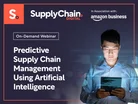
To address this knee-jerk reaction to disruption, supply chain leaders are looking for a more offensive strategy. In association with Amazon Business, Supply Chain Digital hosted an exclusive webinar to explore how organisations are using AI to gain real-time foresight across their global networks.
You can watch the full webinar: Predictive Supply Chain Management Using Artificial Intelligence on demand. Getting ahead has never been more important to ensure the resilience of your logistics operations.
- Why leaders are shifting from reactive to predictive supply chain management
- How AI insights can be utilised to make real-time decisions
- The ways in which predictive analytics can be used to help organisations reduce risk
- The importance of visibility in the supply chain
- How predictive supply chains will evolve throughout the next few years
Why reactive supply chains could fail
The live panel first looked at how traditional, linear logistics operations are vulnerable due to these pressures. Business leaders must adopt proactive logistics in order to develop operational resilience, no longer relying on fixed internal schedules and historical baseline averages.
Danny Lin, Partner of Procurement and Supply Chain at Baringa, highlighted that the baseline requirements for supply chain modelling have completely transformed over the last two decades.
“10, 15, 20 years ago, you could model off of one or two variables,” Danny explained.
“Today, it's a multivariant... We really moved towards the concept of embracing a dynamic supply chain, one that embraces the change versus trying to mitigate against it. And I think that's where the real true competitive advantages are born.”
By using artificial intelligence, organisations can scan entire supply chains and potential suppliers, looking for risk. As it has 24/7 monitoring capabilities, it can flag errors instantaneously, ensuring leaders can change their strategy before disruption takes place. As so much of supply chain planning has moved online, these capabilities mean changes can be made seamlessly, helping businesses avoid disruption and monetary losses.
Clark Campos, Director of Mexico Logistics and Operations at MegaCorp Logistics, pointed out how this shifting landscape alters cross-border realities:
"Tariffs [are] reactive, but as we're working to be predictive on this, it's more of like route optimisation and the inventory positioning... They want to know, not only where the freight is, but what are the risks in the network right now if a new tariff comes into play? Are we positioned correctly?"
Proactive sourcing as an advantage
The panel detailed how predictive AI evaluates complex external variables to anticipate bottlenecks before they can make their way through the network. Rather than simply reacting to a crisis after it manifests, the speakers explained that modern AI tools allow procurement and logistics teams to proactively adjust their sourcing logic and mitigate localised risks.
Abhijit Supekar, Senior Director of Global Supply Chain at Aveya, emphasised the critical importance of looking past internal ERP data to ingest external indicators:
"Sourcing is an important activity, very strategic... having the ability to have external signals about, let's say, the location, the financial health... as examples of what signals could come in to help you make decisions would be very helpful."
Though events cannot be entirely predicted and disruption cannot be completely avoided, these tools help leaders manage complex times and mitigate downstream impacts.
Pushpinder Singh, Partner & Global Practice Leader, Supply Chain Transformation at IBM, added that AI is also dramatically compressing operational learning curves as roles shift faster across the industry: "The lifecycle of various personas in supply chain has reduced from five to seven years before to maybe two, three, four years... those personas can get up to mark, or the learning curves can be shortened drastically by the application of this."
Operationally scaling AI
Another topic the session focused on was what differentiates supply chains that successfully scale AI implementations from those that stall out. The panel agreed that companies must move past viewing AI as an isolated technical upgrade and start treating it as an overarching business architecture.
Start at the critical pinch points. You know where those are. That answer's going to be different for everyone. But I would start there, and then scale from there.
Pushpinder noted that true success lies in the organisational framework rather than the underlying algorithm alone:
"What differentiates is how simple our governance model is, and how easy our decision ownership is already aligned... AI is very promising, but operating model maturity is needed to make this successful in any organisation."
Furthermore, the panel warned against trying to deploy AI everywhere at once, as this frequently leads to failed initiatives. Instead, leaders should build targeted proof points by deploying cognitive capabilities directly against their biggest daily operational friction points.
Danny outlined a precise, practical roadmap for supply chain directors to follow over the next 12 to 18 months:
"Start at the critical pinch points. You know where those are. That answer's going to be different for everyone. But I would start there, and then scale from there."
If you missed the live broadcast, you can still hear the key insights from these industry experts by watching Predictive Supply Chain Management Using Artificial Intelligence on demand.
Company portals





Executives

Abhijit Supekar
Head of Global Supply Chain

Clark Campos
Director of Mexico Logistics and Operations
Danny Lin
Partner
Pushpinder Singh
Partner Global Practice Leader | Driving Supply Chain Transformation & Strategic Offerings