Mercedes F1: Could Electric Trucks Change Race Logistics?
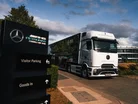
In a first for Formula One in Europe, the Mercedes-AMG PETRONAS Formula One Team is using all-electric trucks to transport its race cars to the track.
Mercedes is the first on the grid to use an electric truck, marking a major step towards the switch to sustainable logistics.
With a history of trialling greener energy and reducing emissions, this is another step towards the team becoming the most sustainable professional sports team in the world.

An industry first
Following a pilot at the 2025 British Grand Prix, Mercedes F1 has transported its W16 race cars to the 2025 Dutch Grand Prix. The 673km journey relied on an all-electric Mercedez-Benz Trucks eActros 600, as it transported the vehicles from the Brackley base to Zandvoort.
These trucks are some of the first of its kind and a huge step towards sustainability within the HGV sector, with vehicles packed with a 600kWh Lithium Iron Phosphate (LFP) battery, delivering a minimum of 500km on one single charge. This means more efficiency and less time charging - the eActros 600 can go from 20% charge to 80% charge in only 25 minutes using the megawattt charging system (MCS).
Due to the rapid charging and green energy, the eActros 600 can save up to 80% CO₂e emissions compared to its diesel truck equivalents throughout its lifetime.
As a result of the high charging speeds and large battery distances, these HGVs need less stops to go the distance, making them a high performance vehicle.
Merging high-performance with sustainability puts Mercedes at the forefront of F1 logistics.
Alice Ashpitel, Head of Sustainability for Mercedes F1 explains: “As a team, our commitment to sustainability means that we rethink how we move, not just how we race.
"While we are driven by performance on track, we are incredibly proud that our innovations travel beyond the grid.
"The use of the Mercedes-Benz Trucks eActros 600, initially piloted at our home race in July, is another important step in our decarbonisation journey.”
A decarbonisation history
MAP has been consistently working to make its emissions as low as possible, working on its decarbonisation journey for years, with a goal of net zero by 2030.
In 2022, it piloted the HVO100 biofuel, then achieved 98% coverage across race and marketing trucks in the 2024 European Season. This saved more than 500 tCO₂e.
Due to the amount of travel involved in F1, alongside the amount of fuel used both within the sport and the transport to each location, F1 has a notoriously high level of emissions.
It has, however, been working to actively combat this over the years and has already seen a major decrease in carbon emissions.
From 228,793 tCO₂e in 2018, Formula One closed the 2024 season at a reduced carbon footprint of 168,720 tCO₂e. Now, individual teams are making necessary changes to limit their impact on the planet.
With the significant global footprint of F1, managing Scope 3 emissions is a top priority for Mercedes.
The company states: "The roll out of HVO100 has been an important step in helping us decarbonise our logistics and the ability to phase in electric vehicles will further reduce our emissions and improve air quality.
Our long-term ambition is to extend the use of the e-fleet across future European Seasons - demonstrating once again that F1 is the fastest test lab helping to catalyse change beyond our world."
Sustainable supply chains
Through the diversification of sustainable technologies and logistics, Mercedes F1 is creating long-lasting, reliable supply chains with responsible suppliers.
Moreover, it is paving the way for individual teams to consider their own emissions and how they can create more sustainable supply chains as they transport their vehicles around the world.
Ash Armstrong, eConsultancy Manager at Daimler Truck UK adds: “We are continuing to push the boundaries of what is possible with battery electric trucks.
"Our partnership with the Mercedes-AMG PETRONAS F1 Team is key in demonstrating that sustainable, long-haul distribution has arrived with our eActros 600.
"We could not be more thrilled that one of our eActros 600 trucks has been used to transport the team’s W16 cars from Brackley to Zandvoort.
"We are extremely proud to showcase the impressive range and capability of this truck. It just goes to show that the era of electrification is upon us and range anxiety is no longer an issue.”
Mercedes F1 is heading towards its ambition of becoming the most sustainable sports team in the world.
With its dedication to forming sustainable supply chains and integrating green logistics, the F1 team is sure to redefine motorsports efficiency.