Amazon: Using Innovation for Logistics Safety and Success
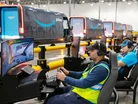
Amazon is putting safety first when it comes to its driver training, ensuring its staff are following regulations and keeping themselves out of harms way.
Through hands-on and immersive training, drivers are are learning essential skills to keep themselves - and others - safe.
With the help of driving simulators and virtual reality headsets, Amazon is making sure its staff are trained across the whole delivery process.

Amazon's driver academy
Amazon positions safety as a top priority within its operations, particularly during delivery. In order to ensure its drivers are abiding by regulations and are adhering to safety practices, they must participate in Amazon’s Integrated Last Mile Driver Academy (iLMDA). This is a two-day, hands-on training at an Amazon delivery station, available to all Delivery Service Partners (DSP).
The training is then followed by a day of on-road experience, ensuring the drivers are able to apply the skills they have learnt in real life. The training includes how to properly and safely leave a package, handle pets, safely exit a vehicle, load and unload vans, as well as prevent incidents during deliveries such as tripping and falling.
By ensuring drivers are working properly and safely, Amazon is protecting its workforce and its supply chain. As long as drivers are taking correct measures when loading and unloading, they are lessening the risk of injury. Work-related injuries which require time-off can be disruptive and costly to a business.
“We initially launched the Driver Academy in Colorado in 2022 and discovered that more interactive and engaging training significantly improved safety, not only for drivers, but also for the community," says Dave Alperson, vice president of Amazon Logistics in North America.
"Building off that success, we started expanding the model throughout the country, with the goal to support even more drivers.”
Reducing worker injury
As of October 2025, more than 140,000 drivers over 65 iLMDA sites have participated, which is still predicted to rise. It is planned to grow to more than 95 delivery stations across North America by December 2026, due to its success and positive feedback.
By training its drivers correctly, Amazon is significantly reducing the risk of injury and time off. In March, the company reported a 65% improvement in its Lost Time Incident Rate (LTIR) over the past five years, with a 13% improvement YoY across its global operations.
Examining its US courier and express delivery services industry in particular, Amazon found:
- Recordable Incident Rate (RIR) - work-related injuries requiring more than basic first aid - improved 50% over the past five years, 16% YoY
- LTIR imrpoved 74% over the past five years, 25% YoY
This shows that the work it has been putting in to protecting its workforce, such as specific training and new technologies, has been working. By ensuring its drivers remain safe from injury, Amazon's risk of last-mile disruption is kept to a minimum. Training staff in something as simple, but necessary, as safety, maintains the integrity of the supply chain.
A range of safety training
The drivers experience a range of teaching methods, including VR headsets and traditional classroom learning. The plan is to expand this into driving simulators and mock towns where drivers can be put into new situations. It helps drivers learn about hazard detection and how to remain alert while on the road.
One of the main training modules is the slip-trip-fall simulator, where drivers learn a marching technique to walk safely across slippery surfaces. In doing this, the academy is training its employees for all situations.
Tyguan Tyler is one of the 300,000 drivers who have completed VR training since 2022. He drives for REB Solutions, a DSP, stating that despite his previous six years of experience, it was the training which made him the most confident on the road.
“I’m more of a physical learner, which helped when I did the VR training,” Tyler explains. “I was in a simulation where you’re standing in somebody’s yard and working through all the steps as if you are there—figuring out if there’s a dog on the premises, finding any trip hazards, checking how to hold your package when leaving the vehicle.”
Amazon has recently debuted the Enhanced Vehicle Operation Learning Virtual Experience (EVOLVE) driving simulator in Denver, Glen Burnie and Seffner. It gives immediate feedback on performance to learners, in a safe and standardised environment.
Through this training, Amazon's supply chain stays running safely and efficiently, minimising disruption through injury and time off.
Company portals

Executives
David Alperson
Vice President, Amazon Logistics