
Why has CMA CGM Ended Plans to Return to the Suez Canal?
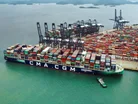
Since 2023, the major trade route through the Red Sea has been a one of disruption, resulting in logistics companies opting for a longer route around Africa.
After a period of calm, many logistics companies were making moves to return to the Suez Canal, cutting down journey times, costs and emissions.
However, CMA CGM has halted its decision to return to this route, announcing that its services will revert to the Cape of Good Hope.

Cancelled rerouting
In late 2023, attacks in the Red Sea meant that the critical Asia-Europe trade corridor no longer became a safe route for shipping companies to take. As a result, vessels were rerouted around southern Africa, using the Cape of Good Hope route. This added 10 more days to a journey from Singapore to Rotterdam, covering 11,800 nautical miles as opposed to the 8,500 through the Suez.
In recent months, shipping companies have been making tentative plans to return to the Suez, following a temporary ceasefire between Israel and Hamas. In December, the CMA CGM Jacques Saade crossed the canal on its journey from Morocco to Malaysia and the CMA CGM Adonis passed from the south on its Asia-Mediterranean route.
Now, it has made the decision to reroute vessels on its FAL 1, FAL 3 and MEX services which had returned to the Suez, but have since been rerouted back to the Cape of Good Hope.
This decision was made "in light of the complex and uncertain international context" but the company will be reviewing the situation regularly. Despite this, the carrier maintains its India America Express service and its Phoenician Express service.
In January, Maersk announced it would return its MECL service to the Suez, so CMA CGM's pullback is made even more significant.
However, Hua Joo Tan, Co-Founder of Linerlytica states: "CMA CGM are only using the political situation as an excuse. The intention is to signal to the market to push back the date of a large-scale resumption of Suez services.”
All supply chain, sustainability, Scope 3 and net zero leaders should attend:
Procurement and Supply Chain LIVE: The Net Zero Summit - QEII Centre, London, March 4-5
Procurement and Supply Chain LIVE: The US Summit - Navy Pier, Chicago, April 21-22
Co-located with Sustainability LIVE, these events brings together CSCOs, CSOs and senior decision-makers at a moment when sustainability, supply chains and commercial performance are increasingly interconnected.
Tickets can be booked online today for The Net Zero Summit and The US Summit. Group discounts available.
Supply chain disruption
The return to the Red Sea has proven to be a cause for logistics concerns, as well as safety ones. Disruption across ocean logistics has been predicted, as shipping times are set to change and supply chains readjust to their operations. The lowered transport time means that scheduled port arrivals are different, resulting in potential port congestion and oversupply.
“The threat of further capacity surplus arising from the reopening of the Suez routes has risen following Maersk’s decision to return its MECL service to the Suez route from January,” said a report by Linerlytica.
“Further reroutings could follow, with the Gemini Cooperation’s IMEX/ME11 ISC/ME-Med service expected to be the next to make the switch.”
CMA CGM was one of the first major carriers to announce its return to the Suez, but this U-turn could cause concern across global supply chains.
The continuous back-and-forth between re-routing and cancelling the rerouting has proven to be a disruption all on its own. With instability in plans resulting in constant route changes, seafarers cannot be confident in their journeys or time at sea. Moreover, it makes it more difficult for businesses relying on these logistics companies to make stable schedules.
"Shippers crave predictability in supply chains. Carriers taking the decision to return to the Red Sea then reversing that decision - even if it is done for important safety reasons - still risks undermining confidence in schedule reliability and eroding trust in partnerships," warns Destine Ozuygur, Senior Market Analyst at Xeneta.
Other factors to consider
A full-scale return to the Suez would enable a significant tonnage to return to the market. According to HSBC, approximately 7-8% of global container fleet capacity was absorbed by the Red Sea diversions.
Prior to the crisis, 3.5 million tonnes were going through the Suez every day, which dropped by almost 60% following the Houthi attacks. Since then, most of these vessels have been travelling more than 3,000 extra nautical miles.
This loss of efficiency and speed has also increased the emissions exponentially, meaning that a return to the Suez would be the most sustainable option. However, as CMA CGM has noted, the ongoing uncertainty makes these decisions much more complex.
A return to the Suez needs to be considered from all angles, noting ongoing unease and having contingency plans in place.
Company portals




Executives

Destine Ozuygur
Senior Market Analyst - Liner Networks