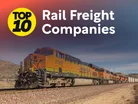
Top 10: Rail Freight Companies
With lower emissions than other logistics modes, higher capacity and seamless multimodal links, rail is a great choice for professionals looking to cut supply chain costs.
Rail freight pulls more than its weight in the global economy. It moves vast quantities of goods over long distances with ease, often replacing hundreds of lorries in a single journey. With dedicated tracks and fewer delays, trains keep to schedule and deliver reliably—essential for supply chains stretched across borders.
Not only that, rail also emits far less CO2 per tonne-mile than road or air, helping companies hit their net-zero targets while cutting logistics costs. It supports jobs, shifts commodities, fuels investment and keeps inland regions linked to key ports.
Rail also flexes to fit with road, sea and air transport, which keeps goods moving fast and just in time. Globally, rail accounts for up to 28% of inland freight—proof it remains a backbone of trade.
Here, we outline some of the best rail freight companies in the world
10. Samskip
Employees: ~1,500
CEO: Kari-Pekka Laaksonen
Founded: 1990

Samskip is a multimodal transportation solution throughout Europe, with its own rail freight service.
It has more than 100 train departures every week, with a network of tailor-made solutions for each customer’s needs. Samskip has a large European network, and even connects to the US and Korea.
It offers door-to-door transportation with its multimodal transportation solutions. It has implemented the IXSuite system for international rail services between Germany and the Netherlands, moving towards standardised inland operations.
9. Lineas
Employees: 1,750+
CEO: Erik van Ockenburg
Founded: 2005
Lineas is the largest private rail freight operator in Europe, with a goal of offering rail transport solutions to help with the growth of businesses.
The company has a range of rail freight transportation options, including single wagon load, intermodal trains and block trains.
It also includes infrastructure to help with first and last mile delivery to help with smooth and efficient transport. Lineas can provide end-to-end transport solutions to meet any business need, offering cost-effective logistics to suit each organisation.
8. Freightliner Group
Employees: 1k-5k
CEO: Tim Shoveller
Founded: 1965
Freightliner began as an operating company of British Rail in 1965, before being privatised in 1996. It has the capacity to reach every area within the UK, with strategically based terminals and depots.
Freightliner is the UK’s largest maritime intermodal logistics operator, part of Freightliner Group which has a significant presence across Poland, Germany and the Netherlands.
Freightliner delivers tailor-made solutions to a range of sectors, enhancing supply chain performance globally. It delivers a range of bulk solutions to more than 100 locations across the UK alone.
7. DB Cargo (Deutsche Bahn)
Revenue: US$6.2bn
Employees: 29,000
CEO: Sigrid Nikutta
Founded: 2009
DB Cargo is Europe’s biggest rail freight operator, moving goods across 18 countries with a huge fleet of trains. It runs around 2,600 locomotives and up to 92,000 freight cars, carrying nearly 180 million tonnes of freight a year. From steel and chemicals to cars and consumer goods, it helps power key industries.
More than 60% of its trains cross borders daily, cutting out around 20 million truck journeys and saving six million tonnes of CO₂.
It connects directly to 4,200 private sidings and even reaches China. Whether it’s a full train, a single wagon or a mix of rail, road and sea, DB Cargo is efficient, wide-reaching and built for modern logistics.
6. Norfolk Southern Railway
Revenue: US$12.1bn
Employees: ~19,600
CEO: Mark R. George
Founded: 1827
Norfolk Southern Railway operates in 22 states, connecting 800 industrial sites, 175 warehouses and spanning more than 19,200 route miles. It has the infrastructure to safely move items across any industry, including agriculture, chemicals, coal, military and metals.
It services the eastern US, delivering reliable service in order to connect businesses to global marketplaces.
Norfolk Southern Rail and Union Pacific Corporation are partnering to connect 50,000 route miles across the US, creating America’s first transcontinental railroad.
5. CSX Transportation
Revenue: US$14.5bn
Employees: 23,500
CEO: Joseph Hinrichs
Founded: 1986

CSX Transportation moves freight across the eastern US, handling intermodal containers, chemicals, agriculture and more.
CSX remains vital, linking ports to inland hubs and keeping goods flowing through key industries, despite weather and construction bringing congestion.
Covering a dense, high-demand region, CSX delivers dependable freight solutions that power energy, manufacturing and consumer supply chains across North America.
4. Canadian Pacific Kansas City (CPKC)
Revenue: US$14.5bn
Employees: 20,000
CEO: Keith Creel
Founded: 1881
Canadian Pacific Kansas City is the only single-line railway connecting Canada, the US and Mexico, covering 20,000 miles. It moves everything from grain to cars and chemicals, linking key ports from Vancouver to the Gulf of Mexico. With nearly US$3bn invested in capacity and sustainability, it targets a 50% cut in emissions by 2030.
Post-merger upgrades boost terminal flow and car use, making CPKC a smooth-running, cross-border freight force powering North American trade from top to bottom.
3. Canadian National Railway (CN)
Revenue: US$17bn
Employees: 24,671
CEO: Tracy Robinson
Founded: 1919
Canadian National Railway runs a massive freight network across Canada and the US, moving grain, steel, coal and intermodal containers.
About one-third of its traffic crosses the border, with strong grain exports and growing US freight in early 2025.
CN controls half of Canada’s grain transport and plans to move 30 million tonnes in the 2025–2026 season. With more investment going into track upgrades and capacity boosts, CN remains a reliable, resilient and ready player.
2. Union Pacific
Revenue: US$24.3bn
Employees: 32,439
CEO: Jim Vena
Founded: 1862
Union Pacific is one of the largest freight railroads in the US, running 32,200 miles of track across 23 western states. It hauls everything from agriculture and chemicals to autos and industrial goods, keeping supply chains moving.
A planned merger with Norfolk Southern will also aim to create America’s first coast-to-coast rail network, cutting delays and boosting service.
Union Pacific also invests heavily in speed, sustainability and innovation, making it a critical link between US industries and global markets. It’s also a regular on Fortune’s Most Admired Companies list, thanks to strong financials and long-term thinking.
1. BNSF Railway
Revenue: US$23.4bn
Employees: 36,000
CEO: Katie Farmer
Founded: 1995
BNSF Railway is a key link between major West Coast ports like Los Angeles and North America’s inland markets.
Its vast intermodal network moves millions of containers a year, blending rail, truck and ocean freight to keep global trade flowing. It invests in major projects, including the Barstow International Gateway to help speed up container handling and ease highway congestion.
With huge logistics hubs and privately owned rail lines reaching key industrial regions, BNSF delivers reliable, fast and cost-effective freight. It is an essential cog within modern supply chains, connecting suppliers to customers across continents.