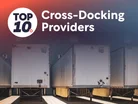
With the need for flexible and timely movement of goods greater than ever in today’s complex global marketplace, those able to leverage technological and logistic advancements to utilise cross-docking services stand out among supply chain operations providers.
From specialist storage cooling to sophisticated goods tracking and trace services, choosing the right cross-docking provider is more important than ever to ensure the seamless movement of goods.
Supply Chain Digital takes a look at the top 10 cross-docking providers that are helping supply chains become faster and more agile than ever before.
10. Lineage Logistics
Employees: ~12,000
CEO: Greg Lehmkuhl
Founded: 2012

Lineage Logistics, one of the largest temperature-controlled industrial REIT and logistics solutions providers, manages complex cross-docking by utilizing blasted dock doors and automated temperature tracking.
It offers cross-docking solutions that enable the faster and more efficient movement of products through the supply chain from inbound to outbound with minimal storage. Lineage Logistics supports both faster turns and more reliable deliveries.
9. CH Robinson
Employees: 12,000
CEO: David Bozeman
Founded: 1905
C.H. Robinson has a network presence in key global locations and offers extensive cross-dock and less-than-truckload (LTL) consolidation services, which reduce the need for safety stock.
As part of its offering of international warehousing solutions for global supply chains, C.H. Robinson’s cross-docking operations include a 2,000,000 square foot warehouse on the US-Mexico border, which supports manufacturers’ reshoring production. It boasts more than 230 dock doors along North American borders.
8. XPO Logistics
Employees: 37,000
CEO: Mario Harik
Founded: 2011
Using its vast network of strategically located cross-dock platforms, XPO Logistics helps its customers expedite their operations by allowing consolidation and deconsolidation of less-than-truckload (LTL) shipments.
XPO Logistics uses advanced tracking tools to provide accurate and transparent tracking, keeping its clients informed about their shipments' status.
Its cross-docking logistics solution ensures the risk of inventory damage, as well as warehouse costs, and overalls a fast and reliable delivery process.
7. CEVA Logistics
Employees: 160,000+
CEO: Mathieu Friedberg
Founded: 2007
CEVA Logistics precisely plans the reception and shipping of goods to ensure the management of just-in-time supply. It also uses adapted indexing to simplify package identification.
The logistics provider claims that its cross-docking offering reduces product storage times by up to 20%. This is especially beneficial for high-priority products such as fresh goods, as well as reducing delivery times in e-commerce.
6. GXO Logistics
Employees: ~150,000
CEO: Patrick Kelleher
Founded: 2021
GXO, one of the world's biggest pure-play contract logistics providers, uses an AI-native operating system that processes live signals from more than 1,000 sites to allow for real-time cross-docking decisions.
Its use of technology helps facilitate seamless supply chain operations for its customers. GXO's multichannel capabilities help support high-volume retail and ecommerce demands, while ensuring costs are kept low by helping to eliminate warehouse handling fees.
5. Kuehne + Nagel
Employees: ~85,000
CEO: Stefan Paul
Founded: 1890
As one of the world's leading logistics providers, Kuehne + Nagel offers cross-docking facilities that specialize in healthcare products.
Its services include the ability to consolidate multimodal cargo in a cross-dock warehouse. This helps to reduce CO2 emissions and costs while improving inventory management within destination warehouse receiving protocols.
Most recently, in May 2026, Kuehne + Nagel further expanded its presence in India, opening a new temperature-controlled airfreight cross-dock facility in Hyderabad.
4. DSV
Employees: ~150,000
CEO: Jens H. Lund
Founded: 1976
DSV works to lower transportation costs by offering its customers the opportunity to consolidate warehouse goods flows into one bundle, making use of its vast European network of storage and transfer points.
If clients have goods coming from multiple warehouses, it stores them for a short time prior to full order completion and then combines the goods into one shipment for increased cost-effectiveness.
3. DHL Supply Chain
Employees: ~188,000
CEO: Martin Willmor
Founded: 1969

By directly delivering products to consumers straight from the station, DHL Supply Chain's cross-docking operations mean that for warehouses processing perishable goods, the chance of delays is greatly reduced.
DHL Supply Chain also offers full end-to-end visibility for logistics operations, with dashboards and real-time tracking allowing customers to monitor inventory and shipments.
It also uses stationary robotics to automate both inbound and outbound warehouse/hub operations, including for palletising and depalletising, further streamlining its processes.
2. UPS
Employees: ~460,000
CEO: Carol Tomé
Founded: 1907
With its extensive supply chain network, which includes more than 27 cross-docking sites, UPS offers a flexible solution that allows freight shipments to be held temporarily before being sent to their next destination.
UPS's customers benefit from access to its business intelligence portal, UPS Supply Chain Symphony, which allows suppliers and carriers real-time visibility. This data helps to ensure that truckloads are reloaded with as little dwell time as possible.
As well as its routing and cross-docking capabilities meaning it serves those looking for time-sensitive solutions, it also specializes in temperature-sensitive movement, offering IATA CEIV Pharma-certified operations for healthcare products.
1. FedEx
Employees: 500,000+
CEO: Raj Subramaniam
Founded: 1971
For both SMEs and startups, FedEx offers a comprehensive end-to-end international logistics service. It uses consolidation cross-docking extensively as part of its supply chain distribution, sorting and loading logistics operations.
FedEx synchronises both inbound and outbound freight at the loading dock, which minimizes warehouse storage times for its users. This is particularly useful for retail, e-commerce and healthcare sectors that require speed-to-market.
The supply chain solution provider uses advanced SenseAware ID technology to receive real-time data about the location of the shipment, allowing for precision tracking. Once the parcel arrives for sorting, FedEx uses AI-powered sorting robots to enhance operational speed and accuracy, meaning it is able to scan, sort and route pallets to their next destination within hours.
Backed by an extensive fleet of aircraft and motorized vehicles, its cross-docking capabilities provide a seamless link between global manufacturing hubs and localized final-mile distribution networks.
Company portals




Executives
Carol Tomé
CEO

David Bozeman
Chief Executive Officer
Greg Lehmkuhl
Chief Executive Officer

Jens Lund
Group Chief Executive Officer
Mario Harik
Chief Executive Officer
Martin Willmor
CEO UK&I at DHL Supply Chain

Mathieu Friedberg
CEO
Patrick Kelleher
CEO
Raj Subramaniam
President, CEO, and member of the Board of Directors
Stefan Paul
CEO