
Liberation Day: What Trump's Tariffs Mean for Supply Chain
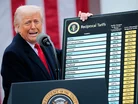
US President Donald Trump has announced sweeping tariffs on what has been dubbed by the White House as 'Liberation Day'.
President Trump and his administration have imposed a baseline 10% tax on US imports, with some countries set to be charged as much as 50%.
Dozens of nations will be impacted by reciprocal tariffs, reflecting what they charge the US.
Many economists say the announcement will trigger a global trade war, with trading partners expected to slap numerous retaliatory tariffs on their own imports from the US.
What's certain is that countless organisations, particularly large enterprises, will see their global supply chain severely tested over the coming months.

What did Trump say?
Speaking in the Rose Garden at the White House, against a backdrop of stars and stripes, Trump called 2 April 2025 "one of the most important days in American history".
“For decades, our country has been looted, pillaged, raped and plundered by nations near and far, both friend and foe alike," he said. "Our country and its taxpayers have been ripped off for more than 50 years, but it is not going to happen any more.
"It’s our declaration of economic independence. For years, hard-working American citizens were forced to sit on the sidelines as other nations got rich and powerful, much of it at our expense, but now it’s our turn to prosper.
“This will be, indeed, the golden age of America. It’s coming back and we’re going to come back very strongly.”
What new tariffs has Trump announced?
Holding aloft a board demonstrating his plans, Trump announced that around 60 countries would be hit by reciprocal tariffs, albeit at a discounted rate.
He regards these nations to be the "worst offenders" when it comes to historic trade policies.
Asian trading partners have been hit particularly hard. They include China (54%), Cambodia (49%), Vietnam (46%), Thailand (36%), Taiwan (32%) and Japan (24%).
Meanwhile, the European Union will feel the effects of a 20% tax. Ursula von der Leyen, President of the European Commission, called the decisions taken by Trump and his administration a "major blow to the world economy".
"Uncertainty will spiral and trigger the rise of further protectionism," she added. "The consequences will be dire for millions of people around the globe."
Despite failing to agree a concrete trade deal in the build-up to Liberation Day, the UK will face a more lenient tariff in the form of the 10% base rate.
Others set to be taxed 10% include Singapore, Brazil and Australia.
The full list of newly-imposed tariffs can be found below.
What tariffs did we already know about?
Heading into Liberation Day, the US had already imposed a flat 25% tariff on global steel and aluminium imports.
We also knew a 25% tax on imported automobiles, including sedans, SUVs, crossovers, minivans and light trucks, alongside key auto parts like engines, transmissions, powertrain elements and electrical systems, would come into effect on 2 April.
When it comes to specific countries, Canada, Mexico and China have been bearing the brunt of Trump's tariffs.
In early March, the US imposed a 25% tariff on goods from its North American neighbours, in addition to a 10% tax on Canadian energy. Amid a mounting regional trade war, Canada responded by imposing a 25% charge of its own on US steel and aluminium.
Tariffs on Mexican and Canadian goods entering the US have not changed following Liberation Day.
Trump had previously announced a blanket 20% levy on Chinese imports, but this has now been raised to more than 50%.
Earlier this week, the US government also confirmed a 25% tariff on all countries that purchase oil or gas from Venezuela. It applies to any country that trades with Venezuela in the energy sector or indirectly through third parties and also engages in commercial relations with the US.
What's the supply chain impact?
Leaders from the world of procurement, supply chain and logistics have been responding to Trump's announcement in their droves.
Ram Ben Tzion, Co-Founder and CEO of Publican, a digital shipment vetting platform, said logistics operators would need to increase customs processing and clearance capacity to handle all new regulations and tariff requirements.
He added: “The announced measures will be a significant milestone in the Trump administration's journey to redefine global trade. Magnitude and extent indicate how serious the administration is about new tariffs."
Focused on the truckload freight market, Matt Muenster, Chief Economist at Breakthrough, said relatively modest gains could be expected until the second half of 2025.
"While capacity continues to gradually leave the market, we expect rate pressure will also be limited until the second half of 2025," Matt continued. "We believe tariff uncertainty increases the probability of a slower freight market because business uncertainty will delay investment decisions."
Jamie Barsimantov, VP of Supply Chain Strategy at Sphera, said supply chain managers had been in "continuous emergency mode" over the past two months due to tariff uncertainty.
"In general, they are looking to understand how they should react in the short and long term based on a range of scenarios," he noted.
"In recent years, companies have started to get better upstream visibility using software tools and by streamlining supplier communication, so they have better planning tools than they used to, and better ways to react."
Looking to the UK, Alex Altmann, Partner at Lubbock Fine, said the country's government should continue trying to negotiate a trade deal with the US in a bid to create a new role for itself as an offshore manufacturing centre for EU companies, such as German automotive manufacturers.
“Helping to build the UK as a key manufacturing hub for German car makers would give a significant boost to the UK economy," he added.
“Achieving this would make more than justify ditching the Digital Services Tax, which is one of the compromises the UK Government is said to considering offering to the US.
“The UK has a lot of spare automotive manufacturing capacity after Brexit, which makes leveraging the UK’s special relationship with the US well worth it.”
Explore the latest edition of Supply Chain Digital Magazine and be part of the conversation at our global conference series, Procurement & Supply Chain LIVE.
Discover all our upcoming events and secure your tickets today.
Supply Chain Digital is a BizClik brand.