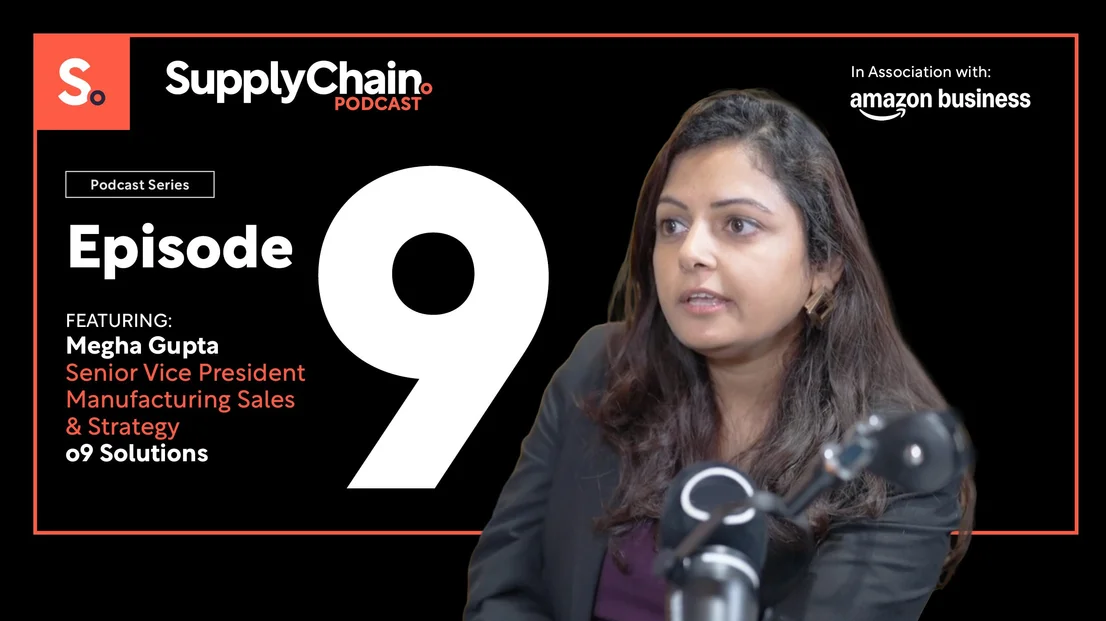
Episode 9 | Megha Gupta: Why Data Defines Supply Chain AI
Related Podcasts
AI is transforming supply chain planning. But without the right foundations underneath it, the technology is working against you, not for you.
In this episode of the Supply Chain Digital Podcast, host Aaron McMillan sits down with Megha Gupta, SVP of Manufacturing Strategy and Transformation at o9 Solutions, live from Gartner's Supply Chain Symposium in Barcelona.
Megha brings 15 years of supply chain experience and a refreshingly direct take on what separates organisations that are genuinely getting value from AI and those that are still talking about it.
Listen and subscribe now on Spotify
Watch and subscribe now on YouTube
In this episode we explore:
- Why advanced scenario planning has become a must-have, not a nice-to-have
- Why data quality is still the defining factor in whether AI delivers or disappoints
- How successful transformation projects are governed, and why most aren't set up right from the start
- Why geopolitical volatility has made proactive planning a survival skill
- Why the future of supply chain is human and AI, not human or AI
From spreadsheets to scenario planning
Megha has watched supply chain planning move from Excel files and manual processes to platforms capable of running real-time simulations across the entire value chain. The shift matters because the world it's responding to has changed. When a supplier fails or a tariff lands overnight, organisations that can quickly model the impact and test alternatives are in a fundamentally different position to those still working out what they have in stock.
Data is still the real differentiator
Megha is direct in her belief in the importance of data: garbage in, garbage out. It was true before AI and it's more true now. Poor data produces unreliable recommendations, and unreliable recommendations destroy trust in the technology before it's had a chance to prove itself. Her advice is to start the digitisation journey even before the data is perfect, using technology to help identify where the gaps are, but master data and transactional data need to be in place before anything meaningful can begin.
Why transformation projects fail
Technology is rarely the problem, says Megha. She makes it clear that the organisations struggling with implementation are usually the ones that didn't set the right conditions from the start – unclear roles, no stage gates and a tendency to blame the platform when data or process issues were the real culprit. Her approach is to establish governance, responsibilities and honest collaboration between all parties before a single line of code goes live.
Disruption as the new normal
Asked what keeps her up at night, Megha doesn't hesitate: geopolitical volatility. Supply chains are being reshaped by decisions that arrive without warning such as tariff announcements, policy shifts, market closures and more. Scenario planning, she argues, is no longer optional, suggesting that the organisations spending less time firefighting and more time running forward-looking simulations are the ones staying ahead.
Human and AI, not human or AI
Megha's view on autonomous planning is measured. Some workflows can and should be fully automated, she believes. But for complex, high-stakes decisions – the ones that affect cost, service and supply – the human has to stay in the loop. In the ideal scenario, the AI handles the analysis and the recommendations and the people make the calls.
Subscribe and Listen
Episode 9 is brought to you by Amazon Business, the one-stop destination for everything your organisation needs.
Catch up on Episode 8, featuring Fraser Ironside, Senior Director of Business Consulting at Kinaxis, discussing faster decision-making, agentic AI and real-time planning.
Company portals

Executives
Megha Gupta
Senior Vice President, Manufacturing Sales & Strategy