
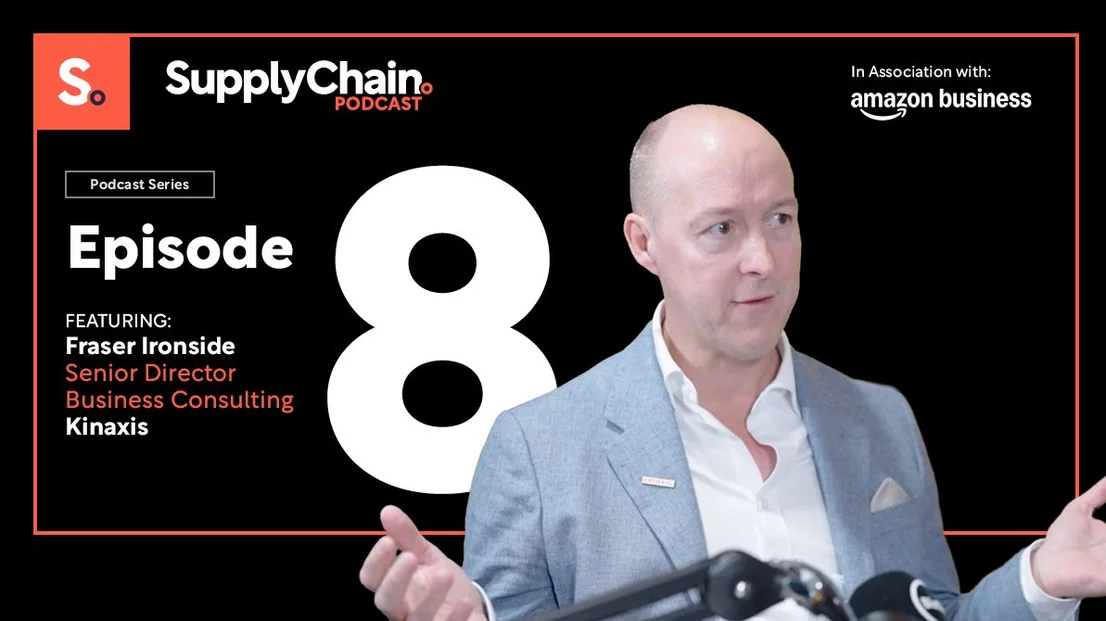
Ep. 8 | Speed as a Supply Chain Enabler with Fraser Ironside
Related Podcasts
Supply chain planning has come a long way from printing forecasts and predictions and walking them round the corridor. But are companies moving fast enough to keep up with a world where the plan changes every day?
In this episode of The Supply Chain Podcast, host Aaron McMillan sits down with Fraser Ironside, Senior Director of Business Consulting at Kinaxis, recorded live at Gartner's Supply Chain Symposium in Barcelona.
Fraser brings three decades of supply chain experience to the conversation, taking us back to the late 90s, doesn’t oversell the technology aspect of evolution and even finds time to drop in a quick Mike Tyson reference for good measure. What he says about where things are heading is worth paying attention to.
Listen on Spotify [here]
Watch on YouTube [here]
In this episode we explore:
- Why the speed of decision making has become the defining competitive advantage in supply chain.
- How agentic AI is democratising supply chain insight, and what that means for team adoption.
- Why data quality, not capability, is still the real barrier to AI trust.
- Why humans stay in the loop, and why political decisions will never be a software solution.
- What agent-to-agent communication looks like and why it could reshape the enterprise by 2030.
From monthly cycles to real-time decisions
Fraser's opening story sets the tone. In the late 1990s, his company spent two weeks building a forecast, printed 30 copies, held a four-hour consensus meeting, then waited another two weeks to find out whether supply could meet the demand they'd just agreed on. A month to answer a question that should take minutes. Some companies, he notes, are still operating that way.
AI is democratising supply chain insight
Where planners once needed deep software expertise to interrogate supply chain data, natural language AI means anyone can now ask the question directly. Type ‘why are my orders late?’ into a planning system and it comes back with an answer and resolution options. User adoption has historically been one of the biggest failure points in enterprise software rollouts, but that problem largely disappears when engaging with tech is a conversation.
Trust, not capability, is the real barrier
Fraser is clear about why hesitation around AI persists. It isn't that the technology doesn't work, it's that planners don't yet fully trust what it tells them. The root cause is data quality. AI trained on inaccurate data produces unreliable outputs, and unreliable outputs undermine confidence. We find out why that hasn't changed.
Humans stay in the loop
Supply chain decisions are frequently political. When finite supply needs allocating between competing markets, the loudest voice often wins. No algorithm solves that. AI will keep improving at presenting options and automating lower-stakes decisions, but significant cost and service calls will stay with people. What does that mean for accountability?
The next frontier: agent-to-agent communication
Most companies find out a supplier is going to fail them via an email. An agent that reads that email and automatically flags the planning impact closes a gap that still catches businesses off guard. Fraser sees cross-enterprise orchestration – agents in planning platforms talking directly to agents in finance, CRM and email systems – becoming standard by 2030.
Subscribe and Listen
Episode 8 is brought to you by Amazon Business, the one-stop destination for everything your organisation needs.
Explore more from the supply chain podcast series
Catch up on Episode 7 featuring Shirell James, Vice President of Supply Chain Advisory at Blue Yonder, discussing how technology, supplier relationships and strong leadership are shaping the future of procurement and supply chain performance.
Company portals

Executives

Fraser Ironside
Senior Director of Business Consulting