
US Trade Court Blocks Trump Tariffs: What Happens Next?
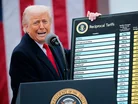
A US trade court has blocked most of the tariff orders President Donald Trump has issued since taking office in January 2025.
The move could have significant implications on the US president’s controversial trade policy, which has seen import taxes placed on most of the US’s trading partners and steeper reciprocal tariffs placed on nations and blocs including the EU, the UK, Canada, China and Mexico.
On Wednesday 28 May, the Court of International Trade said that the US Constitution gives Congress the exclusive authority to regulate commerce with other countries.
It added that this was not superseded by the president’s emergency powers to safeguard the US economy — the White House had previously imposed tariffs after invoking an emergency law under the International Emergency Economic Powers Act (IEEPA).
The Trump administration has lodged an appeal against the ruling.

Court of International Trade rules against Trump
Several lawsuits have been filed against Trump’s tariffs. Wednesday’s ruling relates to two separate suits — one filed by a group of state attorneys general and another filed by five US businesses that rely on goods imported to the US.
They mark the first major legal challenges to the sweeping global tariffs issued by the Trump administration, which have caused significant global disruption.
A three-judge panel ruled that Trump’s tariff orders “exceed any authority granted to the president… to regulate importation by means of tariffs”.
According to a report by Reuters, the courts said it “does not pass upon the wisdom or likely effectiveness of the President’s tariffs as leverage”.
Instead, the ruling focused on the legality of the imposing of trade tariffs by the Trump administration, with the court saying that “use is impermissible not because it is unwise or ineffective, but because (federal law) does not allow it”.
The court rules that the IEEPA does not give President Trump the authority to bypass Congress approval by claiming that US trade deficits present a national emergency.
It invalidated all orders on tariffs rooted in the IEEPA with immediate effect and blocked another set of tariffs imposed on Canada, Mexico and China to mitigate what the White House said was an unacceptable flow of illegal immigrants and drugs into the US.
Global markets respond positively
Trump unveiled the new tariff regime after taking office, imposing import taxes on many of the US’ key trading partners.
Actions included a 10% baseline tariff on most countries — and steeper tariffs on several nations including China.
Since, an ongoing trade war between the US and China has escalated, with the White House raising baseline tariffs on Chinese imports to 145%.
In retaliation, China imposed a minimum 125% tariff on US goods and restricted exports of rare earth materials used in technology applications.

Markets have celebrated the latest ruling.
The US dollar rose after the court’s decision, rallying against currencies including the euro, yen and the Swiss Franc.
European stocks and Wall Street futures also rose, according to Reuters, with S&P 500 future climbing 1.6%.
New York Attorney General Letitia James, representing one of the states involved in the lawsuit, said the decision was welcome.
As reported by the BBC, she said: “The law is clear: no president has the power to single-handedly raise taxes whenever they like.
“These tariffs are a massive tax hike on working families and American businesses that would have led to more inflation, economic damage to businesses of all sizes, and job losses across the country if allowed to continue.”
The White House has appealed against the decision and criticised the ruling. The judges have ordered that new orders reflecting the court’s injunction be issued within 10 days.
White House Deputy Press Secretary Kush Desai said: “It is not for unelected judges to decide how to properly address a national emergency.
"President Trump pledged to put America First, and the administration is committed to using every lever of executive power to address this crisis and restore American greatness."
Explore the latest edition of Supply Chain Digital Magazine and be part of the conversation at our global conference series, Procurement & Supply Chain LIVE.
Discover all our upcoming events and secure your tickets today.
Supply Chain Digital is a BizClik brand