
Trump Mobile's T1: Made in the USA or Rebranded Import?
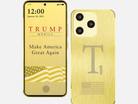
Trump Mobile is entering the market with bold branding and strong messaging, positioning its T1 smartphone as both a political symbol and a technical achievement.
Led by US President Donald Trump’s eldest sons, the launch makes a direct appeal to supporters by promoting a device “proudly designed and built in the United States.”
However, in a sector where 95% of smartphones are produced in Asia, supply chain experts and analysts are not convinced the Trump T1 breaks from that global norm.

The reality behind US-made smartphone claims
Trump Mobile describes itself as a next-generation wireless provider. Its offering includes a T1 smartphone and a US$47.45 monthly mobile plan, linking the figure to Trump’s position as the 47th president.
The device is presented as a gold-coloured phone with artificial intelligence-powered facial recognition, a fingerprint scanner and high-end hardware.
While the presentation leans heavily into patriotic themes, the logistics of delivering a fully American-made smartphone remain unclear.
Analysts draw direct comparisons between the T1 and several models made in China, notably the Wingtech REVVL 7 Pro 5G, which retails for less than half the T1’s US$499 price tag. These similarities have triggered speculation that the T1 may not be newly built in the US but is instead a rebranded import.
Max Weinbach from Creative Strategies is direct: “There are only realistically four or five smartphone ODMs (original device manufacturers) that would be able to manufacture something like this. All of them are based out of China.”
He points out that the hardware components of the T1 – its body, camera and battery – are in line with known Asian models.
Todd Weaver, Chief Executive of Purism, a rare company assembling phones in the US, questions the Trump Organisation’s manufacturing claims.
“Unless the Trump family secretly built out a secure, onshore or nearshore fabrication operation over years of work without anyone noticing, it’s simply not possible to deliver what they’re promising,” he says.
Supply chains still rule global production
The US currently lacks the domestic infrastructure for full-scale smartphone production.
Key components are not made in the country and must be imported. Even Purism, which makes the Liberty Phone in California, still sources crucial parts like GPS crystals from overseas.
Ryan Reith, Group Vice President for IDC’s Worldwide Device Tracker, puts it plainly: “Any phone that is going to be sold in September, or shipped in September into the US, the majority of it’s not going to be manufactured in the US. That’s a given.”
Manufacturing a competitive smartphone without relying on Asian supply chains would push the retail price much higher.
Tinglong Dai, a supply chain expert from Johns Hopkins Carey Business School, estimates the cost of a truly US-made phone would top US$1,000.
“Without access to manufacturing capabilities in Asia and the associated economies of scale, the financials simply do not align,” he says.
Robert D. Atkinson from the Information Technology and Innovation Foundation agrees, noting that the only way US-based production could work is through highly automated factories. Even then, he says, it would require high sales volume to justify the investment.
Regulatory oversight also poses a challenge. The Federal Trade Commission maintains strict requirements for using the “Made in the USA” label.
Todd believes Trump Mobile could struggle to meet those standards: “Just to manufacture a phone in the US with the chip sets you’re actually getting, purchase and support with the US supply chain is a massive undertaking and that’s also the reason why we happen to be the only ones doing it.”
Branding over building?
Much of Trump Mobile’s strategy appears to rest more on messaging than manufacturing. The gold finish of the T1 and the subscription price referencing Trump’s presidency are designed to appeal to a core demographic.
The company operates as a mobile virtual network operator (MVNO), reselling network access from existing carriers rather than building any new infrastructure.
Leo Gebbie from CCS Insight offers a blunt view: “It is exceptionally hard to envision how a smartphone like the T1 device could genuinely be manufactured in the US.
“Ultimate devices cannot be produced in the US due to the dominance of the Asian supply chain, which is far more advanced than anything currently available in the US.”
Weinbach and Weaver both point out that many smartphones share the same internal components, making it relatively easy to rebrand an existing model.
“A lot of them share the same components, parts, boards and antenna hardware,” Max says. “So, you can swap out a couple of things.”
While the Trump Mobile launch generates attention for its messaging and market pitch, experts remain firmly doubtful that it reflects a true shift in manufacturing.
For now, the T1 stands as another device shaped by the global supply chain, regardless of its American branding.