Toyota: How Humanoid Robots are Transforming Factory Floors
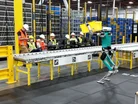
Toyota Motor Manufacturing Canada's Woodstock facility in Ontario is preparing to integrate humanoid robotics into its operations through a robots-as-a-service agreement with Agility Robotics.
Following a successful pilot programme, the automotive manufacturer will deploy Digit robots to support manufacturing and logistics functions at the plant.
The decision to adopt humanoid robotics through a leasing model rather than outright purchase could represent a significant development for supply chain operations in automotive manufacturing.
According to Agility Robotics, Digit will work alongside employees to support manufacturing, supply chain and logistics activities.
Tim Hollander, President of Toyota Motor Manufacturing Canada, says: "Toyota Motor Manufacturing Canada has long been a leader in automotive manufacturing innovation.
"After evaluating a number of robots, we are excited to deploy Digit to improve the team member experience and further increase operational efficiency in our manufacturing facilities."
Humanoid robotics in logistics operations
Digit is described as the world's first commercially deployed humanoid robot. The unit combines traditional controls with AI-based learning methods and can be deployed in hours rather than weeks or months.
Each robot contains approximately 5,000 parts and is manufactured at Agility's RoboFab facility in Oregon, US, which has the capacity to produce 10,000 robots annually at peak production.
The robot is designed to perform tasks including line feeding, tote loading and unloading and tote recycling. These functions are critical connective operations in automotive manufacturing, moving components from warehouse locations to assembly lines.
Because Digit is humanoid in form, it can navigate spaces designed for human workers, including standard shelving systems and narrow aisles, without requiring extensive facility modifications. This design approach allows manufacturers to integrate robotics into existing infrastructure.
Toyota operates three vehicle production plants in Canada and a component manufacturing facility in British Columbia. The Woodstock West plant, which produces the RAV4 and RAV4 Hybrid models, will serve as the deployment location for Digit.
The Canadian facilities utilise Toyota New Global Architecture platforms, which standardise vehicle parts and assembly processes across different models. As part of a CAN$1.1bn (US$803m) investment for the sixth-generation RAV4, the Ontario plants were reconfigured to manufacture hybrid battery packs in-house rather than importing them from Japan.

Leasing model for robotics
Rather than purchasing the robots outright, Toyota is leasing them through Agility's robots-as-a-service model. This approach converts what would traditionally be a capital expenditure into an operating expense, potentially reducing the financial barrier to automation adoption.
As Agility improves Digit's hardware, older models can be replaced with newer versions without loss of initial investment. This provides manufacturers with access to the latest technology without repeated capital outlays.
Agility handles maintenance of Digit units, which are managed through Agility Arc, a cloud-based fleet management system. This platform allows plant managers to assign tasks to robots via computer, monitor battery levels of each unit in real-time and make updates when factory floor layouts change.
Peggy Johnson, CEO of Agility Robotics, adds: "Toyota is one of the premier companies in the world; one with a long history of innovation and success, so it's a privilege to join forces to integrate humanoid robotic solutions like Digit into automotive production.
"I look forward to continuing our work with Toyota to identify all the ways that Digit can help the employees working at their production facilities.
"With our next generation of Digit, we will be the first company to deliver the first cooperatively safe humanoid robot to work alongside people, allowing companies like Toyota to scale their use of humanoids well beyond what is possible today."
Evolution of automation strategy
While Digit represents the newest robotic addition to Toyota's operations, the company has been integrating industrial robots into manufacturing lines since the 1970s. Rooted in the Toyota Production System, the approach relied on a concept called Jidoka, meaning automation with a human touch.
Toyota used robots to assist human workers and improve ergonomics rather than attempting to fully automate production processes. The company has been developing specialised industrial robots since the 1980s to optimise vehicle production lines, leveraging sensor and mobility control technologies initially developed for automotive applications.
Toyota co-developed Kirobo in 2013, a 34 cm-tall humanoid that became the first robot to speak in space during an 18-month deployment on the International Space Station. In 2017, the company unveiled the T-HR3, an advanced humanoid robot that mirrors the movements of a remote human operator.
The deployment of Digit marks a shift towards third-party humanoid robotics rather than proprietary systems.
For supply chain operations, this development could signal a move from experimental robotics to operational utility in production environments, particularly as the industry faces ongoing labour challenges for manual handling tasks in logistics and material movement.
Company portals


Executives
Peggy Johnson
Chief Executive Officer

Tim Hollander
President, Toyota Motor Manufacturing Canada