
The Supply Chain Risks of Colorado River Water Shortages
As the mid-February chill settles over the American west, a far more chilling reality has dawned on the seven states reliant on the Colorado River.
The 14th February, a date once circled as a key negotiating milestone for a consensus on water management, has passed without a handshake or a deal.
This second missed deadline marks a significant shift from collaborative diplomacy to federal intervention.
As the US Bureau of Reclamation prepares to impose its own "Record of Decision" by October, the implications for the American west and Mexico are becoming increasingly stark.
The impasse is defined by a fundamental disagreement between the Upper Basin states, Colorado, Wyoming, Utah and New Mexico, and those in the Lower Basin: California, Arizona and Nevada.
John Entsminger, Nevada's Chief Negotiator, remarks that the states "have failed to reach an agreement to collectively protect our respective communities and economies in the face of almost certain reductions."
In the Lower Basin, Arizona has suggested significant additional voluntary reductions in recent negotiations. However, California's stance remains more conservative.
Protected by "senior water rights" established under early 20th-century prior appropriation claims and later formalised through the 1922 Colorado River Compact and subsequent agreements, California's negotiators maintain that historical legal priority must be respected.
Why have Basin states rejected reduction proposals?
The Upper Basin states have rejected these proposals, arguing that they cannot commit to firm reductions when their supply is already dictated by unpredictable Rocky Mountain snowpack.
Becky Mitchell, Colorado's Lead Negotiator, argues that "we're being asked to solve a problem we didn't create with water we don't have."
The Upper Basin is already living with cuts caused by low runoff and "thirsty soil" that absorbs snowmelt before it reaches the river.
As negotiations stall, Mexico finds itself in an increasingly precarious position. Under the 1944 Water Treaty and "Minute 323" agreement, Mexico's water supply is linked to Lake Mead levels.
With the reservoir at roughly one-third of total capacity in recent years, though levels fluctuate annually, Mexico is already facing shortage reductions tied to Lake Mead elevation levels under existing agreements. This scarcity is disrupting Mexico's industrial nearshoring boom.
Factories have begun experiencing production halts and many are forced to purchase water from private tankers at high costs.
Agriculture faces mounting pressure
The agricultural sector in Mexico is feeling the pressure most acutely. Roughly 80% of Colorado River water delivered to Mexico irrigates the Mexicali Valley.
As a major supplier of winter produce to the UK and North America, any disruption has global consequences.
Reduced water volumes could mean less acreage for crops like lettuce and broccoli, leading to supply chain gaps and volatile pricing.
The crisis is further complicated by climate change fundamentally altering the river's infrastructure. Water flowing into Lake Mead is projected to be nearly 11°F warmer than historical averages by the end of 2026.
This temperature spike threatens Hoover Dam's power generation. If intake temperatures exceed 78.8°F for more than three days, operations could be disrupted to prevent permanent equipment damage.
Secretary of the Interior, Doug Burgum, states that whilst the Federal Government remains dedicated to finding a "shared solution," it cannot afford further delay.
The Bureau is now moving forward with its Post-2026 Environmental Impact Statement, which will likely dictate the rules of the river for the next generation.
The role of climate change
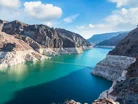
The topic of sustainability has also moved to the very centre of the debate. Those visiting the Hoover Dam can note the white ring on the canyon walls of Lake Mead, indicating where the water level used to be.
The white colour comes from calcium carbonate primarily, which is naturally present in the Colorado River.
The water level has dropped significantly in recent years, reaching 150-170 feet below the water mark.

Don't miss the opportunity to discover more at Sustainability LIVE: The Net Zero Summit.
On March 4 panellists from Veolia, Business Stream and Anglian Water will come together to discuss how leading organisations are improving water stewardship through innovation in treatment, sourcing and reuse.
Learn about measurement frameworks and collaborative approaches that support long-term water security.
Tickets can be booked online today for The Net Zero Summit.
As Dr Jack Schmidt, Director of the Center for Colorado River Studies, notes: "Everyone agrees we have to use less water, the problem is states look at each other and say you should use less."
The path forward requires a transition from managing temporary drought to adapting to "aridification", a permanent shift to a drier climate.
For California, this could mean that even if senior rights are legally upheld, the physical disappearance of water may eventually render those rights moot.
For Mexico, it could mean greater reliance on expensive water recycling and desalination technology.
As the October 2026 deadline approaches, the coming months will determine whether the basin states can embrace "shared responsibility" or if the system will descend into decades of litigation that no one can afford.