The Supply Chain Impact of Canada’s Trade Pivot Toward China
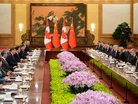
Canada and China have formalised an initial trade agreement that could significantly reduce tariffs on EVs and agricultural products.
The deal, struck during Prime Minister Mark Carney's high-stakes visit to Beijing in February 2024, marks the first visit by a Canadian leader since June 2017 and represents a pragmatically driven reset of a long-fractured relationship.
For supply chain professionals, the agreement is indicative of an ongoing reconfiguration of North American logistics networks and sourcing strategies.

The agreement has emerged against a backdrop of increasing volatility in the traditional Canada-US trading corridor.
Following the re-election of US President Donald Trump, Ottawa's officials say they faced on-again-off-again tariffs and threats to the United States-Mexico-Canada Agreement (USMCA) free trade agreement.
While the US remains Canada's largest partner, the Carney administration is increasingly viewing China – the world's second-largest economy – as a necessary counterweight. Economic observers suggest this recalibration is a response to a world where multilateral systems have been, as the Canadian Prime Minister noted, "eroded."
By securing direct access to Chinese markets and manufacturing capabilities, Canada aims to insulate its economy from protectionist shifts in Washington, creating alternative supply routes that could reshape continental trade flows.
Implications for automotive logistics
A central pillar of the deal involves a significant rollback of the 100% tariffs on Chinese-made EVs imposed in October 2024.
Under the new terms, Canada will allow an annual quota of 49,000 Chinese electric vehicles to enter the country at a most-favoured-nation tariff rate of just 6.1%, according to government sources. This quota is projected to rise to 70,000 vehicles within five years.
The move is expected to lower prices for consumers and accelerate Canada's green transition. Early beneficiaries are likely to include Tesla, which previously shipped tens of thousands of Chinese-made cars to Canada and Geely-owned brands like Volvo and Polestar.
However, the domestic industry remains wary. The Premier of Ontario, Doug Ford, criticised the move, arguing it would hurt our economy and lead to job losses by inviting a flood of cheap made-in-China EVs.
To mitigate these concerns, the deal includes a provision where 50% of the import quota must be priced under US$35,000 by 2030, theoretically incentivising the entry of affordable mass-market models from manufacturers like BYD.
For supply chain managers, this could mean establishing new port-of-entry protocols, customs clearance procedures and distribution networks to accommodate increased Asian vehicle imports.
Agricultural export corridors reopen
In a direct exchange for the EV concessions, Beijing has agreed to slash punitive tariffs on Canadian canola seed from 85% to 15%. This will provide a vital lifeline to farmers in Western Canada who have been caught in the crossfire of recent trade wars.
In addition to canola seed, China has committed to removing anti-discrimination duties on Canadian lobster, crab and peas until at least the end of the year. In Manitoba alone, canola supports approximately 35,000 jobs.
However, the deal is not a total victory for the sector: canola oil remains subject to a 100% tariff, a detail that industry leaders say requires further negotiation. Nevertheless, the reduction in seed duties is seen as enormous progress for growers.
For logistics providers, this could mean resumed bulk cargo shipments through Pacific coast terminals and renewed demand for grain handling infrastructure.
Strategic positioning amid uncertainty
The diplomatic atmosphere in Beijing was described as realistic and respectful, though Prime Minister Carney was careful to acknowledge that significant red lines remain regarding human rights and foreign interference.
"We take the world as it is – not as we wish it to be," he stated when questioned on China's human rights record.
This approach was echoed by Chinese President Xi Jinping, who noted: "The healthy and stable development of China-Canada relations is conducive to world peace, stability, development and prosperity."
While Washington has labelled the deal problematic, according to US State Department officials, the Canadian government appears committed to this new approach, prioritising its economic predictability and supply chain resilience.
For supply chain executives, the agreement may prompt a more careful assessment of cross-border regulations, compliance requirements and an assessment of the geopolitical risks inherent in diversifying away from traditional North American supply routes.