The LNG Fleet Expansion: A Bet on Transitional Fuels
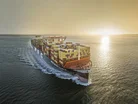
As global logistics takes a turn towards more sustainable operations, many ocean carriers are modernising and expanding their fleets.
Now, with consumer demand prioritising clear sustainable practices, companies that don't reframe their strategies risk losing out.
Ocean carriers are working to decarbonise their fleets, through new purchases which also increase capacity.

Fleet modernisation
Major companies, such as MSC, Evergreen and Hapag-Lloyd have been placing large orders for liquefied natural gas (LNG) and duel-fuel vessels from now to 2029, in order to improve efficiency and increase capacity across operations, as well as move to more sustainable processes. These investments demonstrate how carriers are modernising their fleets in order to stay competitive.
This investment reflects the consumer demand for more efficiency and sustainability in shipping solutions, as the purchasing of these ships will reduce emissions and enhance operational efficiency. The final weeks of 2025 and the opening of 2026 saw a movement of major shipping companies work to modernise, secure future capacity and meet the demand for rising global trade volumes.
As carriers move to implement natural gas as a fuel alternative, this source needs to be transported safely and efficiently. In order to do so, it must be converted into liquid first. When it gets cooled, it transforms into a liquid state and reduces to a 1/600th of its original volume.
LNG carriers are tank ships designed to handle liquefied natural gas during its transportation, as it cannot be shipped on regular vessels. The LNG is kept at higher pressures, temperatures of around -162°C, or a combination of both.
Industry expansion
Container shipping companies around the world are accelerating plans to upgrade fleets to offer more sustainable options.
COSCO Shipping Holdings has placed orders for 18 container vessels in mid-January, totalling approximately US$2.7bn in its first steps to LNG dual-fuel propulsion. Out of these, its 12 18,000 TEU capacity vessels will be delivered between 2028 and 2029, whereas the six 3,000 TEU vessels have a six month window in 2028.
Evergreen has made an order worth US$1.47bn after signing contracts with two Chinese shipyards for 23 newbuilds.
Pacific International Lines (PIL) has signed letters of intent regarding the construction of eight 13,0000 TEU LNG duel-fuel container vessels.
Hapag-Lloyd signed a contract in December for the construction of eight new 4,5000 TEU container ships which will have state-of-the-art dual-fuel methanol engines, with expectations of delivery between 2028 and 2029.
"We have ordered eight new dual-fuel methanol vessels of 4,500 TEU, with deliveries scheduled for 2028 and 2029. The ships will be equipped with state-of-the-art dual-fuel methanol engines and will be up to 30 percent more efficient than older vessels of similar size," explains Rolf Habben Jansen
CEO of Hapag-Lloyd AG.
"Saving up to 350,000 metric tons of CO₂e per year when operating on methanol, the new ships will help further decarbonize the Hapag-Lloyd AG fleet, replace older tonnage, and reduce our dependence on the charter market. What’s more, operating these state-of-the-art ships will be much more cost-efficient."
The MSC Group's investments
The MSC Group has been making significant contribution to sustainable operations across its fleets. It is approaching the energy transition by investing in new technologies and adapting to green fuels.
In November, MSC Cruises confirmed the order of two new 'World Class' LNG vessels, which has brought its total investment in France to €10.5bn (US$12.5bn). Its partnership with Chantiers de l’Atlantique has been ongoing, with the float out of MSC World Asia and coin ceremony of MSC World Atlantic taking place alongside the announcement. The newest announcement marks the 7th and 8th World Class ships under this agreement.
"These are some of the most energy efficient ships in the world and we continue our commitment to LNG, ensuring we are ready for future renewable fuels," said Pierfrancesco Vago, Executive Chairman, Cruise Division, MSC Group.
"We look forward to continuing with our innovative and successful collaboration with Chantiers de L’Atlantique – our long-term partner for more than 20 years.”
The MSC Group has also turned to China for new vessels as it seeks to expand its logistics fleet. MSC Mediterranean Shipping Company has ordered an additional eight 11,500 TEU LNG dual-fuel ships from Penglai Zhongbai Jinglu Ship Industry Co., Ltd. (Jinglu Shipyard). This brings up the number in their partnership to 16 vessels, having started their partnership in 2024.
Deliveries in this partnership are set to begin by 2029, with current value of orders estimated at US$2.24bn. This marks Jinglu Shipyward's largest single shipbuilding contract and its first order for LNG dual-fuel vessels.
MSC Mediterranean Shipping Company currently has almost 130 vessels on order, demonstrating its plans to expand and modernise its fleet. MSC has placed orders for at least 30 LNG dual-fuel container ships by 2025, with all of its carrier ships being built by Chinese shipyards, including Zhoushan Changhong International, which was finalised in January 2026.
These major investments demonstrate a shift to meet demand, across volume, efficiency and sustainability across logistics.
Company portals


Executives
Pierfrancesco Vago
Executive Chairman - Cruise Division
Rolf Habben Jansen
CEO