
JPMorgan: Climate Risk set to Test Global Trade Resilience
Trade has been a major topic of discussion as of late thanks to rising geopolitical tensions and US President Donald Trump’s sweeping tariffs.
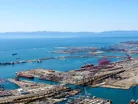
Clearly, ports are at the centre of trade and supply chains, which represent critical infrastructure ensuring commerce can move freely.
J.P. Morgan assesses how, as the geopolitical climate becomes more unstable, ports must upgrade their infrastructure in order to meet trade needs.
Increased needs for increased trade
Naturally, as more and more organisations expand, the volume of global trade increases dramatically.

In 2024, global trade was valued at US$33tn, with more than 70% by value in maritime transport. In fact, 80% of global trade is transported by sea when measured by volume of goods.
Trade bottlenecks, such as the Suez Canal and Strait of Malacca, form critical trade infrastructure for refuelling, repairs or swapping out containers.
The Organisation for Economic Cooperation and Development estimate maritime trade will more than double by 2050, meaning ports need to grow in scale in order to cope with demand.
- Investment in the efficiency of containers
- Technology to lower the area per container
- Building out hard infrastructure to expand ports footprint
Potential risks
A significant majority (80%) of ports are annually exposed to flooding, whereas ports in the US Gulf Coast and Southeast Asia are vulnerable to hurricanes and typhoons.
According to the study, “a single 300-mile-wide hurricane/typhoon can cause damage across multiple ports at once with wind damage, saltwater storm surge and rain and riverine induced flooding". Such an event would devastate trade, resulting in huge financial losses and severely disrupt global supply chains.
J.P. Morgan states that, as sea levels rise, port infrastructure will find itself damaged by floodwaters from storms and typhoons.
The report says: “The total estimated investment required globally for port adaptation to sea-level rise is US$223bn to US$768bn by 2050.”
Geopolitical uncertainty, such as tariff changes or war, greatly affect trade going into and coming out of ports. When containers are dwelling – stalling at a location rather than at a port – port capacity gets reduced and efficiency diminishes dramatically.
If one or several major ports are disrupted through instability, the world will see huge ripple effects throughout the supply chain.
For example, in 2021, when the Suez Canal was blocked, more than 200 vessels were halted in their movements, resulting in them carrying a total of approximately 16.9 million tonnes of deadweight.
This crisis alone cost shipping company Maersk nearly US$89m, according to reports.
Port planning strategies
The report finds that most ports have favoured climate mitigation (reducing greenhouse gas emissions) rather than climate adaptation when it comes to global spending.
31 out of 35 of the largest ports have developed mitigation plans, whereas only 23 have developed adaptation plans.
This means funding is going towards building sustainable infrastructure that reduces environmental impact, rather than building infrastructure which prepares for issues.
As sea levels continue to rise, some ports are finding themselves at risk of being underwater.
If this occurs, global trade will be majorly disrupted, as items will have to be shipped elsewhere to be flown in, or alternative measures will have to be taken.
As demand for global trade increases, ports must prepare for all risks and environments.
As 80% of trade is dependent on the efficient running of ports, any issues they face can be devastating for trade.
J.P.Morgan points out the risks and the predictions of the future of ports, so individual ports must make the appropriate steps to ensure they remain reliable when faced with uncertainty.
To minimise breakdowns in a supply chain, and to ensure efficient global trade, ports around the world must prepare for expansion and disruption.