Applied Materials Turns to Suppliers in Net-Zero Plan
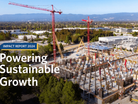
Applied Materials (Applied), the US-based semiconductor manufacturer, positions supply chain front and centre in its 2024 Impact Report by treating supplier emissions not as a footnote but a core element of its net-zero pathway.
With operations in 24 countries and more than 35,000 employees, Applied is a major player in semiconductor manufacturing worldwide.
Its tools are used across the global semiconductor industry, meaning the environmental performance of its supply chain affects far more than just its own business.
This is a company keenly aware that it cannot meet its sustainability goals without pulling its suppliers along with it.
Suppliers step up on carbon data and targets
According to the report, Applied’s supply chain accounts for about 10% of the firm’s total carbon footprint.
But the report insists its role in transforming the industry’s footprint is “exponentially greater since our supply chain partners also supply our customers and peers”.
As part of its SuCCESS2030 programme – a 10-year roadmap for improving environmental and social performance across its supplier base – Applied surveys its top 80%-spend suppliers every year. These are the companies that provide the bulk of its materials and components.
In 2024, 183 suppliers responded to the survey. Of those, 109 provided detailed Scope 1 and 2 emissions data from their sites. More than half (97) reported greenhouse gas reduction targets, and 23 had science-based targets approved.
This level of transparency is helping Applied shape targeted climate action plans for its partners.
The report says: “Applied continues to collaborate with suppliers, using their provided survey data, to help them create emissions-reduction plans. We also engage a third party to help them calculate their emissions data.
“In 2024, we began one-on-one conversations with our major suppliers to discuss our net zero aspirations and review their ability to transition their facility and suppliers to renewable energy.”
That kind of close contact reflects a shift from generic questionnaires to tailored conversations.
The focus now is on practical support – helping suppliers source renewable energy, build reporting capability and align with Applied’s own emissions targets.

Supply chain influence goes beyond emissions totals
Applied sees its role as extending far beyond its 10% share of the carbon footprint. The company argues its suppliers’ behaviour influences others in the industry. In that sense, Applied acts as a multiplier – driving broader change through its own procurement decisions.
The 2024 report also shows how supplier data feeds into broader reporting and planning. All this information is now shaping the company's updated Net Zero 2040 Playbook, which outlines emissions projections and action plans for the coming years.
Progress is already visible in the company's Scope 3 numbers. These cover indirect emissions not just from suppliers, but also from how Applied’s tools are used once sold.
Specifically, the report notes a 27% decrease in Scope 3 Category 11 emissions—those linked to the energy use of its semiconductor products—per US$1m of gross profit, compared with the 2019 baseline.
Chris Librie, Chief Sustainability Officer at Applied, writes: “I’m pleased to share that Applied Materials has published our 2024 Impact Report detailing great progress in reducing our Scope 3 emissions (down 24% since 2022), controlling our Scopes 1 and 2 emissions in spite of business growth and continuing to invest in the communities where we operate.
"We are transforming the future of technology innovation while we anchor purpose at the heart of our business strategy.”
Building a net-zero supply chain for the chip sector
The 2024 Impact Report also confirms Applied’s continued investment in renewable energy.
Across the company, 73% of electricity now comes from renewables, including 100% in the US. But it’s clear that the real energy shift will need to happen inside its supplier network, especially in Asia, where many production facilities are based.
New energy initiatives, from on-site solar installations to renewable sourcing conversations, are increasingly part of supplier dialogues. Applied’s focus now is on accelerating that change and backing it with data.
- US$3.2bn R&D investment
- US$27.2bn revenue
- 35,700 employees in 207 cities, 24 countries
- More than 20,000 patents
Chief Executive Gary E. Dickerson sets the tone in his foreword to the 2024 Impact Report: “Tectonic shifts in technology are reshaping our lives and the global economy. Transformative innovations, like artificial intelligence and the internet of things, have near-infinite potential and we’re only beginning to explore what’s possible. Semiconductors are the foundation of these technological megatrends.
“To scale breakthrough innovations, our industry must confront the environmental and social impacts associated with the exponential advancement of these data-intensive applications. In short, we must drive sustainable growth across our entire ecosystem.
"As the world’s leading semiconductor and display equipment company, Applied is uniquely positioned to accelerate our industry’s roadmap and enable more energy-efficient computing.”
That ambition hinges on more than internal energy savings. It requires supplier cooperation, shared data, aligned targets and joint accountability. Applied's net-zero future, it turns out, may be built just as much in the supply chain as in its own facilities.