
Inside the Supply Chain Management Forum at PSC LIVE
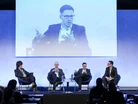
The roles within supply chain and procurement have shifted dramatically over the last few years, moving away from cost savings and efficiency to building long-term resilience plans which support total business growth.
Supply chain management (SCM) is the end-to-end process of planning, sourcing and delivering goods to final consumers. It merges all the most important supply chain functions within a company's strategy in order to unlock value.
Supply chain leaders came together to discuss the future of sustainable SCM at Procurement & Supply Chain LIVE: The Net Zero Summit.

Proactive strategy shifts
Supply chain management was once a back-office function, operating as a cost-focused, manual and fragmented function. Now, it is a cohesive, agile ecosystem, demonstrating end-to-end visibility, agility and resilience. Due to ongoing volatility across the world, supply chains have become more data-driven and flexible in order to predict, rather than respond to, risk.
It has become an AI-powered network, focusing on sustainability and collaboration in order to create a unified system and remain unshakeable during turbulence. Ongoing instability has highlighted the need for more strategic supply chain operations, resulting in the changing of roles and the shifting priorities across procurement and supply chain leadership.
Now, leaders understand that it is not enough to react to instability, but rather it is necessary to predict it. Facing ongoing geopolitical crises, supply chain management is now a proactive attack rather than a reactive defense.
At Procurement & Supply Chain LIVE: The Net Zero Summit, leaders took to The Supply Chain Management (SCM) Forum, where they discussed the best way to balance resilience and impact while ensuring business growth.
"Everything used to be optimised in this belief that we could chase stability," says James Moffatt, Director at Baringa.
"The idea was always there's these small variations that happen, but supply chain leaders were aiming for stability to build off. Now it's impossible to get that stability. There's too many things that change. The complexity is too high, like the geopolitical things that go on – the events outside of our control are changing what happens.
"The main thing that I see change is supply chain leaders have gone from being people that are trying to create stability to people that now have to bring predictability, then work out what to do in the event things go wrong rather than trying to stop things there."
Increasing collaboration
Supply chains are often global networks, spanning across several countries with many different components to it. This puts them at risk of fragmentation and risk of vulnerabilities. An event in one country can have devastating impacts on the rest of the world, even if the event itself does not breach the borders.
Whether its a climate event having an impact on agriculture, or trade wars impacting the prices of manufacturing, seemingly singular events often have a much wider scope. The events of the last few years has therefore brought about more communication and collaboration across every step of the supply chain, recognising where resilience can be formed.
"Supply chain has been in the news now more than ever because it used to be a back office job that no one took much notice of, until we had Brexit and the pandemic," reflects Alex Johnson, Chief Transformation Officer at Clinigen.
"With that, we realised that, actually it's the trucks on the road and all the complexities, sustainability and that blend as well around how do we keep shops open, maintain the food we want to eat and so on. But it's about change.
"I spend a lot of time with my team developing them to be change agents. So I want them to be confident in problem solving, particularly when businesses change every few years."
Technological implementation
As supply chain management has therefore become a more visible role within a business operations, companies are adapting their strategies and welcoming more technology. Supply chain management has evolved into a more company-shaping feature, meaning the demand and the pressure procurement and supply chain leaders are facing has increased dramatically.
This realisation has driven the implementation of technology across procurement and supply chain functions. It is being implemented in various ways across company operations, whether through digital twins, predictive analytics or automation.
"For us, it's productivity," explains Scott Corboy, Regional Director of AtkinsRéalis.
"What's it freeing people up to do? Can it help with the planning to get people closer to more valuable activities and the execution stage, or even getting closer to their supply chain partners who are the experts in what they do, unlocking the innovations and the value they can bring.
"But also traceability, understanding where your products are really coming from, which is important and obviously supports the conversation around scope 3 emissions.
"I think for us really it's what we're trying to do in our industry, we're trying to make people safer, we're trying to get things done quicker, we're trying to be more efficient and we're trying to unlock value and so that's ultimately what we're looking for."
Effective SCM is now about optimising a global supply chain network, through sustainable procurement, strong supplier relationships, the implementation of moderns technology and operational transparency. For businesses to build resilience, they need this ability to merge efficiency with sustainability and collaboration.
Company portals




Executives

Alex Johnson
Chief Transformation Officer

James Moffatt
Director

Scott Corboy
Regional Director