Heineken Italia Boosts Water Resilience in Supply Chains
Italy is facing growing water stress as climate change reduces freshwater availability and places greater pressure on businesses, agriculture and local communities.
In Puglia, one of the country’s hardest-hit regions, declining reservoir levels have highlighted the need for long-term water resilience strategies to protect both local livelihoods and national supply chains.
The European Commission (EC) states that Italy experienced 3,192 extreme weather events in 2022, underlining how climate volatility is now a structural risk to production networks.
Heineken Italia is responding with an initiative designed to protect local water resources while supporting agriculture and industrial output in its beverage value chain.
The project reflects a wider shift in procurement and manufacturing towards strengthening supply chains by improving the sustainability of the natural resources they depend on.
Restoring water security for production
According to the EC, more than 40% of Italy’s public water supply is lost due to leaks in the system, which increases pressure on aquifers that underpin agricultural and food production.
Heineken Italia has partnered with the Regional Agency for Irrigation and Forestry Activities (ARIF) to launch the Valore Acqua project in Massafra, home to one of the brewer’s four Italian breweries and a key node in its national distribution network.
The initiative aims to reduce pressure on the Murgia aquifer, one of southern Italy’s most important freshwater reserves, by restoring existing water infrastructure and increasing the use of surface water for agriculture that feeds into beverage and food supply chains.
- Italy experienced 3,192 extreme weather events in 2022, with droughts costing up to €9bn (US$10.3bn) annually.
- More than 40% of Italy’s public water supply is lost through leaks, increasing pressure on key aquifers such as the Murgia aquifer.
- Heineken Italia’s Valore Acqua project in Puglia will reactivate a 10,000m³ storage tank linked to the Bradano River and San Giuliano dam to support local agriculture.
- The initiative is expected to deliver an annual water benefit of 318,000m³, strengthening resilience for farms that supply ingredients like barley.
- Since 2010, Heineken Italia has reduced brewery water use per litre of beer by around 60%, from seven litres to 2.9 litres.
The project is set to reactivate an unused 10,000m³ storage tank connected to the Bradano River and the San Giuliano dam, improving regional water logistics and storage capacity that support upstream farming.
“For Heineken Italy, sustainability is a strategic lever that guides our way of doing business and creating long-term value,” says Alexander Koch, Chief Executive Officer of Heineken Italy.
“Protecting natural resources and water in particular, is a responsibility that goes beyond the confines of our breweries and requires an approach based on innovation, collaboration and a long-term vision.
“With the ‘Valore Acqua’ project, we want to help build greater resilience in the communities in which we operate and confirm our desire to generate a positive and shared impact on communities, the environment and the production system.”
Once operational, the system will distribute surface water to agricultural land in Contrada Borgo Perrone, reducing groundwater abstraction and helping safeguard the aquifer against further depletion and saline intrusion that can undermine crop reliability.
“Italy consumes a high amount of water, 25% above the EU average,” says the EC, highlighting the importance of efficient water management for supply chain stability.
Completion is expected during the first quarter of 2028 before testing and certification begin, giving local partners a clear timeline to plan for more resilient sourcing and production.
Supporting sustainable agriculture and inputs
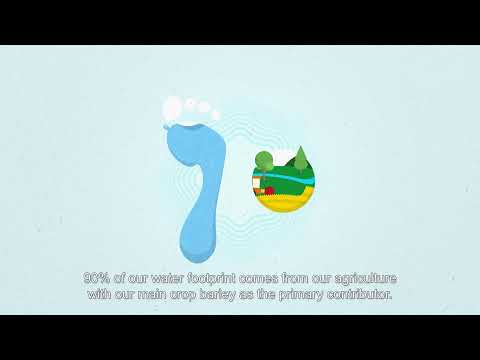
Agriculture represents the largest share of Heineken’s overall water footprint, making resilient farming systems essential for both environmental protection and business continuity across its global supply chain.
By replacing groundwater withdrawals with existing surface water resources, the Valore Acqua project is expected to generate an annual water benefit of 318,000m³, equivalent to almost 130 Olympic-sized swimming pools, strengthening the reliability of agricultural inputs.
The additional water availability is expected to strengthen the resilience of local farms, improve irrigation reliability and reduce the risk of soil salinisation, all of which directly affect yields for key ingredients such as barley.
“Valore Acqua represents a concrete example of how collaboration between businesses and institutions can develop solutions capable of strengthening the water resilience of local areas,” says Leo Gasparri, Sustainability Manager of Heineken Italy.
“The goal of this initiative, which we developed together with ARIF, is to help increase the overall availability of water at the local level, thus generating a shared water benefit that involves communities, agriculture and ecosystems.
“We hope that this project will become a positive example in other Italian contexts called upon to address the challenges posed by climate change and the growing scarcity of water resources.”
These outcomes support not only farming communities but also the wider beverage supply chain by helping secure the production of key ingredients such as barley while reducing climate-related risks to agricultural output and procurement.
As droughts become more frequent across southern Europe, improving water efficiency within supply chains is becoming an increasingly important sustainability priority for manufacturers and retailers.
According to the EC, droughts can cost up to €9bn (US$10.3bn) annually, which can translate into significant disruption and cost volatility across European supply chains.
Building water stewardship beyond breweries
The project forms part of Heineken’s wider global water strategy, which focuses on reducing water use in production, restoring water resources in communities and improving water stewardship throughout its agricultural supply chain.
Since 2010, Heineken Italia has reduced the amount of water required to produce beer by 60%, lowering consumption from seven litres of water per litre of beer to 2.9 litres, which improves operational efficiency and resource productivity in its plants.
Water is an essential resource for people, the planet, agriculture and of course for our business.
Globally, the company has strengthened its 2030 targets by aiming to reduce average water use to 2.6 hectolitres per hectolitre of beer produced worldwide and 2.4 hectolitres in water-stressed locations, aligning production practices with local watershed conditions.
Water scarcity affects 30% of Europeans and 20% of land each year, states the EC, increasing physical and regulatory risks for supply chains dependent on water-intensive agriculture and processing.
Heineken also plans to fully balance the water used in its products in water-stressed areas by returning 1.5 litres of water for every litre of beer produced through watershed restoration, irrigation improvements, wetland restoration and reforestation projects that benefit local catchments.
“Water is an essential resource for people, the planet, agriculture and of course for our business,” writes Simon Henzell-Thomas, Global Sustainability Director, The Heineken Company.
“Through the recovery of existing infrastructure and the enhancement of already available water resources, the project aims to replenish up to 318,000 m³ of water per year, benefiting local agriculture and the community.
“We know that water-related challenges can be tackled by building solid partnerships and working together with local stakeholders.
“Since 2010, Heineken Italy has reduced water consumption - per hectolitre of beer produced in our breweries - by around 60%.”
Alongside operational improvements, Heineken is targeting 100% sustainably sourced barley and hops by 2030 using the Sustainable Agriculture Initiative Platform’s Farm Sustainability Assessment, embedding responsible water management standards at farm level.
The programme encourages responsible water management across farms, reinforcing the resilience of agricultural supply chains while supporting broader biodiversity, soil health and climate adaptation goals that are increasingly important to supply chain leaders.
Company portals
Executives
Alexander Koch
CEO of Heineken Italy

Leo Gasparri
Sustainability Manager of Heineken Italy
Simon Henzell-Thomas
Global Sustainability Director