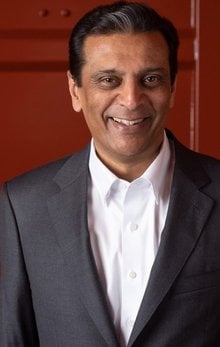
Inside FedEx CEO Raj Subramaniam's AI Strategy for Logistics

The integration of humanoid robotics into industrial environments has shifted from a theoretical concept to a potential reality as AI advances.
AI is taking automated supply chain processes to the next level. For logistics leaders, this evolution could represent a significant shift in how warehouses are staffed and operated.
Elon Musk, the multi-Chief Executive of Tesla, xAI and SpaceX, has spoken about how advancements of humanoid robots may take away the need for a human workforce altogether.
He shared this with investor Nikhil Kamath in December 2024: “In a future where anyone can have anything, you no longer need money as a database for labour allocation.
“If AI and robotics are big enough to satisfy all human needs, then the relevance of money declines rapidly, I’m not sure we will have it.”
While Musk discusses the broader economic implications of labour, FedEx Chief Executive Officer Raj Subramaniam believes that advancement of humanoid robots is already needed to keep up with the consumer demand of his company.

The focus for Raj sits firmly on addressing immediate logistical constraints through advanced automation.
In an interview with The New York Times on 18 January 2025, in which he discussed automating the delivery process, Raj says: “Truck unloading and truck loading are a very difficult problem for robotics to solve - packages come in every size, shape and weight.
“We’re not looking for humanoid robots – we’re looking for super humanoid robots, because maybe they need to have a couple of elbows. More degrees of freedom.”
Adding that he understands automation has a long way to go, the CEO adds: “We’re in the pilot stage. It is not ready for prime time yet.”
Addressing complex logistics constraints
Under the leadership of Raj, FedEx is pursuing an AI-native strategy aimed at transforming its vast, 50-year-old logistics network into a more agile, data-driven and “smart” operation.
This strategy prioritises the optimisation of warehouse functions and network fluidity. This includes the AI-powered robots, such as those from Dexterity AI, which are deployed in hubs to handle sorting and loading.
They are increasing trailer utilisation by up to 13% and sorting accuracy to over 99%. These statistics serve as indicators of how automation could mitigate inefficiencies within the middle mile of the supply chain.
Alongside this, the firm uses machine learning to analyse traffic, weather and logistical constraints in real time, reducing delivery times by up to 20%.
“We move 17 million packages per day through the global system,” Raj adds. “That generates multiple petabytes of data. We realised that the data is valuable in its own right.”
All supply chain, sustainability, Scope 3 and net zero leaders should attend:
- Procurement and Supply Chain LIVE: The Net Zero Summit - QEII Centre, London, March 4-5
- Procurement and Supply Chain LIVE: The US Summit - Navy Pier, Chicago, April 21-22
Co-located with Sustainability LIVE, these events brings together CSCOs, CSOs and senior decision-makers at a moment when sustainability, supply chains and commercial performance are increasingly interconnected.
Tickets can be booked online today for The Net Zero Summit and The US Summit. Group discounts available.
Leveraging data for optimisation
The accumulation of data across such a wide logistics network provides the necessary foundation for high-level supply chain visibility.
According to Raj, the efficacy of AI applications is entirely dependent on the quality and organisation of this input data.
Discussing the importance of AI, he says: “The fuel for AI is data. If you don’t have your data appropriately organised, then there are limits of what you can do with it.
“We’re using AI to make supply chains smarter for everyone. We can now say with more and more precision when that package is going to arrive.”
This focus on precision allows for better predictability within the supply chain, potentially reducing the friction often associated with last-mile delivery.
Unifying the logistics network
Since taking over as President and Chief Executive Officer of FedEx in June 2022, Raj has spearheaded a major, multi-year transformation strategy.
This strategy is designed to shift the company from a “growth at all costs” model to one focused on efficiency, profitability and consolidation.
He is merging the distinct FedEx Express, Ground and Freight businesses into a single unified organisation. This consolidation effort is designed to streamline operations and remove silos that often hinder supply chain performance.
This aims to eliminate redundant facilities, stop sending redundant trucks to the same neighbourhoods, and by 2027, save an estimated US$12 bn a year.
Faced with declining revenue and high inflation, he also initiated a US$4 bn cost-cutting plan. This has included restructuring, reducing structural costs and focusing on profitable residential deliveries rather than just volume.
Raj is continuing this approach to growth by taking steps with AI-led automation, acknowledging that its development also has progress to make in order to further automate supply chains.
Company portals

Executives

Elon Musk
Tesla CEO
Raj Subramaniam
President, CEO, and member of the Board of Directors