Inside BITZER & SAP's Supply Chain Efficiency AI Pilot
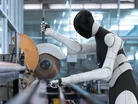
BITZER and SAP are working together to deliver health, safety and comfort to customers around the world with new AI project.
Under its Project Embodied AI plans, the partnership is prioritising AI optimisation and integration, in order to revolutionise intelligent automation across warehouses.
Through this, warehouse operations are more efficiency and seamless, enabling businesses to meet demand and reduce errors.

Supply chain innovation
BITZER is a specialist for refrigeration and air conditioning manufacturing, working to ensure the optimal temperature condition is met for goods across industries. Its solutions help companies around the world operate, whether guiding comfort, safety or health. BITZER technologies help maintain the correct temperatures across hospital operating theatres, supermarket shelves and hotel rooms.
Moreover, its compressors are vital for the storing of medication, preserving perishable goods in shipping containers and processing frozen foods. Without them, cold chains would be broken and much more vital goods would be wasted every year.
BITZER is a RISE with SAP customer, using its subscription-based offering to undergo transition into the cloud, gaining access to SAP technology systems and solutions. SAP is a multinational software company, providing software solutions to help businesses undergo operational transformation, increasing their efficiency across the company through digitalisation.
The two companies are consistently undergoing innovation and BITZER's current priority is the integration and adoption of AI.
Discussing its vision of an SAP strategy to increase digitalisation, Christian Stenzel, Vice President of Organisation and IT at BITZER says: "Optimising business processes is as important as product innovation at BITZER.”
AI for efficiency
Under Project Embodied AI, the SAP Research and Innovation team is exploring new technologies and is committed to innovation. The project blends artificial intelligence (AI) with a physical form - like robots - which then use real-time data to work in the real world. The project then takes this integration further, making robots cognitive with SAP Business AI.
To tests its capabilities, exploring where these robots can be of value, the Project Embodied AI team formed a Physical AI and Cognitive Robots Exploration Council, made up of innovation professionals, including BITZER.
Upon joining the council and seeing the value in these robots, Christian added: “Demand-driven production is key in our business."
By creating these new AI-driven robots, operating capacity is sure to grow, allowing for more production to occur and demand to be met at a faster pace. BITZER already uses the SAP Business Technology Platform and SAP Extended Warehouse Management, meaning it had the capabilities to become the proof-of-concept test ground for these Embodied AI bots.
“The proof of concept at BITZER is great first step for experiencing first-hand how the impact of SAP Business AI can be extended into physical operations," explains Dr Lukasz Ostrowski, Head of Embodied AI and Robotics at SAP.
"Further proofs of concept are planned as Project Embodied AI continues to assess the business value of embodied AI for customers.”
Trial results
The proof of concept demonstrated a new level of value for intelligent automation across warehouses. Deploying NEURA's 4NE1 humanoid robot, the trial revealed:
- Seamless integration - SAP EWM was able to connect directly with physical warehouse operations, without the need for expensive or time-consuming middleware
- True autonomy - There was a great level of independence when robots were performing tasks, meaning there was no requirement for manual or human involvement
- Agility and flexibility - The robots can operate 24/7 in order to adapt to demand and meet high expectations, due to their ability to enable demand-driven production
- Reliable processes - Operational mistakes were shown to be minimised as orders of materials were automatically created
Through these robots, warehousing can be much more efficient, meaning a reduction of warehouse bottlenecks. As these robots can work manually and across different shifts, demand can be met to a higher degree. In businesses such as BITZER, which are needed for seamless cold chain work, this timely warehouse efficiency is much needed.
Company portals



Executives
Christian Stenzel
Vice President Corporate Organization and IT
Dr. Lukasz Ostrowski
Development Manager at SAP Research & Innovation