Why China is Accusing the US of Tariff 'Double Standards'
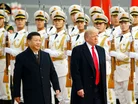
Bidding once again to boost domestic manufacturing and level the playing field with trading partners, US President Donald Trump has threatened an additional 100% tariff on Chinese goods.
In response, the Chinese government has accused the US of "double standards" and threatened its own countermeasures.
Failure to reach an agreement could lead to a potentially-damaging trade war, impacting thousands of global supply chains.
US-China tension
China is putting more controls on rare earth and other critical materials as it continues trade negotiations with the US. Around 90% of the world's rare earth minerals are processed by China.
Rare earths are a group of 17 elements which are hard to find in a pure form and difficult to extract. Despite this, they are used in everything from solar panels to smartphones, making them critical in today's world.
Neodymium, for example, is a rare earth mineral. It is used to make the magnets in loudspeakers, electric car motors and computer hard drives.
Beijing's latest announcement formalises restrictions on processing technology and unauthorised overseas co-operation. Foreign nations must now gain approval from the Chinese government before they can export products that include any amount of rare earths.
They must also explain what they will be used for as an extra authorisation measure. This, Beijing said, is designed to safeguard Chinese national security.
Overseas defence manufacturers, including the US, appear to be among those targeted by the rulings due to their reliance on rare earths.
The International Energy Agency (IEA) estimates that around 61% of rare earth production takes place in China, as does 92% of the processing.
Falling trust and falling shares
President Trump has, unsurprisingly, hit back by threatening to impose an additional 100% tariff on imports from China, as well as implementing export controls on critical software. He took to social media to claim China was "becoming very hostile".
His remarks shifted financial markets, with the S&P 500 share index closing down 2.7% on Friday (10 October) – its steepest fall since April. Meanwhile, the Shenzhen Component Index – the main stock index in the Shenzhen Stock Exchange – was down by more than 2.5%, while Hong Kong's Hang Seng was approximately 3.5% lower.
Experts have warned that, without a resolution, the S&P 500 is at risk of an 11% drop.
Days later, Trump followed up on social media by saying "don't worry about China, it will all be fine!"
He added: "Highly respected President Xi just had a bad moment. He doesn't want Depression for his country, and neither do I. The U.S.A. wants to help China, not hurt it!!!"
Following initial concerns over a US-China trade war earlier this year, an agreement was reached to drop triple-digit tariffs on each nations' goods back in May, but many economists fear that agreement is now at risk.
An end to the truce?
President Trump and President Xi are due to meet later this month, but, amid ongoing tension, it remains to be seen whether this will go ahead as planned.
Trump's proposed 100% levies on Chinese products would kick off from 1 November, ending a carefully-constructed truce.
The Chinese commerce ministry criticised Trump's tariff threat as a "double standard" and defended its own export controls. A spokesperson for China said the US had long "overstretched the concept of national security, abused export control measures" and "adopted discriminatory practices against China".
They added: "Resorting to tariff threats is not the right way to engage with China. China's position on a tariff war has always been consistent: we do not want one, but we are not afraid of one."
The constant back-and-forth between China and the US continues to strain relations.
A full-blown trade war would inevitably impact global trade and supply chains touching all corners of the world.