Boston Dynamics: Automating Supply Chains with AI Robots
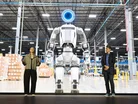
Hyundai Motor Group's ambitious rollout of Boston Dynamics' humanoid AI robot Atlas could signal a transformative shift in automotive supply chain operations, with the manufacturer planning factory deployment from 2028.
The announcement, made by Hyundai at the Consumer Electronics Show (CES) in Las Vegas, US, outlines how cutting-edge robotics might reshape manufacturing logistics and production workflows across Hyundai's global network.
The initiative centres on establishing a production system capable of manufacturing 30,000 robot units annually by 2028, supported by strategic partnerships with Google DeepMind and NVIDIA. This infrastructure aims to create an end-to-end AI robotics value chain that could fundamentally alter how components move through Hyundai's manufacturing facilities.
Supply chain integration strategy
Hyundai's approach to robotics deployment focuses heavily on supply chain optimisation across its Group affiliates. The company is building what it describes as a Group Value Network, with specific logistics responsibilities assigned to different entities within the organisation.
Hyundai Glovis will take the lead on optimising logistics and supply chain management to ensure efficient delivery of robotic systems, while Hyundai Mobis will develop high-performance actuators and standardise key components. This division of labour could streamline the distribution and maintenance of robotics technology across Hyundai's manufacturing footprint.
The integration strategy relies on coordinating multiple business units to create a seamless robotics ecosystem. Each affiliate brings specialised capabilities that support different aspects of the robotics value chain, from component manufacturing to logistics distribution. This coordinated approach aims to reduce implementation costs and accelerate deployment timelines across Hyundai's global manufacturing network.
According to Hyundai, the Group has a unique advantage in extending its electrification value chain and leveraging its supply chain capabilities to support this robotics rollout.

Atlas deployment in manufacturing
Boston Dynamics' Atlas robot features 56 degrees of freedom, most with fully rotational joints, and human-scale hands with tactile sensing. The robot can perform precision tasks and lift up to 50 kg, making it suitable for various supply chain applications within factory settings.
Initial deployment from 2028 will target processes with proven safety and quality benefits, such as parts sequencing, a critical function in automotive supply chains where components must be organised and delivered to assembly lines in precise order.
Zachary Jackowski, Vice President and General Manager of Atlas at Boston Dynamics, says: "The convergence of robotics and AI represents more than a technological advancement. It is a transformative innovation that will make human life safer and more enriching.
"By combining capabilities of Boston Dynamics and Google DeepMind through this strategic partnership, we are taking a significant step toward redefining the future paradigm of the industry."
By 2030, Hyundai expects Atlas' applications to extend to component assembly and tasks involving repetitive motions and heavy loads—functions that could significantly impact throughput and efficiency in manufacturing supply chains.
Robotics-as-a-Service model expansion
Hyundai's strategy extends beyond internal manufacturing to encompass Robotics-as-a-Service (RaaS) offerings, transitioning robotics from one-time sales into flexible, ongoing services delivered through subscription plans. This model has already been deployed with major logistics operators including DHL, Nestlé and Maersk.
Boston Dynamics' existing robots demonstrate the potential for supply chain applications. Spot, a quadruped robot, is operational in more than 40 countries performing tasks like data collection and safety monitoring. Stretch, a warehouse robot, has unloaded more than 20 million boxes globally since its launch in 2023.
Carolina Parada, Senior Director of Robotics at Google DeepMind, says: "We are excited to begin working with the Boston Dynamics team to explore what's possible with their new Atlas robot as we develop new models to expand the impact of robotics, and to scale robots safely and efficiently."
NVIDIA's AI infrastructure, simulation libraries and frameworks will be used across the Group by affiliates including Hyundai Motor Company, Kia Corporation and Hyundai Mobis Company, alongside Boston Dynamics' strategic partnership with Google DeepMind. Software-defined factories and a Robot Metaplant Application Center will be used to teach the robots with real-world production data and safety for human-robot collaboration.
The Group has announced an US$86bn investment in Korea over five years and a US$26bn investment in the US, both aimed at advancing robotics powered by AI technologies—investments that could reshape automotive supply chain infrastructure on a global scale.





Executives
Carolina Parada
Senior Director and Head of Robotics
Zachary Jackowski
General Manager - Atlas