
AI-Powered Demand Intelligence with Zebra Technologies

Parth Thakker leads Demand Intelligence at Zebra Technologies, overseeing commercial and go-to-market functions including sales, customer success and solution consulting.
He joined Zebra through its acquisition of antuit.ai, where he was among the earliest employees in 2015 and later ran global sales as the startup pioneered AI-driven inventory decisioning for retail, manufacturing and consumer packaged goods.
Originally trained as an engineer, Parth began his career in aerospace as an electrical engineer on complex programmes that showed how technology can transform outcomes.
After earning an MBA from New York University, he moved into sales to combine technical depth with strategic, customer-focused leadership.
Over 15 years, Parth has helped organisations tackle complex supply chain and merchandising challenges. He treats sales as partnership, focused on measurable outcomes and solutions that make a tangible difference for customers.
At Zebra, a global market leader in printing, scanning and mobile computing, Parth’s vision centres on connection, intelligence and innovation.
“We look to empower the frontline across a variety of industries – whether retail, manufacturing or healthcare – centred around automation and digitisation at the edge,” he says.
Since joining, he has seen Zebra evolve “into more of a solution organisation, really embracing the power of artificial intelligence – first predictive, prescriptive and now generative and agentic AI in each and every one of our solution offerings.”
“We are now helping our customers be more focused on solving an outcome rather than a piece-point siloed solution,” he explains.
Within Zebra’s inventory and supply chain ecosystem, Parth oversees solutions that manage “the two biggest assets an organisation has: its people and its inventory”, advancing technologies that “track inventory from a supply chain plan, source, make, deliver in that ecosystem”.
“At Zebra, we aim to connect upstream supply chain planning decisions with downstream execution decisions – whether in a warehouse, distribution centre, or retail store,” he adds.
What are the biggest challenges you face in your role?
I think it’s important to understand why our roles exist and why we’re here, essentially to help support our customers and make those lives somewhat less complex. You have so many complexities in a global supply chain today.
You have ever-evolving consumer demand behaviour changes. How do you then ensure you put your best foot forward every day in solving those challenges for your customers?
I think for me that’s a couple of different things. Number one, say stay hyper-focused and relevant in addressing what is critical or top of mind for that customer. But more importantly, how do you stay on topic?
If you think through what’s unique and what is important to those customers, as well as to myself, it’s how do you always come with something new, something credible and essentially be able to learn and share those learnings and network across so that there is a network effect around what you are bringing to the table.
Could you share a specific moment when Zebra’s solutions helped a customer recover from a disruption?
We have worked with Bimbo Bakeries USA for quite a few years, I think we’re at eight years now. They’re the world’s largest bread baking company.
The journey with Bimbo was interesting. They embarked on an initiative with a consulting company to reduce waste by forecasting better: how much spoilage could they reduce?
There’s a double bottom line here: the top line is to forecast the demand of bread that hits grocery shelves accurately so when you shop, the loaf is there. But you don’t want to overproduce because bread has a short shelf life; if it sits on the shelf and no one buys it, it spoils and becomes wasted food.
That was a great success story helping Bimbo get the accuracy correct on what inventory to keep where as well as optimising waste reduction. Today, they’re looked at as the gold standard in the industry around forecast accuracy and reduction of spoilage waste.
How do you reflect on the balance between remaining agile and remaining resilient in today’s climate?
Many supply chains I’ve spoken with do not see it as a trade-off or an either/or but an “and.” We’ve seen more disruption over the past five to 10 years than anyone could have predicted. Black Swan events are no longer considered Black Swan in the supply chain.
I’m also proud to say supply chain is a cool and sexy career now. I grew up not knowing what supply chain was until my first job needed me to understand global supply chain complexities in aerospace engineering. Today, my children, who are in grade school, know about global supply chains due to shortages during the pandemic, the Suez Canal issues, tariffs and changes in retailer and manufacturer ordering from overseas.
You have to be agile to react to shifts but also plan for resiliency—understanding risks and mitigating them. The best supply chains I admire are able to do both and no longer see it as balancing a fine line but a must between both.
Are there particular people, processes or technologies you believe are essential to remaining resilient?
I’m a big believer in processes and people. You need the right processes for both agility and response, plus mechanisms to handle risk in your supply chain. The processes determine the people, knowledge, skills and empower them to make decisions when situations arise. You don’t want to have a process without empowered people.
From a technology standpoint, the best supply chains I’ve seen have implemented some sort of digital twin. A digital twin helps simulate scenarios, aids rapid decision-making instead of waiting weeks for answers. For example, modelling demand fluctuations as risks and deciding next best options quickly.
It’s a balance of all three, but you have to start with processes and people, then have the right tools and technology to support those people and processes.
Has Zebra learned any lessons from supporting organisations as they rethink their strategies?
We worked with a large global food and beverage manufacturer that came to us with capacity constraints issues. They had shelves bare in their category at one point. Our solution, while robust, didn’t initially meet their specific needs around dynamically prioritising orders to ensure equitable on-shelf availability with retailers or end customers.
The keyword is equitable. Many tools optimise for a KPI or cost, but equitable was key here. Within four or five months, we piloted with that customer. Today, they use our solution dynamically to promise orders across the US and Canada, with a 95% “no touch” rate, meaning minimal human interaction, freeing them to focus on higher value strategic initiatives rather than firefighting missed orders.
How is Zebra embedding AI within its platform?
Zebra has always been an AI solution company.
Look at our capabilities in machine vision, optical character recognition, barcode scanning. More recently, through our acquisition of antuit.ai, plus a few other acquisitions, we’re moving from foundational AI to transformational AI across enterprise businesses.
Most recently, Zebra had its first annual AI summit a few weeks ago in Nashville, Tennessee. We brought leaders from our customer portfolio, discussing how organisations - leading retailers, manufacturers, healthcare, consumer packaged goods companies - can leverage Zebra’s AI portfolio to transform operations.
It was a great event with around a hundred attendees.
The dialogue focused on lessons learned, knowledge sharing, talks from industry leaders and how Zebra is addressing these industry themes.

Do you have advice for other supply chain leaders?
Yes, it’s okay not to conduct a full, detailed analysis before setting up new processes or buying technology. I believe in small, short bets or pilots that demonstrate value and can be scaled.
I read a great MIT study that 95% of organisations have launched some AI pilot, whether generative AI, agent AI or predictive AI, which we see as core to supply chain optimisation.
It’s okay to fail but important to take small bets, identify and structure hypotheses, measure outcomes in a short, meaningful way, so you continuously drive value and move on to the next challenge.
Looking to the future, how do you see the balance between resilience, agility and AI shaping supply chain management’s future?
Today, more capability is available to individuals in supply chain roles than ever before. Traditionally, people and processes differentiated success, with technology as an enabler.
Now, capabilities like warehouse orchestration, precision demand forecasting and agentic AI to alert scenarios about disruptions, out-of-stock or Black Swan events and suggest next best actions exist.
It will continue to be a balancing act of mixing people, process and technology. The supply chains that win won’t take oversized bets on any single area but will have a balanced approach for running and executing their business.
Company portals

Executives
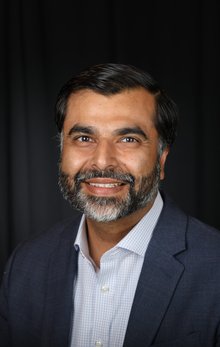
Parth Thakker
Demand Intelligence Leader