Control Towers: The Brains Behind Modern Supply Chains
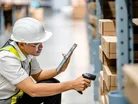
Supply chain control towers are central to the success of global operations.
Acting almost as a nerve centre, they automatically gather, integrate and analyse data from across supplier networks. They pull from internal systems including ERP, TMS and WMS, as well as external sources such as IoT sensors, logistics partners and weather feeds.
One of the main uses for these towers is to give supply chain teams personalised alerts, so they can monitor the movement of goods, materials and information from start to finish.
This is because control towers provide end-to-end visibility; by connecting real-time data from suppliers, manufacturers, transporters, warehouses and third-party logistics providers, they create a complete view of activity.

Visibility across the supply chain
Advanced systems use AI, machine learning and predictive analytics to detect and flag issues the moment they appear.
Ben Massie, Vice President of Global Supply Chain for Lenovo’s Servers & Storage division, leads a team of approximately 800 employees across 13 countries, overseeing fulfillment, demand planning, supply management, inventory, quality engineering and back-office operations.
He believes a control tower’s purpose is to “provide real-time insights and enable fast, informed decision-making that improves performance, resilience and customer satisfaction”.
With more than 23 years of experience in the technology industry, Ben has built a diverse background spanning supply chain, sales operations, development and finance. He joined Lenovo in 2014 as a result of the acquisition of IBM’s System x business and has remained with the server division ever since, playing a key role in its growth and evolution.
Under his leadership, Lenovo’s supply chain has earned global recognition, including a number eight ranking in Gartner’s list of top supply chains worldwide.
“Over the past eight years,” Ben says, “we’ve invested in building digital capabilities that connect planning, procurement, logistics and production. AI plays a central role in this framework helping us process vast amounts of data, anticipate challenges and improve agility.”
By breaking down data silos between departments and partners, supply chain teams improve collaboration and synchronisation - proving critical in large organisations where delays or miscommunication can quickly hit performance.
The benefits include faster risk detection, better agility, optimised inventory and stronger partner relationships. Plus, cost savings follow through more efficient logistics, shipping, inventory and labour management.
A Deloitte survey warns that “76% of manufacturers say visibility across their supply chain is limited. In the past, this meant delayed shipments or missed deadlines. In 2025, it can mean reputational damage, compliance violations or multi-million-dollar losses.”
With those risks in mind, 55% of supply chain leaders are increasing tech investment and 60% plan to spend more than US$1m on solutions such as orchestrated visibility platforms, cloud computing, predictive analytics and AI.
Inside Lenovo’s AI-driven control tower
Lenovo operates in more than 180 markets and runs 30 manufacturing sites in 11 countries. Its hybrid model of in-house and partner facilities allows it to produce closer to customers, respond faster to demand and reduce lead times. The company invests heavily in AI and predictive analytics to improve planning, production and logistics.
Ben shares: “Intelligent scheduling tools streamline production decisions, while AI-driven sentiment analysis helps us understand customer needs and improve service.”
For him, it’s about “transforming data into decisions and aligning the entire enterprise around a shared operational view”.
This enables Lenovo to reduce order-to-ship times, improve accountability and lead through disruption.
Ben adds: “In today’s world, where speed and adaptability are everything, the control tower is no longer optional; it’s foundational.”
A more intelligent solution?
Supply chain control towers have evolved from dashboards with limited capacity for interaction, to intelligent command hubs.
Bryan Gross, a Principal in PwC’s Operations Transformation practice, leads the US and Mexico Supply Chain Execution and Logistics team. He calls control towers “a dynamic command hub that connects siloed systems, aggregates real-time data and empowers AI-enhanced decision-making”.
With more than 30 years of experience in supply chain leadership, project delivery and consulting, Bryan helps clients transform their supply chains for greater agility and performance.
He explains that, by uniting TMS, WMS, ERP and IoT data into one intelligent platform, companies can predict and prevent disruptions before they snowball.
“When you unify your data,” Bryan adds “automate intelligently and embed analytics into your decision-making, you don't just track the supply chain – you actively shape it to be ready for what’s now and what’s next.”
He’s not alone. Andre Luecht, Global Strategy Lead for Transportation, Logistics and Warehousing at Zebra Technologies, agrees that “visibility without accuracy is a liability”.
Andre continues: “That kind of mismatch guarantees customer disappointment.”
With more than 25 years of experience, Andre focuses on making every worker, asset and process visible, connected and optimised.
Both he and Bryan agree that, without visibility, companies risk poor situational awareness, inefficiency, lower service levels and lost revenue – a menu that should frighten any supply chain executive.
Zebra Technologies focuses on adaptable solutions for warehousing, transport and logistics, designed to address current needs while preparing for future demands.
Andre advises: “Look for technology that will solve today’s problems, allow you to grow and prepare for future requirements.”
Zebra’s portfolio includes purpose-built industrial devices with modern chip architecture, robotics like Symmetry Fulfillment and software such as WorkCloud Sync – all tailored for operational fit.
“Adaptability requires flexibility,” says Andre, highlighting features such as predictive analytics, temperature and motion sensing, and advanced data capture. These tools deliver continuous situational awareness across the value chain, enabling intelligent, responsive operations.
Trusted by leading postal, courier and logistics providers, Zebra’s solutions enhance speed, accuracy and last-mile performance. Their systems ensure real-time updates, reliable proof of delivery and fewer disputes or delays, helping businesses scale deliveries efficiently while maintaining consistent service quality.
The scalability challenge
Lenovo’s control tower success was built through a multi-year digital transformation connecting operations across more than 30 global sites.
Ben explains: “Many companies operate in silos and, without consistent, real-time data, a control tower cannot function effectively.”
As a result, the company is focused on aligning people, processes and technology, ensuring scalability through a hybrid manufacturing model that adapts regionally while keeping central oversight.
Zebra’s approach matches that adaptability.
“Look for technology that will solve today’s problems, allow you to grow and prepare for future requirements,” says Andre.
Zebra’s tools “accelerate deliveries with consistent reliability, real-time updates and precise proof of delivery—reducing disputes, improving satisfaction and minimising delays or missed windows”.
Bryan adds that deployments can fail from fragmented data, poor interoperability and organisational resistance. Instead, he suggests implementing centralised data ecosystems, AI-powered process intelligence and modular, cloud-native platforms that scale without disruption.
Ben stresses that this end-to-end visibility boosts efficiency, customer satisfaction and cost control.
“Our intelligent production scheduling tools allow us to simulate scenarios and adjust rapidly,” he explains. “AI-driven customer sentiment analysis gives us deeper insights.
“The result is improved satisfaction and stronger warranty-related outcomes.”
Meanwhile Bryan points out that AI adoption is already helping 53% of organisations pre-empt disruptions. In industries like retail, manufacturing and healthcare, he says control towers are becoming “indispensable.”
According to him, AI, machine learning and predictive analytics are turning control towers into “intelligent decision-making engines”. They move from monitoring to recommending – and even automating – the best actions, not just reactions, such as inventory shifts or rerouting shipments before delays hit.
He forecasts an era of connected, autonomous supply chain ecosystems with IoT sensors, digital twins, scalable TEL infrastructure and AI models that act without human intervention.
Are control towers the future of supply chains?
As he looks to the future, Ben sees supply chain visibility evolving into a predictive capability integrated across the enterprise.
Lenovo’s focus is on becoming “anti-fragile,” with systems that adapt and improve automatically. Expanding regional manufacturing, like at its Riyadh facility, will boost flexibility and reduce reliance on single supply routes, while AI will take an even larger role, including in sustainability tracking to meet ESG goals.
“In short, supply chain visibility is shifting from an operational tool to a strategic asset,” he concludes.
Meanwhile, Andre advises CSCOs to “invest in connected platforms that optimise workflows and allow them to anticipate challenges to their operations, ultimately giving them a long-term competitive advantage”.
Together, these perspectives highlight a major transformation: supply chain visibility is progressing beyond tracking and monitoring to become a driver of strategic agility and operational intelligence.