How Tesco is Leading on Green Supply Chain Initiatives
The UK is grappling with an enormous food waste challenge, discarding approximately 9.52 million tonnes of food every year.
Supermarkets contribute significantly to this problem, with around 270,000 tonnes attributed to their operations, according to the Waste and Resources Action Programme.
This waste not only represents a loss exceeding £19bn (US$25.4bn) annually but also contributes to increased greenhouse gas emissions.
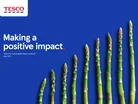
Tesco’s 2025 sustainability report, Making a positive impact, illustrates how the supermarket giant is actively addressing food waste, emissions and energy efficiency challenges.

Integrating sustainability in operations
Sustainability is central to Tesco's corporate strategy, with a commitment to benefit "customers, communities and planet a little better every day".
Tesco is confronting environmental and social issues throughout its supply chain, store operations and through customer initiatives. The company's "planet plan" is articulated through six priority areas to guide their efforts:
- Enhance product quality
- Decarbonise logistics
- Minimise emissions from retail locations
- Promote sustainable consumer habits
- Eradicate waste
- Conserve natural resources
Tesco implements these targets with bold internal emission reduction programmes, fostering supplier climate action initiatives and engaging in community health projects. Additionally, the company invests in sustainable agriculture partnerships, supports robust policy frameworks and works with NGOs to align retail practices with broader societal and environmental objectives.

Addressing food waste reduction
Tesco has set an ambitious goal to cut its operational food waste by 50% by the end of 2025, with 2016/17 as a benchmark.
In the latest reporting year, 82% of unsold food fit for human consumption in the UK was redirected to food banks or animal feed. Tesco's investment in partnerships and infrastructure supports this distribution effort.
Leveraging its expansive network of over 1,000 community collaborations, bolstered by FareShare and OLIO, Tesco managed to redistribute over 25,000 tonnes of surplus food in 2023/24, equivalent to more than 60 million meals. Together with other leading retailers like Sainsbury’s, Morrisons and Waitrose, Tesco collaborates with FareShare to alleviate hunger in the UK.
“We are excited to support the ‘Let’s Make a Meal of It’ campaign and strengthen our partnership with FareShare,” says Matthew Barnes, UK CEO of Tesco.
“Collaboration is key to addressing food insecurity and we are happy to partner on this with the other retailers.”
New facilities have also been introduced to process surplus food into animal feed, diverting up to 1,000 tonnes of unsold perishable items from landfills weekly.
Tesco continues improving forecasting and inventory management using machine learning to ensure timely sales of perishable products. The removal of ‘best before’ dates on over 100 product lines aims to minimise consumer confusion and prevent unnecessary disposal.
In-store efforts like ‘reduced to clear’ sections and donation stations help maximise leftover food usage. Advocating for transparency, Tesco was the first UK retailer to publish its food waste data, urging the industry to adopt similar reporting standards to drive national improvements.
Commitment to renewable energy and decarbonisation
Surpassing its 2025 goal, Tesco has slashed Scope 1 and 2 emissions by 65% from its baseline ahead of time. With aspirations for carbon neutrality by 2035 and net zero emissions across its full value chain by 2050, Tesco is on a trajectory guided by Science Based Targets initiative (SBTi)-approved benchmarks.
This includes an 85% reduction in Scope 1 and 2 emissions by 2030 and a 55% cut in Scope 3 emissions by 2032.
Supporting these targets, Tesco uses 100% renewable electricity for its group operations and has signed the UK’s largest corporate solar Power Purchase Agreement (PPA), securing a major share of the 373MW output from Cleve Hill Solar Park, set to generate enough renewable energy to power 144 large stores annually.
“We’re delighted to be announcing such a step in our journey towards carbon neutrality,” Ken Murphy, Group CEO of Tesco, highlights.
The solar park promises to provide essential energy storage and stands as a cornerstone of the UK’s renewable energy strategy.
Circular economy and supply chain evolutions
Tesco's commitment to a closed-loop system for packaging and waste reinforces its objective to halve food waste by December 2025.
Efforts include moving to paper-based packaging for products like pasta and onions and employing laser-etched labels to reduce single-use plastic reliance. Currently, 99% of Tesco’s UK Own Brand packaging is recyclable.
Innovation in agriculture continues with Tesco’s Future Dairy Partnership, collaborating with partners like Arla and Müller to pioneer sustainable farming solutions. This builds upon Tesco’s longstanding work through its Sustainable Dairy Group.
"We've been leading the transition to low carbon agriculture with our Sustainable Dairy Group farmers," explains Ashwin Prasad, Chief Commercial Officer at Tesco. “To meet our climate goals, industry-wide collaboration and innovations are vital and we’re excited to work alongside Arla and Müller."
Tesco is also dedicated to sourcing sustainably, using deforestation-free resources like soy, palm oil and seafood by 2025, supporting farmers through initiatives like the Responsible Commodities Facility and the UK Soy Manifesto.
Explore the latest edition of Supply Chain Digital Magazine and be part of the conversation at our global conference series, Procurement & Supply Chain LIVE.
Discover all our upcoming events and secure your tickets today.
Supply Chain Digital is a BizClik brand