
Maersk & Danone: Partnering Towards Greener Logistics
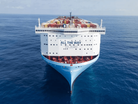
In a significant move toward reducing the environmental footprint of maritime logistics, global logistics giant Maersk is partnering with food and beverage leader Danone to cut greenhouse gas (GHG) emissions associated with seaborne transport.
Through Maersk’s ECO Delivery Ocean programme, Danone can now leverage lower-emission fuel options like biodiesel and biomethanol, which are sourced entirely from waste materials.
The approach allows Danone to achieve a substantial reduction in GHG emissions, surpassing 40% compared to standard fossil fuels, and aligns with both companies’ long-term decarbonisation goals.
Through Danone’s Partner for Growth programme, this collaboration reflects Danone’s wider strategy to reduce CO₂ emissions, centring on alternative fuels and efficient multimodal transport.
Jean-Yves Krummenacher, Global CPO at Danone, explains: “The ECO Delivery Ocean product and its reduced greenhouse gas emissions align well with our decarbonisation strategy to focus primarily on alternative fuels and multimodal transportation.
"Maersk is an important partner and using their product to reduce CO₂ emissions on sea freight marks yet another step in our decarbonisation journey.”
Science-based targets and industry decarbonisation
Sustainability lies at the heart of both Danone and Maersk’s long-term business models and each has established a net-zero roadmap grounded in science-based targets.
Danone is aiming to reach net-zero emissions by 2050, an ambition approved by the Science-Based Targets initiative (SBTi) in 2017.
Maersk, the first shipping company to secure SBTi approval for its net-zero pathway, is targeting 2040 to reach this goal.
Their latest collaboration represents a bold step forward, with Maersk’s ECO Delivery Ocean scheme marking a significant stride in making sustainable maritime transport a reality.
According to Emilio de la Cruz, Maersk’s Area Managing Director for South West Europe, companies like Danone are vital in the decarbonisation journey for industries worldwide: “The swift reduction of greenhouse gas emissions is at the core of both our companies.
"Well-known companies like Danone can act as a beacon in their industries by using effective levers to decarbonise their supply chains. We are proud to be Danone’s trusted partner in this important task.”
Science-based targets provide an evidence-based framework for both companies’ climate strategies, ensuring their carbon reduction initiatives align with global climate goals.
This partnership serves as a model for the logistics industry, illustrating how organisations can work together to address Scope 3 emissions, which account for the majority of indirect emissions across the supply chain.
Addressing Scope 3 emissions is critical, as they encompass all the indirect emissions produced by an organisation’s activities and can be challenging to monitor and manage.
By combining ambitious science-based targets with cutting-edge fuel alternatives, Maersk and Danone are demonstrating that decarbonisation in logistics is achievable.

Beyond ocean freight: A comprehensive approach to sustainability
This partnership extends well beyond ocean transport alone, encompassing inland logistics as well.
In addition to ECO Delivery Ocean, Maersk is providing Danone with enhanced inland transport solutions and specialised control towers, designed to optimise the flow of goods throughout the supply chain and reduce emissions at every step.
This holistic approach addresses the emissions associated with the movement of goods over land, contributing to Danone’s broader sustainability ambitions.
For both companies, a sustainable supply chain must be robust and adaptable, capable of responding to logistical challenges while prioritising emissions reduction across multiple transportation modes.
A commitment to reducing Scope 3 emissions requires a versatile, end-to-end approach, and the collaboration between Maersk and Danone offers exactly that.
This expanded reach amplifies the environmental impact of their partnership, positioning it as a framework for other companies in the logistics sector to follow.
Together, the firms are setting a new standard, highlighting how intermodal solutions play a key role in reducing emissions across complex, global supply chains.
Check out the latest edition of Supply Chain Digital and sign up to our global conference series – Procurement and Supply Chain LIVE 2025.
Supply Chain Digital is a BizClik brand.