CH4 Global & Mitsubishi Cut Methane Emissions in Agriculture
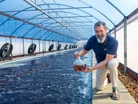
When Steve Meller attended a conference in New Zealand six years ago, he did not foresee founding a company that could potentially reshape supply chains within the agricultural sector.
Listening to a Pacific island Prime Minister highlight displacement issues due to rising sea levels ignited a spark in him.
With a successful career at Procter & Gamble and academic credentials as a PhD scientist, Steve’s commitment to sustainability and climate action was longstanding.
This pivotal moment led him to pursue transformative actions within the agricultural supply chain.
Steve resided in California at the time, where State Bill 1383 demanded reductions in methane emissions from farmers.
Coincidentally, he had encountered research on a seemingly ordinary seaweed, Asparagopsis, native to Australia, which has the potential to revolutionise livestock feed.
Research suggested that integrating Asparagopsis into cattle feed could significantly curb livestock methane emissions.
With this revelation, Steve found his purpose.
"Everything I’ve done in my career has actually led up to what we do now," he says.
Steve now plans o leverage his expertise to scale the production of Asparagopsis, aiming for a systemic reduction of the agricultural industry's carbon footprint.
"The convergence of those three things at that point in time meant I knew there was a product that would be safe and effective. I knew that there was a large commercial market," Steve recalls.
Everything I've done in my career has actually led up to what we do now.
The journey of CH4 Global and Methane Tamer
Following this epiphany, Steve founded CH4 Global, a company dedicated to innovating within agricultural supply chains.
Using his network from Procter & Gamble and Silicon Valley, he assembled a leadership team of Fortune 100 alumni and skilled scientists to advance product development.
The core of CH4 Global's initiative is its product, Methane Tamer, which seamlessly integrates into existing cattle feed systems.
Studies have demonstrated that Methane Tamer can slash methane emissions by up to 90%, a transformative figure.
- Methane is 28 times more potent than CO₂ | Credit: European Commission
- 32% of all human-caused methane emissions come from agriculture | Credit: United Nations Environment Programme
- Whilst estimates differ, it is generally agreed that agriculture contributes to between 8.9% - 19.6% of greenhouse gas emissions globally | Credit: The Breakthrough Institute
"Between 8% and 12% of all the calories a cow consumes is burped out as methane," Steve elaborates.
"It's the byproduct of the organisms, the bacteria that live in there breaking down complex carbohydrates like grains and grasses."
Innovatively, Methane Tamer's stability and efficacy depend on precise formulation, allowing durable performance over long durations in standard feed practices.
"Methane Tamer has the ability to deliver on that promise that when farmers use it on day one, it's the same as if they used it on day 180," says Steve.
"It's fully stable and it fits with the habits and practices. It's not like you need to introduce a new habit; it'll fit into and integrate with the feeding practices that you normally have."
The product yields economic advantages. For example, retaining carbon boosts feed efficiency and cuts feed costs, presenting opportunities for premium pricing on low-methane beef and carbon value through insetting partnerships.
"The key thing is it has to have a net return on investment," Steve notes, emphasising stakeholder engagement.
"Farmers have to make money out of it, simply put."

Scaling sustainable solutions across global supply chains
In January 2024, CH4 Global established what it claims to be the inaugural commercial-scale Asparagopsis production facility in South Australia.
Beyond infrastructure, it showcases comprehensive supply chain operations, covering cultivation, stabilisation, processing, formulation, and packaging of Methane Tamer.
CH4 Global's distribution strategy prioritises alliances with multinational firms instead of targeting individual farmers directly.
These alliances include major entities like Mitsubishi, Lotte, UPL and Chipotle, enabling broader adoption via extensive supply chain networks.
"If you want to get to scale and it's ultimately your goal, you have no choice but to start to work with that big end," Steve explains.
"The larger corporations have all made public commitments of their carbon reduction goals. They manage that supply chain so they can look back to their supply chain and facilitate the use of products that have a lower carbon profile."
Mitsubishi’s partnership emerged after a conference in Singapore, enhancing CH4's credibility and market reach.
This partnership promises Methane Tamer's integration into cattle farming practices throughout Australia and East Asia.
CH4 Global aims to introduce Methane Tamer to wider international markets by 2026, as regulatory approvals come through.

Advancing sustainability in global agriculture
Currently, CH4 Global capitalises on corporate collaborations for rapid market expansion, but Steve envisions future accessibility for individual farmers.
"Once we get past the 2030 timeframe, I can see it being more widely available because it'll be in more wide use, farmers will be more convinced," he predicts.
Addressing agricultural sustainability, Steve highlights the urgency of refining food systems while securing global food supplies amid population growth.
"There is a large double-digit percentage of the world that relies on protein sources from ruminants, whether it's cow, sheep, goats, camels and the like for its protein sources, both milk and beef," he explains.
"When you think about the farmers across the world, it's getting close to two billion who are really integrated across that entire ecosystem."
"When you've got ruminants who are clearly large producers of methane – the single largest source on the planet, more than from the oil and gas industry – if you can do something about it, you have the chance to move the needle and buy the world another decade."
Explore the latest edition of Supply Chain Digital Magazine and be part of the conversation at our global conference series, Procurement & Supply Chain LIVE.
Discover all our upcoming events and secure your tickets today.
Supply Chain Digital is a BizClik brand.