
Inside DPD's Sustainable Electric HGV Trial
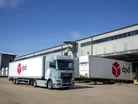
Around the world, DPD shifts billions of parcels each year. With that kind of scale, the emissions from its fleet are anything but negligible.
Every package delivered carries with it an environmental cost, not just for DPD but also for the businesses relying on its services.
These emissions fall into the Scope 3 category, usually accounting for the majority of a company's emissions.
DPD now wants to cut its footprint and it's turning to electric trucks to do it.

In a new collaboration with commercial vehicle manufacturer MAN Truck & Bus, DPD has begun trials of an all-electric heavy goods vehicle (HGV), the MAN eTGX. The vehicle boasts a driving range of up to 800km and a charging capacity of up to 750 kilowatts.
After full induction and driver training, the electric HGV is set to begin real-world testing from DPD’s central UK hub in Hinckley, Leicestershire.
The aim is to evaluate whether the vehicle can integrate into the parcel delivery firm's regular operations, with a view to rolling out electric HGVs more broadly from late 2025.
This is more than just a one-off experiment. The transport sector is the UK’s largest emitter of greenhouse gases.
In 2023, it was responsible for 26% of total emissions, and heavy goods vehicles accounted for 20% of that. Shifting this segment to electric could make a substantial contribution towards the UK’s net zero targets.
Tracey Perry, Sales Director for Truck, Bus & Coach at MAN Truck & Bus UK, says: “We’re proud to partner with DPD on this important journey towards electrification of their HGV fleet.
"These trials will provide invaluable insights for both companies as we work towards a greener future. As a leading commercial vehicle manufacturer with a growing portfolio of battery-powered solutions, MAN is committed to investing in cutting-edge, climate-neutral transport technologies and actively supporting our customers in decarbonising their operations.
"Achieving the 1.5-degree target of the Paris Climate Agreement requires bold action, and electric trucks like our eTGX are a critical part of that mission.”
Optimising for double-decker trailer efficiency
DPD and MAN are also working on a second, more tailored solution — one that adapts the eTGX for use with double-decker trailers. These high-capacity trailers are central to DPD’s logistics model.
By fitting two levels of parcels into a single trailer, DPD reduces the number of HGVs needed on the road while maintaining delivery volumes.
The adapted electric vehicle for this configuration is expected to enter testing later in 2025. If successful, it could support DPD’s goal to transition its entire trailer fleet without sacrificing capacity or efficiency.
Tim Jones, Director of Marketing, Communications & Sustainability at DPD UK, sees a clear path forward: “Electric HGVs have the potential to become a viable solution in the future and we now believe we can get the configuration we need to maintain our double decker trailer fleet, which has enabled us to reduce the overall number of HGVs we put on the road for many years.
"We are keen to help to develop the electric trucks that can work for us in the real world.”
Inside the eTGX and DPD's wider climate targets
The MAN eTGX is built around battery systems manufactured in Nuremberg, Germany.
Depending on operational needs, battery capacities of up to 480 kilowatt-hours (kWh) can be installed, offering a driving range of roughly 500km without any intermediate charging. For longer hauls, the batteries can be largely recharged in just 45 minutes.
A key part of the vehicle’s design is a high-voltage battery pack fastening system that allows batteries to be swapped quickly. This kind of modular approach helps keep trucks on the road for longer and avoids long charging delays.
For DPD, these vehicle trials are just one part of a broader commitment. The company wants to reach net zero by 2040. Since 2020, it has already cut its emissions by 27.5%.
Today, nearly 40% of its fleet consists of electric vehicles and it has already completed more than 22 million deliveries using EVs. In total, that’s saved more than 6,000 tonnes of CO₂.
There’s still a long way to go, but partnerships like the one with MAN Truck & Bus are helping push things forward.
Explore the latest edition of Supply Chain Digital Magazine and be part of the conversation at our global conference series, Procurement & Supply Chain LIVE.
Discover all our upcoming events and secure your tickets today.
Supply Chain Digital is a BizClik brand.