DP World Southampton Hitting Operational Net Zero by 2025
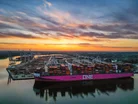
DP World's container terminal in Southampton is set to achieve operational net zero emissions in 2025. The terminal has already cut its Scope 1 and 2 greenhouse gas emissions by 87% in 2024 compared to 2021, with these reductions independently assured by LRQA.
A major milestone was reached in 2022 when the port became the first in the UK to eliminate fossil diesel from its operations entirely, switching to Hydrotreated Vegetable Oil (HVO), a renewable biodiesel that has slashed net carbon dioxide emissions by over 80% and significantly improved local air quality.
Now, the terminal is set to hit its biggest landmark to date, with it on track to be operational net zero this year.
Based on verified data from 2021-2024 and the implemented and future decarbonisation projects, DP World Southampton is on track to become Operational Net Zero for the 2025 Reporting Period.
This will be a direct result of the continued efforts to reduce carbon emissions from our operations. Once the emissions have been reduced beyond this 10% of the baseline value, the appropriate amount of carbon credits will be retired to offset the final unabated and residual emissions.

Combining innovation with strategic offsetting
Operational Net Zero is defined as achieving and maintaining a balance between the Greenhouse Gas (GHG) emissions produced through its Scope 1 and Scope 2 operations, and the measures taken to remove or offset emissions for them to equal zero.
This aligns with the DP World global GHG emissions reduction targets as well as the Paris Agreement, GHG Protocol and SBTi Guidance.
The container terminal operator, which plays a crucial role in the UK's supply chain infrastructure, has announced it is firmly on track to balance all greenhouse gas emissions from its operations through a comprehensive decarbonisation strategy that combines emissions reduction with high-quality carbon offsetting.
This commitment represents more than just an environmental target – it's about reimagining how major port operations can contribute to a sustainable future. The initiative aligns with DP World's global science-based targets, validated by the Science Based Targets initiative (SBTi), which call for a 42% reduction in direct emissions by 2030.
Using 2021 as its baseline year – when the company first externally verified its carbon emissions against ISO 14064-1 standards – DP World Southampton has developed a robust five-year decarbonisation plan that focuses on three key pillars:
- Energy Efficiency Revolution: The terminal is adopting cutting-edge energy-efficient technologies and dramatically increasing its renewable energy usage, moving away from traditional fossil fuel dependencies.
- Operational Innovation: By utilising low-carbon fuels and promoting sustainable operational practices, the facility is fundamentally transforming how container handling can be conducted with minimal environmental impact.
- Strategic Offsetting: For remaining emissions that cannot be eliminated, the company will retire high-quality, verifiable carbon credits meeting strict ISO 14068 criteria.
The timing of this commitment is particularly significant for Southampton, as the city council has set an ambitious target to become net zero by 2035. DP World Southampton's 2025 achievement will provide crucial momentum for the broader regional decarbonisation effort.
What sets this initiative apart is its commitment to rigorous verification and transparency. DP World Southampton will continue to have its emissions data independently verified annually against ISO 14064-1 standards, ensuring accountability and maintaining public trust in its environmental claims.
The company has also committed to regularly reviewing and enhancing its decarbonisation plan to incorporate the latest scientific guidance and technological innovations, while carefully considering any potential unintended environmental or social consequences.
Ambitious long-term targets
While the 2025 operational net zero target represents a significant milestone, DP World Southampton's ambitions extend much further. The facility remains committed to supporting the global business target of reducing Scope 3 supply chain emissions by 28% by 2030 and achieving full net zero across all emission scopes by 2050.
This includes innovative programmes such as the Modal Shift Programme and Carbon Inset Programme Trial, designed to reduce emissions throughout the entire supply chain ecosystem.
John Trenchard, Vice President - Commercial & Supply Chain, DP World in the UK, says: "At DP World, we are committed to reducing our environmental impact and offering our customers lower carbon options for their supply chains. I'm incredibly proud of the achievements at our Southampton port, a true team effort.
"Our sustainability strategy has fostered dedication across the business, and we will continue to invest in low-carbon technologies and business models to support our customers' sustainability goals. The sustainability journey continues."
DP World has also supported Southampton, with the introduction of items like the Green Charter, to support Southampton city's vision to create a cleaner, green, healthier and more sustainable city. DP World is the first port in the UK to introduce a 'green' charge on older trucks to pick up or drop off a container. It is part of a number of measures the company is taking to help cut emissions.
DP World has also teamed up with Hampshire Wildlife Trust, through which it has funded the installation of two seabins helping the fight against plastic pollution in our local waterways. As well as launching an innovative Carbon Inset Programme Trial from 1 January 2025, providing importers into the UK the ability to reduce hard-to-abate Scope 3 carbon emissions from their containerised supply chains.
The groundbreaking programme began issuing certificates in May following the registration of over 150,000 import containers since its January launch. Strong participation prompted an extension through year-end, expanding beyond the original six-month timeline to accommodate growing interest from cargo owners seeking carbon credits.
In addition to the progress made in Southampton, DP World's site at London Gateway has invested heavily in electrification of its operations and has also made major progress to enable the energy transition.
DP World's expansion project will add a further 400m-long all-electric berth and host Europe's tallest quay cranes, helping to enhance the decarbonisation of port operations and craft greener supply chains.
Explore the latest edition of Supply Chain Digital Magazine and be part of the conversation at our global conference series, Procurement & Supply Chain LIVE.
Discover all our upcoming events and secure your tickets today.
Supply Chain Digital is a BizClik brand