Verizon & Nokia: How 5G Powers Thames Freeport Logistics
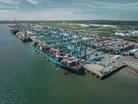
A major telecoms deployment is landing along the Thames Estuary, one of the UK’s busiest freight corridors.
Verizon Business, working with Finnish network specialist Nokia, is rolling out private 5G infrastructure across three major sites within the Thames Freeport area. These private networks will become the digital backbone of large-scale logistics, manufacturing and port operations.

Thames Freeport includes DP World’s London Gateway, the Port of Tilbury and Ford’s Dagenham plant—all of which manage high volumes of cargo and industrial output. This latest investment supports a wider redevelopment programme aimed at regenerating the River Thames Estuary region.
With billions of dollars committed to infrastructure and commercial innovation, the 5G deployment underpins the area’s long-term shift to advanced supply chain technologies.
It is a designated Free Trade Zone—meaning goods can be imported, stored or manufactured with simplified customs arrangements and fewer tariffs.
The private 5G rollout is intended to help unlock further value across this zone by enabling more intelligent, efficient and secure operations at each of its core sites.
Transforming logistics with private 5G networks
The new private 5G networks will deliver ultra-low latency and higher bandwidth connectivity across DP World London Gateway, the Port of Tilbury and Ford’s Dagenham plant. Each of these sites plays a key role in UK logistics.
Tilbury alone manages 16 million tonnes of cargo annually through 31 different terminals. London Gateway handles more than three million shipping containers every year, while Dagenham remains one of the UK's key automotive manufacturing sites.
Verizon’s private 5G system allows on-site control of sensitive data and uninterrupted connection for automated systems. That makes it especially well-suited for environments like ports, where real-time coordination is crucial.
The technology will support AI-led process automation, remote equipment monitoring, predictive maintenance and autonomous vehicles.
Jennifer Artley, Senior Vice President of 5G Acceleration at Verizon Business, says: “Our partnership with Thames Freeport and Nokia shows the full promise of private 5G at scale.
"Thames Freeport is developing one of the most technologically advanced commercial corridors in Europe to enable forward innovation and economic revitalisation for an entire community.”
Industrial edge computing from Nokia
Nokia will supply the hardware and software infrastructure behind the network rollout. Its system, based on the Digital Automation Cloud (DAC) and MX Industrial Edge (MXIE) platforms, enables real-time data processing at the edge of the network—meaning closer to the source of activity. This helps reduce latency and improves efficiency for tasks like cargo tracking and emissions monitoring.
According to David de Lancellotti, Vice President of Enterprise Campus Edge Sales at Nokia: “Private wireless and industrial edge are the foundations for the digital transformation of industrial sites and the Thames Freeport deployment is a landmark example of the evolution at scale.
"It is one of the largest commercial private 5G rollouts in a European port incorporating the Nokia DAC platform.
“Together with Verizon Business, we’re proud to be enabling the infrastructure that will help Thames Freeport drive new efficiencies, sustainable growth and long-term economic opportunity for the region.”
The deployment is not only about streamlining freight operations. Thames Freeport also intends to use the networks for monitoring environmental impact, using AI to assess air and water quality as well as noise pollution. These tools will also support wider circular economy practices.
Enabling jobs, trade and smarter infrastructure
The broader Freeport initiative is aimed at attracting global investment, creating jobs and modernising UK trade infrastructure. Already, the project has generated more than 1,400 roles.
By 2030, that number is expected to grow to 5,000. Many of these jobs are focused on digital skills and advanced manufacturing.
Martin Whiteley, Chief Executive of Thames Freeport, sees the 5G network as critical to that mission: “Our investment in private 5G is not an incremental network upgrade—it’s the backbone of a technological transformation fueling our long-term multi-stakeholder mission.
"By partnering with Verizon Business and Nokia, we’re delivering the technology needed to propel our region to the front of the leading edge.”
The private 5G system is designed to be scalable and site-specific, allowing each Freeport facility to tailor the network’s functionality to local needs.
Already identified use cases include real-time cargo tracking through the internet of things (IoT), autonomous yard tractors and AI-assisted diagnostics.
By combining Verizon’s connectivity expertise with Nokia’s industrial computing platform, Thames Freeport is laying the groundwork for a smarter supply chain.
It aims to become a model for similar zones across Europe, showing how private infrastructure investment can support trade, technology and sustainable growth at once.
Explore the latest edition of Supply Chain Digital Magazine and be part of the conversation at our global conference series, Procurement & Supply Chain LIVE.
Discover all our upcoming events and secure your tickets today.
Supply Chain Digital is a BizClik brand.