Supplier.io: Can Small Suppliers Reduce Supply Chain Risks?
In a business environment marked by persistent trade shifts and geopolitical instability, businesses are rethinking their approach to risk management and supply chain resilience.
A report from Supplier.io indicates that procurement strategies are evolving, with business leaders looking to supplier diversification as a means for growth and stability.
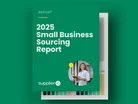
The 2025 Small Business Sourcing Report from Supplier.io surveyed over 150 enterprise executives, including CEOs, CPOs and CFOs. It details a trend towards incorporating small businesses into corporate supply chains to better navigate disruption.

Rethinking risk
The perception of risk within the supply chain is changing. Where small suppliers might have been viewed as a greater risk than larger incumbents, they are now often seen as a solution.
According to the report, 91% of leaders have either adjusted their small business sourcing strategy or have plans to do so following global trade shifts and tariffs.
The data suggests a strong belief in this strategic change, with 86% of business leaders stating that small suppliers reduce supply chain risk. Consequently, 85% plan to increase their spending with small suppliers in the next year.
Small businesses can offer an agility that is difficult for larger corporations to replicate. They can pivot more quickly in reaction to market changes and provide more tailored solutions to meet specific operational needs.
Carmen West, Vice President at the US Chamber of Commerce, says: “Small businesses are nimble. They often pivot faster than large companies and can provide tailored solutions that help organisations meet complex needs. Supporting them isn’t just the right thing to do, it’s smart business.”
The operational gains
Businesses that have integrated small suppliers into their procurement processes are reporting tangible outcomes.
The Supplier.io survey found that 56% of respondents saw improved performance or quality in their business operations.
A further 53% cited greater supply chain resilience as a direct benefit.
The financial implications are also noteworthy, with leaders claiming a 50% reduction in costs could be attributed to working with small suppliers and 43% pointing to a faster time-to-market.
Companies like Unilever have long relied on smallholder farmers for key ingredients, integrating them into their supply chain for many years.
Similarly, The L'Occitane Group has placed local and small suppliers at the centre of its sustainability efforts to ensure traceability.
For the services company Aramark, using small suppliers has produced clear results. “[Small supplier] partnerships have not only produced results, they’ve reshaped how we think about value and innovation in procurement," says Natily Santos, Vice President, Responsible Sourcing at Aramark.
Overcoming hurdles
Despite the clear benefits and a willingness from 96% of leaders to source from small suppliers, major barriers remain.
On average, businesses allocate only 7% of their spend to small suppliers, largely because they lack the infrastructure for secure and efficient onboarding.
The report identifies onboarding complexity as a primary hurdle for 41% of procurement leaders.
Another 34% flag a lack of risk data or reliable performance metrics as a major issue, highlighting a need for greater transparency in the vetting process.
These gaps in data and processes create consistent problems for sourcing teams. The consequences of inadequate vetting can be severe. #
According to Supplier.io, 41% of enterprises experienced a failed partnership with an improperly vetted small supplier in the last year.
Of those affected, 66% reported financial loss as the biggest impact, while 48% cited delays to key project launches.
Until large businesses can invest in systems that streamline the finding, vetting and onboarding of small businesses, they may not fully realise the benefits of a diversified supply base.
Investing in robust databases and vetting tools could allow procurement teams to improve their sourcing strategies and trace supplier performance in real-time.