Rolls-Royce: Powering AI Usage with Clean Energy Supply
In the pursuit of sustainable AI solutions, balancing energy use with environmental impact is a critical goal for supply chain leaders.
While advancements in AI promise enhanced efficiency and innovation, these benefits come with substantial energy and cooling demands. Notably, 56% of global data centre energy is currently sourced from fossil fuels, as per the Environmental and Energy Study Institute.
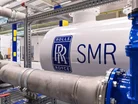
It is within this context that Rolls-Royce is redirecting its focus towards Small Modular Reactors (SMRs) as a cleaner energy alternative for powering its AI usage.

Strategic implementation of SMRs
Rolls-Royce is committing to a nuclear energy transformation by integrating SMRs into its existing operations. The effort involves laying the groundwork for SMR implementation, with agreements to establish three reactors in the UK and six more in the Czech Republic.
SMRs deliver up to 300 MW of electricity, highlighting their efficiency compared to traditional nuclear power plants.
Tufan Erginbilgic, CEO at Rolls-Royce, underscores the company's expansive nuclear capabilities, stating: "There is no private company in the world with the nuclear capability we have. If we are not the market leader globally, we did something wrong."
It's projected that by 2050, there will be a requirement for approximately 400 SMRs, paving the way for an overhaul in energy sourcing within supply chains.
The Information Technology and Innovation Foundation has endorsed the potential of SMRs as a cost-effective and efficient alternative to larger reactors. The US sees similar investments, with companies like Google collaborating with Kairos Power to integrate SMRs by 2030. This momentum underscores an emerging trend in the integration of cleaner energy solutions to empower AI capabilities.
Leveraging AI in operations
Rolls -oyce is not new to AI; its implementation in the company dates back to 1999, initially to predict maintenance for aviation engines.
Today, AI extends across their manufacturing processes, involving automated quality checks and collaborations with R2 Data Labs. Here, data harnessing optimises performance and customer value, transforming operational procedures.
Further expanding its climate-conscious initiatives, Rolls-Royce implements technologies such as the mtu EnergetIQ, which uses data-driven strategies to balance energy requirements against pricing and weather data.
Jan Henker, Senior Expert Automation and Controls at Rolls-Royce, elaborates: “If you want to achieve perfect interplay in leveraging the strengths of the different technologies, not just today, but tomorrow, next week and beyond, then what you need isn't a fixed operating strategy but one that constantly recalculates itself automatically.
"That requires an over-arching, data-driven solution – in other words, the optimiser function of mtu EnergetIQ.”
Such innovations position Rolls-Royce at the forefront in refining sustainable practices in AI deployment.

The wider impact of SMR Investment
The SMR initiative is set to produce enough energy to power a million homes, providing stable, affordable and emissions-free energy for at least 60 years. Expected outputs of 470 MW of low carbon energy by each SMR equate to the production capacity of 150 onshore wind turbines.
Such contributions are poised to infuse up to US$73bn into the UK economy between 2025 and 2105.
The UK supply chain stands to benefit significantly, with a focus on domestic manufacturing and assembly to maintain high-quality standards and mitigate site-level disruptions. This operational structure is instrumental in supporting global SMR rollout while enhancing local industry capabilities.
Moreover, the development of these SMR plants in the UK is projected to create 40,000 regional jobs by 2050.
Reflecting on the transformative potential of SMRs, Tony Blair, Executive Chairman at the Institute for Global Change, articulates: "SMRs can be a cornerstone of the long-term, secure and low-cost decarbonised energy system that can power the future economy."