SAP: Powering a New Era of Supply Chain Orchestration

Disruption defines today’s global supply chain environment. From pandemics to shifting trade policies and geopolitical volatility, organisations continue to show resilience, but the next decade demands more.
Meanwhile, the rise of AI and agentic workflows has created a moment to fundamentally rethink how supply chains operate.
The message from SAP is clear: businesses that invest in AI-enabled applications and data reliability while reworking core processes maintain continuity and customer trust. Those that delay face continued disruption, rising costs, reduced service levels and revenue loss.
At Supply Chain Connect, part of the inaugural edition of SAP Connect, SAP expanded on this vision by unveiling a suite of AI-focused innovations to help supply chain leaders transform disruption into a growth opportunity.
These updates focus on orchestration, planning, logistics and embedded AI assistants across systems and networks.
AI-powered orchestration provides early risk detection
SAP Supply Chain Orchestration introduces a new approach to managing disruption with foresight.
The platform is designed to detect risks early, assess impact in the context of a company’s unique supply chain model and trigger AI-led actions across procurement, manufacturing, logistics and planning.
Built on SAP Business Technology Platform (SAP BTP), the orchestration solution connects with SAP Business Network and SAP Business Data Cloud. This enables a multi-tier view across supply networks, giving companies the visibility to respond before disruptions become critical.
Organisations stand to gain access to contextual risk alerts that convert into prioritised actions, improving operational efficiency, supplier compliance and customer satisfaction. The solution also integrates Joule, SAP’s AI-powered assistant, to automate decisions and reduce revenue exposure.
“To thrive when volatility is the new normal, businesses need more than a patchwork of disparate best-of-breed applications," says Muhammad Alam, Executive Board Member for SAP Product & Engineering.
"Our announcements demonstrate the power of SAP Business Suite, where AI, data and applications come together in an experience to propel smarter decisions, faster execution and scalable transformation.”
SAP has confirmed general availability of SAP Supply Chain Orchestration in the first half of 2026. It is built for businesses looking to shorten time-to-recover, improve decision-making and anticipate global shifts before they escalate.
Unified AI planning links forecasting to operational action
SAP Integrated Business Planning (SAP IBP) receives a major upgrade, combining a harmonised data model with AI tools to deliver faster, more connected planning. The system now supports both time-series and order-based planning, allowing users to move between strategic, tactical and operational decisions without switching platforms.
This supports a method known as telescopic planning – the ability to align short-term operational moves with long-term strategic forecasts. Embedded scenario simulations allow planners to see how alerts and risks affect supply chains across multiple horizons.
AI-driven forecasting improves inventory accuracy, while characteristic-based planning helps match stock and capacity more effectively in complex sectors like life sciences, fashion, consumer goods and high-tech manufacturing.
What's more, a new Configurable Planner Workspace serves as a central planning interface, offering real-time insight and AI-powered recommendations from Joule. Planners can simulate and act on scenarios immediately, instead of relying on separate systems or manual checks.
All planning enhancements are now generally available, with full AI capabilities entering general release in Q2 2026.
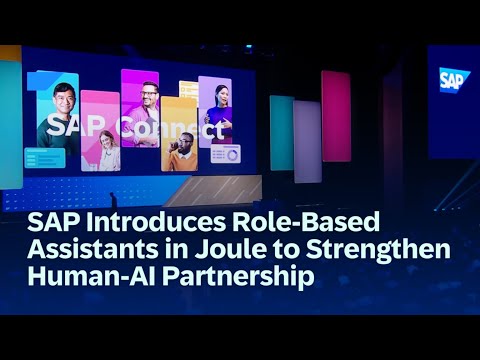
Joule agents automate key supply chain workflows
SAP is introducing three new Joule Agents that bring AI-native automation directly into daily supply chain operations.
These agents embed within SAP Cloud ERP, SAP Cloud ERP Private and SAP Business Network workflows, reducing the burden of manual tasks and accelerating strategic decisions.
-
Production Planning and Operations Agent: Automates prerequisite checks for production orders by validating material, capacity and scheduling. It can suggest workarounds or instantly release orders, helping reduce delivery cycles and operational cost. General availability is expected in Q1 2026.
-
Change Record Management Agent: Helps product teams manage problem reports and change requests. It interprets data, recommends next steps and initiates changes, improving traceability and governance (available Q2 2026).
-
Supplier Onboarding Agent: Speeds up onboarding by reasoning over supplier data, issuing invites, validating information and handling exceptions. This allows procurement teams to scale quickly and concentrate on supplier development.
These agents bring automation into high-friction areas of the supply chain, reducing delays and error rates while supporting high-speed decision-making.
Business Network and Logistics Management evolve
SAP Business Network, which manages more than US$6.3tn in annual transactions across 190 countries, has undergone structural updates to better support end-to-end commerce. The platform now runs on SAP BTP, offering modernised integration with SAP and third-party systems.
Features include a global supplier directory with guided onboarding, custom workflow options via SAP Build and upcoming AI-powered analytics through Joule from January 2026.
SAP has confirmed that, later this year, the network will support end-to-end value streams integrated with SAP Cloud ERP, SAP Ariba, SAP Fieldglass and SAP Transportation Management. This will help businesses reduce disputes, track emissions and navigate supply chain activity with AI-assisted tools.
From Q4 2025, users will also be able to search and access supplier data directly through their ERP system, reducing activation costs and improving visibility into new vendors.
On the logistics side, SAP has unveiled SAP Logistics Management, a cloud-native solution designed for multi-tier distribution networks. It connects large distribution centres with smaller warehouses, enabling rapid delivery, stock consistency and reduced manual tasks.
Integrated with SAP Cloud ERP Private and SAP Business Network for Logistics, the tool centralises inventory, shipments and partner coordination. AI-driven functionality helps eliminate silos and streamline decisions across logistics ecosystems.
Widely available from Q1 2026, the solution is being implemented by Doehler, a global supplier of natural ingredients for the food, beverage and nutrition sectors.
Dr Michael Merget, COO at Doehler Group, says: “SAP Logistics Management is set to deliver lean process automation and accelerated transformation for most of our more than 50 production sites, sampling operations and technical warehouses. We see its powerful, integrated AI capabilities not as an add-on, but as the core intelligence that will define the future of our logistics."
Orchestrated, intelligent supply chains
SAP’s latest product and platform updates reflect a shift toward orchestration-led, AI-enabled supply chains that are collaborative, responsive and always operational.
With the ability to detect risk early, simulate action at scale and automate complex tasks, supply chains no longer need to choose between speed and stability. Instead, businesses gain tools that allow them to meet disruption with confidence and efficiency.
In a global market shaped by uncertainty, the most resilient supply chains will turn complexity into clarity, powered by systems that think and act faster than human response alone. SAP’s latest releases aim to make that model standard practice.
Company portals

Executives
Muhammad Alam
Member of the Executive Board of SAP SE, SAP Product & Engineering