
Supply Chain Crisis Predicted as US-Iran Talks Break Down
The geopolitical situation has in the Middle Eastern has continued to unfold, despite Iran, the US and Israel agreeing to a last-minute two-week ceasefire on 8 April.
Since then, Israel has continued its bombardment of Lebanon, while the Trump administration has remained infuriated by the lack of progress in the Strait of Hormuz.
This vital chokepoint handles up to 20% of global oil and gas shipments along with over 33% of urea fertilizer exports and key industrial inputs like methanol, aluminium and helium essential to food, manufacturing and healthcare supply chains.
Meanwhile, peace talks have taken place in Islamabad with each of the involved parties laying out their terms for an end to the conflict.
But after 21 hours of negotiations in the Pakistan capital on 12 April diplomacy efforts ended without agreement. The markets have wasted little time in passing judgement with supply chain disruptions amplifying the fallout.

By the morning of the introduction of the blockade the price of Brent crude had risen 7% to US$102.29 a barrel and US crude jumped 8% to US$104.24 as traders digested what the breakdown in negotiations meant for a strait through which in normal times up to 140 vessels sail daily carrying not just energy but fertilizers for crops, aluminium for manufacturing and helium for semiconductors.
The talks brokered by Pakistan had been the best and perhaps only realistic near-term path to reopening the Strait of Hormuz which has been effectively closed since the war began on 28 February, with US and Israeli airstrikes on Tehran.
US focuses on nuclear weapons programme
The closure has forced ships to reroute via the Cape of Good Hope adding eight to 15 days to Asia-Europe transit times while CMA CGM imposed emergency conflict surcharges of US$2000 on 20-foot containers and most lines halted bookings due to cancelled war-risk insurance.
US Vice President, JD Vance, who left Islamabad on Sunday morning, blamed the collapse on Tehran's refusal to abandon its nuclear weapons programme, while Iranian sources hit back at what they described as excessive demands from Washington.
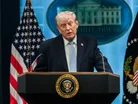
After the breakdown in negotiations, US President, Donald Trump, announced on Truth Social that the US Navy would begin “blockading any and all ships trying to enter or leave the Strait of Hormuz”.
He also added that it would destroy any Iranian mines laid in the waterway.
US Central Command followed with a formal statement announcing a blockade of all Iranian Gulf ports and coastal areas, effectively seizing control of maritime traffic in the strait.
Traffic through the Strait of Hormuz has remained extremely limited since the two-week ceasefire between Iran, the US and Israel was agreed on 8 April.
Lloyd’s List Intelligence reported that traffic through the strait stopped almost immediately after Trump’s post, with two vessels that had been departing the waterway turning around.
'Act of piracy'
Maersk paused nonessential cargo acceptance, prioritising food and medicine via trucking from ports like Jeddah, while Gulf hubs including Dubai saw airport closures slashing 16-18% of global air cargo capacity, especially on India routes dominated by Emirates, Etihad and Qatar.
Iran’s Revolutionary Guard warned that bringing “military vessels to the Strait of Hormuz is considered a violation of the ceasefire”. Tehran has called these proposals an “act of piracy”.
Meanwhile the country’s Parliamentary Speaker, Mohammad Bagher Ghalibaf took to X to taunt the US President.
“Enjoy the current pump figures” he said. "With the so-called ‘blockade’ soon you'll be nostalgic for $4–$5 gas.”
So what exactly is the outlook for global energy markets and the broader supply chains they underpin?
Brent crude which sat at roughly US$70 a barrel before the conflict began in late February has surged as high as US$119.45 during the war before settling back to US$94.26 at the close of last week following the short-lived ceasefire announced on Wednesday.
Beyond oil the blockade tightens supplies of urea (prices up 26%), methanol (up 17%), aluminium (up 9%) and helium (up 35%) from GCC producers, disrupting everything from crop yields to car production, semiconductors and MRI machines.
The announcement of a US blockade has already reversed much of that relief with rerouting, delays and surcharges reshaping Asia-Europe logistics corridors previously hit by Red Sea issues.
'Insult to injury'
Michael Lynch, a Distinguished Fellow at the Energy Policy Research Foundation, estimates the blockade could push prices up by a further US$5 to US$10 a barrel, noting that the Iran conflict had already removed roughly 10 million barrels a day from global supply.
“This is a pretty big insult to a pretty big injury”, he says, while he also suggests the measure could prove short-lived.
“I wouldn’t be surprised to see him give it up by midweek especially if oil prices keep going up.”
Analysts from JPMorgan expect prices to remain above US$100 a barrel through the second quarter of 2026 before easing in the second half of the year.
That forecast looks increasingly optimistic given the way this week has already begun to unfold, with airspace closures in Dubai, Abu Dhabi and Doha forcing cargo reroutes via China and Hong Kong.
The wider supply chain fallout
According to industry insiders the economic consequences look set to reach far beyond the price of oil, with prolonged closure risking raw material shortages, logistics cost spikes and reduced manufacturing output if the war extends beyond four weeks.
The UN Development Programme warned on Monday that more than 32 million people worldwide could be pushed into poverty by the conflict’s economic shockwaves describing a “triple shock” of rising energy costs food insecurity and weakening growth that will fall hardest on developing nations as fertilizer and food supply chains strain.
Humanitarian chains face chaos too with IFRC reporting delays in sea land and air transport for aid while Dubai's role as a stable hub for Middle East South Asia and East Africa cargo evaporates under missile and drone threats.
Mohamed El-Erian, Adviser to Allianz and former President of Queens’ College Cambridge, was blunt about what the breakdown means for the UK specifically. “For the UK all this translates into another hit to the cost of living and less flexibility for both fiscal and monetary policy responses” he says.
The IMF and World Bank spring meetings which opened Monday in Washington are expected to be dominated by the conflict's impact with the IMF's managing director Kristalina Georgieva set to present three economic scenarios – all of which predict lower growth and higher inflation amid supply chain shocks.
For now the strait remains closed the blockade is live and global supply chains are watching oil prices and input costs tick upwards.
Company portals






Executives

Michael Lynch
Distinguished Fellow

Mohamed El-Erian
Adviser