Pax Silica, China and the US: The Supply Chain Power Play

The U.S. Department of State announced in early 2026 that it will work with Congress to allocate US$250m in foreign assistance funding for the new Pax Silica Fund, aimed at supporting critical minerals extraction, processing, infrastructure and manufacturing tied to secure semiconductor supply chains.
Pax Silica is a US-led initiative coordinated by the State Department, with its inaugural summit held in Washington in December 2025. Positioned at the intersection of geopolitics and technology, it reflects a growing effort among advanced economies to secure the supply chains that underpin AI, semiconductors and critical minerals.
At its core, Pax Silica is about resilience. The initiative aims to reduce reliance on single-country supply chains by strengthening coordination between trusted partners. This includes everything from the extraction and processing of raw materials to the manufacturing of advanced chips and the deployment of AI systems.
In doing so, it addresses a central concern for governments and industry alike: how to safeguard access to the technologies that will define economic and military power in the decades ahead.
Supply chain and technology strategist Wolfgang Lehmacher noted on LinkedIn: “Pax Silica is not a simple export-control regime. It is better understood as an attempt to re-architect a strategic stack among like-minded economies, from the mine and refinery through wafer fabrication and advanced packaging, all the way to hyperscale compute, clouds and cross-border data flows."
Pax Silica: Expanding global participation
Initial participants included a group of US-aligned economies across Asia-Pacific and Europe. Countries such as Japan, South Korea, the United Kingdom, Australia, Singapore and Israel were involved in early discussions, reflecting a shared interest in securing critical technology infrastructure.
Over time, participation has broadened. The initiative expanded beyond its original trans-Pacific focus, with countries such as India becoming involved, alongside partners in the Gulf including Qatar and the United Arab Emirates (UAE).
The framework brings together these countries to coordinate policy, investment and industrial strategy across key sectors. This includes semiconductors, where supply chains remain highly concentrated, and critical minerals such as rare earth elements – essential in everything from electric vehicles and consumer electronics to defence systems and high-performance computing.
Why critical minerals matter
US officials have framed Pax Silica primarily in terms of economic security. Jacob Helberg, US Under-Secretary of State for Economic Affairs, captured this shift in stark terms, saying: "If the 20th century ran on oil and steel, the 21st century is going to run on computers and minerals." He also emphasises that the initiative is not explicitly targeted at any one country, telling CNBC: “Pax Silica is really not about China, it is about America. We want to secure our supply chains.”
Despite this framing, Pax Silica is widely interpreted as part of a broader effort to reduce dependence on China in critical technology sectors. In recent years, Beijing has tightened export controls on a range of critical minerals and related technologies, highlighting the risks associated with concentrated supply chains.
China remains the dominant global supplier and processor of rare earth elements, while the US and its partners have historically relied on imports to meet demand. Rare earths and other critical materials are vital inputs for modern industry, used in the production of electric vehicles, lithium-ion batteries, semiconductors and advanced electronics, as well as in defence applications and high-performance computing.
Ensuring reliable access to these resources has become a strategic priority for governments seeking to maintain technological competitiveness.
What sets Pax Silica apart?
Trisha Ray, Associate Director and Resident Fellow at the Atlantic Council’s GeoTech Center, analyses what sets Pax Silica apart. She writes in the Atlantic Council: “Some members, such as Japan and South Korea, bring semiconductor manufacturing expertise. Australia houses critical mineral reserves. Israel and the United Kingdom bring specific niches in chip design.
"India has engineering talent and growing mineral processing capacity. Singapore is a critical connectivity node in the Indo-Pacific and the regional base for many US tech companies.
"The UAE and Qatar bring energy and abundant sovereign capital. Sweden’s presence stems from its 5G equipment manufacturing capabilities. If new members are brought in, it would likely be because they fill a particular capability gap."
In essence, Pax Silica represents an effort to align AI, semiconductors and critical minerals into a single, allied supply chain strategy. Rather than focusing solely on chips, it seeks to build an end-to-end ecosystem spanning extraction through to advanced computing across trusted partners.

The gaps that remain
Ray also highlights key weaknesses in the current framework. She argues it lacks depth in three critical areas: domestic and allied mineral processing capacity, a coordinated talent pipeline and a clear, unified strategic stance toward China. Addressing these gaps will be essential if the alliance is to become resilient and credible.
Stephen Bates, Senior Director for Aerospace & Defense at Exiger, a supply chain risk specialist, wrote on LinkedIn following the USS$250m allocation: “State’s Pax Silica announcement today is one of the clearest signals yet that supply chains have moved beyond current operations. They now sit at the core of economic security.”
He adds: “Governments are not just setting policy, they are actively shaping industrial ecosystems across critical minerals, semiconductors, AI infrastructure, energy, water and data with a variety of hook and crook methods involving strategic alliances, incentives and yes, tariffs.”
Pax Silica: a turning point for global supply chains
Wolfgang notes debate among policymakers, strategists and analysts. Is Pax Silica overdue, as many industry advocates suggest? Or is it necessary but pragmatic only if backed by serious capital and long-term learning. Or – most concerningly – will it “accelerate a bifurcation of the global economy into rival techno-blocs”?
He says: "Pax Silica signals the arrival of a more silicon-centred geo-economic era, one in which the geometry of AI-relevant supply chains will be shaped as much by politics and policy as by cost curves and comparative advantage.
“The question for business is not whether politics will reshape supply chains, but how quickly, along what lines and with whose foresight and input.
“Companies that treat this as a strategic inflection point, linking their de-risking moves, technology bets and governance reforms to the contours of Pax Silica and its counterparts, will be better positioned to thrive in the world that follows, even as the precise trajectory remains uncertain.”
Company portals



Executives
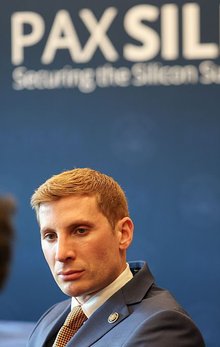
Jacob Helberg
US Under-Secretary of State for Economic Affairs
Stephen Bates
Senior Director, Aerospace and Defense

Trisha Ray
Fellow and Associate Director