
Inside Molson Coors' Blueprint for a Greener Supply Chain
As one of the world’s largest beverage producers, Molson Coors manages a vast supply chain and consequently a large environmental footprint.
The organisation behind brands such as Carling and Coors is implementing a detailed strategy to improve its environmental performance, focusing on areas from its agricultural sourcing to the packaging of its finished products.

Molson Coors’ ‘Our Imprint’ strategy provides a framework for transforming its operations to meet ambitious targets that address its global scale and commitment to responsible business practices. First launched in 2017 and updated in 2020, the strategy is structured around People and Planet.
Environmental initiatives concentrate on four key areas: carbon reduction, water stewardship, sustainable packaging and responsible agricultural sourcing.
Molson Coors’ approach aligns with the UN’s Sustainable Development Goals and its targets have been ratified by the Science Based Targets initiative, confirming they meet the standards of the Paris Climate Agreement's 1.5C°C pathway.
Reducing value chain emissions
Molson Coors has established clear carbon reduction goals.
By 2025, it aims to cut absolute carbon emissions from its direct operations by 50% against a 2016 baseline. It is also targeting a 20% reduction in its supply chain emissions, a goal it confirmed its UK operations had met in the 2024 financial year.
These targets span the entire value chain with a specific focus on packaging materials, which account for around 38% of Molson Coors' total carbon footprint and are subject to a targeted 26% reduction.
Investment in renewable energy has been an important part of Molson Coors' strategy. Its operations in Wisconsin, for instance, now run on renewable electricity through programmes like We Energies' Renewable Pathways, where Molson Coors was the first subscriber.
Modernisation of Molson Coors’ breweries is also progressing, with its Golden, Colorado facility expected to lower energy use by up to 30% and save millions of gallons of water annually through new equipment.
Rethinking packaging and water use
A core part of Molson Coors’ sustainability plan is the elimination of single-use plastic rings from all its North American production sites.
This US$85m investment, announced in 2022, facilitates a transition to sustainably sourced recyclable fibreboard packaging for its four and six-packs.
The change makes Coors Light the largest beer brand in North America to move away from plastic rings, and the conversion is scheduled for completion by the end of 2025.
For Molson Coors, conserving water is a major responsibility. The company has set a goal to improve water use efficiency in its large breweries by 22% compared to 2016 levels, aiming for a water-to-product ratio of 2.8 hectolitres per hectolitre.
Several facilities, including its breweries in Trenton, Ohio and Fort Worth, Texas, have already met or are close to achieving this benchmark.
Fostering a sustainable agricultural supply base
Molson Coors is also advancing towards its goal of sourcing 100% of its barley and hops from sustainable suppliers.
Molson Coors collaborates with its agricultural partners on improving water efficiency, soil health and biodiversity through programmes such as the Molson Coors Growers Group in the UK, which involves over 140 farmers.
To support this objective in the US, Molson Coors created the ‘Grower Direct Portal’, which allows farmers to provide field-level data on their agricultural practices, enabling Molson Coors to track collective progress.
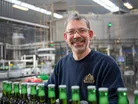
Guiding these efforts across Europe, the Middle East, Africa and Asia-Pacific is Craig Woodburn, Sustainability Director for EMEA & APAC at Molson Coors.
Since joining in 2024, Craig, with his background in the circular economy and supply chain sustainability, has highlighted the critical role of data and supplier collaboration in meeting Molson Coors' goals.
“Data collection, accuracy and availability is a key priority for us and our suppliers and customers,” he says. “Data provided by our suppliers will improve visibility of the trajectory needed to ensure we achieve net zero across our value chain by 2050.”
His focus on the supply chain highlights that for Molson Coors, sustainability is an issue that extends far beyond the brewery walls.
Company portals

Executives

Craig Woodburn
Sustainability Director