Maersk: Showing Logistics Resilience Amid Trade Risks
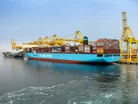
Amid ongoing shifts in tariffs and uncertainty regarding import and export costs, container shipping giant Maersk is demonstrated admirable resilience.
The company has raised its financial guidance for the year after second-quarter reviews showed it was on the up.
Taking geopolitical instability into consideration, Maersk remains on course for a successful year.

Quarterly success
A.P. Moller - Maersk is a Danish shipping and logistics company focusing on port operation, supply chain management, warehousing and air freight.
The company has a presence in more than 130 countries, working to connect its customers' supply chains.
Shipping has been confronted by extreme unpredictability in light of US President Donald Trump's programme of sweeping tariffs, but Maersk has remained strong, providing a reliable service to concerned customers.
The company has raised its full-year financial guidance for 2025, having achieved revenue growth of 2.8% to achieve US$13.1bn.
Vincent Clerc, CEO of Maersk, says: "We have had a strong first half of the year, driven by consistent follow through on our operational improvement plans and the successful launch of the Gemini Cooperation.
"Our new East-West network is raising the bar on reliability and setting new industry standards. It has been a key driver of increased volumes and solid delivery of our Ocean business.
"Even with market volatility and historical uncertainty in global trade, demand remained resilient and we’ve continued to respond with speed and flexibility.
"As our customers navigate these complex challenges, we remain committed to helping them build stronger and more adaptable supply chains, making sure they are ready to not just weather disruption, but to grow through it."
Productivity throughout
Q2 2025 saw revenue from Maersk's Ocean division grow by 2.4% compared to the equivalent quarter in 2024, reaching US$8.6bn. Shipping volumes grew by 4.2%, with Asia being the biggest exporter.
Maersk has increased its EBIT margin from 3.5% to 4.8% over the past 12 months, driven by increased productivity throughout logistics and services.
For the Terminals division, volumes increased 9.9%, aided by Ocean volumes as well as the introduction of the Gemini Cooperation. This long-term operational collaboration with Hapag-LLoyd is intended to create a well-connected ocean network which is more reliable, more efficient and more sustainable.
As trade bottlenecks increase in frequency due to tariff increases and geopolitical tensions, Maersk recognises the importance of collaboration and supplier diversity.
Vincent comments: "Two fundamentals have become clear: trade imbalances, such as the sustained deficits with China, will need to be addressed. And predictability in trade policy is not a luxury; it’s a support on the ground for strategic business decisions.
"As we look ahead, our focus remains on being a trusted partner in uncertain times. Through collaboration, transparency and resilience, we can help global trade not just survive, but to evolve and thrive."
Supply chain diversification
Maersk has witnessed the impact of US tariffs in real time, noting that container traffic in North America has stagnated, while trade elsewhere is growing.
Although some companies are investing into the US in order to beat tariff costs, other countries are focusing their trade outside of North America, diversifying their supply chains.
Vincent explains: "A lot of what our customers are doing is they're managing existing supply chains and then they have to reflect on what is the supply chain of the future for them?
"And that discussion is going to be ongoing for a while, but we will probably see significant shifts in sourcing in the coming years."
Despite widespread global uncertainty, Maersk remains a constant and trusted presence in the realm of shipping and logistics. Over the coming years, it looks set to offer continued stability during turbulent times.