How Rolls-Royce's Hydrogen Powers Europe’s Largest Port
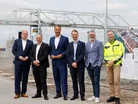
Rolls-Royce and logistics hub duisport are running a world-first hydrogen-powered energy system at the Duisburg Gateway Terminal, the largest inland container terminal in Europe.
With more than four million twenty-foot equivalent units (TEU) moved each year, the port is a critical link in the continent’s supply chain.
Now, it’s also a testbed for energy transition.

The new set-up delivers CO₂ neutral and self-sufficient power using combined heat and power (CHP) units developed by Rolls-Royce’s Power Systems business. These units, designed to run on 100 percent hydrogen, are the heart of the system now operating at full scale.
Dr Jörg Stratmann, Chief Executive of Rolls-Royce Power Systems, says the system marks a real shift in infrastructure energy use: “The launch of this carbon-neutral energy system at the Duisburg Gateway Terminal is a big step toward a more climate-friendly, resilient energy supply.
“Together with our partner duisport, we're showing how scalable technologies from Rolls-Royce can really help transform critical infrastructure - and help make the energy transition happen.”
Greening supply chains with hydrogen power
Hydrogen’s role in port operations is growing as pressure increases to decarbonise supply chains.
At Duisburg, energy is needed around the clock to power cranes, shore power facilities and charging infrastructure. The new system integrates a 1.3 MWp photovoltaic (PV) array, which provides electricity during daylight hours.
Any surplus electricity is stored in a dedicated battery known as the MTU EnergyPack and used when solar generation dips.
When sunlight alone cannot meet demand, the system relies on hydrogen-powered MTU fuel cells and combined heat and power plants. These backup units generate both electricity and usable heat, allowing for no-carbon output.
The whole system is controlled by a smart energy management unit, distributing electricity efficiently around the terminal and reducing reliance on the grid.
Hydrogen itself is stored energy, usually derived from compounds like water or hydrocarbons. It can be produced by electrolysis, a process that splits water into hydrogen and oxygen using electricity.
When that electricity comes from renewables, the result is green hydrogen. Though hydrogen combustion doesn’t emit CO₂, it can release nitrogen oxides, depending on engine type.
Duisburg's approach is different from many port electrification efforts because it relies on a localised microgrid.
According to Alexander Garbar, Head of Corporate Development at duisport: “Our microgrid is running reliably and shows that it is possible to supply such a large port terminal completely independently with green energy.”
The companies are also exploring how nearby neighbourhoods could tap into this hydrogen-powered energy network.
The next step for energy tech
At the core of Rolls-Royce’s contribution are the MTU Series 4000 engines. This is the first time the 12-cylinder version has been deployed to run on 100 percent hydrogen. Each engine provides 1 megawatt (MW) of output.
While this trial proves the model works, Rolls-Royce is already aiming for more powerful designs. Future versions of these CHP units may produce up to 2.5 MW, matching the output of current natural gas equivalents.
Michael Stipa, Vice President for Business Development and Product Management for Stationary Energy Solutions at Rolls-Royce, explains the wider ambition: “As soon as sufficient green hydrogen is available, MTU gas engines, such as those in Duisburg, can also make a significant contribution to reducing CO₂ emissions by running on 100% hydrogen or a hydrogen blend.”
This project, known as Enerport II, is funded by Germany’s Federal Ministry for Economic Affairs and Energy.
It brings together multiple partners including Westenergie Netzservice, Netze Duisburg and Stadtwerke Duisburg Energiehandel.
For duisport, sustainability and future-proofing the port’s role in global logistics remain central.
“Sustainability is an integral part of our corporate strategy that compels us to act responsibly and with a view to the future,” says Markus Bangen, CEO of Duisburger Hafen.
“With this self-sufficient and CO₂ neutral energy system, we also have a clear competitive advantage.”
The Port of Duisburg now stretches across an area equivalent to 33 football fields. With supply chains under growing scrutiny, its push into green energy could serve as a model for logistics hubs worldwide.