US Blockades Hormuz: Are Supply Chains at Breaking Point?
A threatened US naval blockade of the Strait of Hormuz risks tipping an already fragile global trading system into a new energy and inflation shock, even as Washington insists it can shield American consumers from the worst of the fallout.
President Donald Trump’s order to prepare to interdict tankers that keep paying Iran’s transit tolls escalates a crisis that has simmered for weeks, turning a contested waterway into an explicit battlefield over the rules of global commerce.
For now, US officials say the operation will 'take a little while' to put fully in place, but the threat alone is already reshaping markets and shipping decisions. Nathan Charlies, Managing Partner at Charles International Law, says: "From a strategic standpoint, this raises serious concerns.
"A blockade is not a marginal policy adjustment - it is widely understood as an act of war, particularly when applied to a global chokepoint responsible for around 20% of the world’s oil supply.
"This is not just a geopolitical issue - it has direct implications for global markets, supply chains and economic stability.”

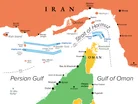
The stakes are now enormous both in the US and around the world. The narrow channel between Iran and Oman carries about 20 million barrels of crude and refined products a day in normal times, roughly a quarter of all seaborne oil trade and around one‑fifth of global petroleum consumption.
It also handles close to 20% of global liquefied natural gas shipments, much of it from Qatar to power‑hungry Asian economies. When Iran first moved to restrict traffic, shipping giants and insurers had already pulled back, creating a de facto closure.
The emerging US blockade now formalises that disruption and is intended to extend it to any vessel deemed complicit in Tehran’s toll regime, even if the full naval cordon is not yet physically in place.
American sanctions
Shipping expert, Lars Jensen, Chief Executive of Vespucci Maritime, says that for now, a blockade would only affect a small handful of vessels that are still navigating the waterway.
Lars adds: “If this is actually done by the Americans, it will halt a very tiny trickle of vessels. In the greater scheme of things, it doesn't really change anything.
“First of all, there's very few ships that pass. There's even fewer of those that pay, and those that pay will already be subject to American sanctions.
"Most shipping companies will continue to wait and see if there is a tentative peace agreement and whether that might hold.
"Because at the end of it, it boils down to trust: trust that any agreement between the US and Iranians will hold for a significant portion of time, and that's a subjective feeling, there is nothing hard and tangible you can point to."
Amid the scramble, some see a deeper redefinition of how global trade treats its most critical arteries.
Wolfgang Lehmacher, global supply chain strategist, wrote on LinkedIn before the blockade was announced: “When a corridor that carries roughly a quarter of global seaborne oil turns from assumed commons into a priced, contested asset, the message is clear: chokepoints have become instruments of power, not just passages of trade. Visibility without access is not resilience.
"Nearly two thousand vessels idling, routes stretching around Africa, costs cascading from bunker surcharges to consumer prices - all show the limits of treating geopolitics as an exogenous shock to be tracked, not shaped.
"More sensors, more data and smarter algorithms can tell us where ships are; they cannot, on their own, reopen a strait or stabilise a corridor.”
Energy markets react
Energy markets have nonetheless reacted instantly to the new US stance. Oil traders are now pricing in the risk that the threatened interdictions, layered on top of existing Iranian restrictions and self‑sanctioning by shipowners, will delay or effectively remove flows that cannot be fully rerouted, despite spare pipeline capacity from Saudi Arabia and the United Arab Emirates to Red Sea and Gulf of Oman ports.
Analysts warn crude could spike toward $US200 a barrel if the standoff drags on and the blockade is tightened, dwarfing previous shocks and feeding directly into higher fuel, freight and food costs worldwide.
Emergency releases from strategic reserves and pledges of additional supply from producers outside the Gulf may soften the blow but cannot replace Hormuz‑scale volumes for long.
Rewriting trade rules
Lehmacher argues that the answer lies not only in diversifying routes and suppliers, but in rewriting the rules of how key corridors are governed. “This is where supply‑chain diplomacy enters the core resilience toolbox," he says.
"The differentiator will be the ability to co‑create governed corridors: clear rights of passage, agreed dispute‑resolution, interoperable digital infrastructure and pre‑negotiated playbooks for the next disruption.
“Shipping and logistics now face a strategic choice. Those who remain passive price‑takers at chokepoints will absorb every new toll and premium; those who help design corridor governance and align their commercial strategies with geopolitical realities will turn today’s disruptions into tomorrow’s competitive edge.”
Hormuz, he suggests, is “not an exception; it is a live test of whether globalisation can adapt to a world in which access is negotiated, not assumed. Today the most valuable capability in logistics is the ability to secure, in advance, the conditions under which trade can flow.”