Exploring Female Leadership in the Supply Chain Industry
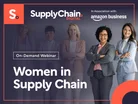
The supply chain industry has been dominated by male voices, with unnoticed barriers preventing women from taking on those higher roles.
Now, however, supply chains around the world are realising the value unlocked through diverse voices, with resilience strategies focused on bringing in new leadership styles.
Through mentorship and collaboration, or developing new skills, women leaders are demonstrating how business performance can be increased through diverse voices.
During the Women in Supply Chain webinar, hosted by Supply Chain Digital in association with Amazon Business, leaders spoke about how gender equity can be driven in the supply chain.

Industry shifts
In the last few years, supply chains around the world have undergone significant transformation, driven by major geopolitical events. This shift has resulted in a deeper analysis into supply chain operations, including the people who are running them.
"The supply chain industry is undergoing a significant transformation. While technology is a major driver, the real catalyst for innovation is the people that are behind the strategy," said Ella Wilkinson, Director of BizClick Studio and host, as she introduced the webinar.
"Today, we focus on a critical part of that: the advancement of women into leadership roles. This conversation isn't just about representation, it's about performance, leadership and the future of the industry."
These leaders are channelling innovation and driving advancement, with more women entering the scene.
The panel focused on how the industry is developing into a more diverse and rich sector, celebrating new types of leadership and performance as the industry moves into the future. Though women are working steadfastly across the industry, industry research demonstrates a significant drop-off at the higher levels, resulting in a leadership team dominated by men.
"I've been working in supply chain and procurement for 15 years, and I'm a big advocate for having conversations around diversity – especially women in the supply chain," explained Mira Korhonen-Low, Group Head of Procurement at Forenom.
"I know we have probably not been represented as much as our male colleagues, but I've had a long career in supply chain and I've seen a lot of change. That's why I think this is a great conversation to have and I'm really happy to be here having it."
Diversifying and uplifting
The webinar had a focus on driving female representation within leadership and how it can add value to a business. In particular, as AI is reshaping the supply chain landscape, speakers discussed how this is leading a growth in importance of soft skills, such as emotional intelligence and communication. This is where women often strive, meaning there is a growing favour for women in leadership roles.
"It's most important in procurement to have diversity of thought, because where you have this in procurement, you gain better results," added Jarrod Glover, Director of Cost Management and Procurement at Santander.
The webinar explored insights into how to uplift women into these roles. The speakers stressed the importance of personal responsibility, self-advocacy and sponsorship. Throughout, utilising internal networks became a major theme, with relationship-building being important to career development.
"Sponsorship is about having somebody who is your advocate, who can support with those opportunities," explained Emma Loyden, Head of Third Party Risk Management at Santander.
"Looking at your personal development and creating the action-orientated activity that you need to do, is that's really invaluable in terms of the actions that you can take and the visibility that you can have and the opportunities you get to broaden your experience and build on those skills.
"With mentorship that is there for guidance, support, insight and feedback at times on how to approach different scenarios. So they're very different, and I think having both obviously helps you in different ways in how you use those as part of your personal growth and development."
Progression in the supply chain contains a range of factors, including individual capability, visibility and support structures.
Company portals




Executives
Emma Loyden
Head of Third Party Risk Management

Jarrod Glover
Director of Cost Management and Procurement
Mira Korhonen-Low
Group Head of Procurement