
DP World: Developing Flexibility Across Global Trade Routes
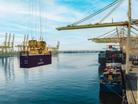
DP World is working to provide greater connectivity and flexibility to customers in UAE, through the expansion of the Fujairah Ports Authority.
Amid ongoing geopolitical volatility and disruption in the critical trade route of the Strait of Hormuz, logistics companies around the world are looking to better support their customers.
This new development will support UAE capacity growth and will help streamline global trade.

The Al Rugaylat and Dibba terminals will bring world-class operating capability, expanded capacity and new investment to the emirate.
Developing resilience
The Port of Fujairah is the only multi-purpose seaport on the eastern coastline of UAE, located 70 nautical miles from the Strait of Hormuz. Due to this,it has been strategically located in order to provide essential access to trade. The port acts as an economic link between Europe and Asia, as well as providing more trade opportunities to India and North East Africa.
To increase operation capacity, DP World has developed an agreement with the Fujairah Ports Authority, to develop two new terminals, as part of a 50-year deal. The Al Rugaylat terminal is a multi-purpose and container terminal, and DP World will also operate the Dibba General Cargo terminal. DP World currently operates four ports and facilities in the UAE; Jebel Ali, Mina Al Hamriya, Mina Rashid and Dubai Creek & Deira Wharfage.
By introducing the terminals at the Port of Fujairah, it is bringing in trade from the other side of UAE, operating on the Gulf of Oman, rather than the Persian Gulf. This means the cargo does not need to go through the Strait of Hormuz, as recent volatilities has made the passage unsafe and unpredictable. Through expanding DP World's UAE capacity, it is creating a more reliable connectivity across global trade routes.
"Locating the new terminal outside the Straight of Hormuz would enable ships to sail in relative safety; the construction of the port was effectively a response to the closure of the Straight in the 1980s Iran-Iraq ware. However, the 12 May 2019 attack as well as more recent issues shows that it is not immune from danger," explains Emile Naus, Partner at BearingPoint in a statement to Supply Chain Digital.
Greater flexibility
The new terminals will create a deep-water trade gateway on the east coast of UAE, with capabilities of handling Ultra Large Container Vessels. Al Rugaylat will be able to handle up to 2.5 million TEUs every year, as well as 1.7 million tonnes of general cargo and 190,000 Car Equivalent Units (CEUs). Dibba will manage up to 3.6 million tonnes of annual general cargo capacity.
"The partnership with DP World marks an important milestone in Fujairah's continued development as one of the region's most important maritime gateways," says H.H. Sheikh Saleh Bin Mohamed Al Sharqi, Chairman, Fujairah Ports Authority.
"The Al Rugaylat and Dibba terminals will bring world-class operating capability, expanded capacity and new investment to the emirate. We look forward to working with DP World to deliver a project that will benefit customers, communities and the UAE's wider economy."
- Construction is expected to take 24 to 30 months
- Capacity for DP World in the UAE will reach 22 million TEUs
- Al Rugaylat will handle 1.7 million tonnes of general cargo and 190,000 CEUs every year
- Dibba will increase general cargo capacity by 3.6 million tonnes annually
- The Port of Jebel Ali and the Port of Fujairah are 152 km apart by road
- There are approximately 245 nautical miles between Jebel Ali Port and the Port of Fujairah
It is anticipated that the new logistics zone will drive further investment, employment and long-term economic opportunity to the region. Moreover, it will expand DP World's capabilities of supporting global trade.
Within the UAE, DP World currently has a total container handling capacity of 19.4 million TEUs, but with this expansion, it will reach almost 22 million TEUs. It will be able to deliver as a global integrated platform across global supply chains, with more capacity amid growing demand for trade. With the rise of ecommerce and a growing need of supply chain diversification, ports and terminals around the world are challenged with growing their operational capacity.
It offers greater choice of destination for cargo owners, as well as more flexibility when operating in periods of high demand, as well as more supply chain resilience amid global volatility.
"The UAE has been at the heart of DP World's story for more than four decades, and this investment reflects our confidence in its future as one of the world's leading trade and logistics hubs," explains H.E. Essa Kazim, Chairman, DP World.
"Building on the strength of Jebel Ali, this development deepens our commitment to the UAE and reinforces the country's strategic role in global trade."
Multimodal opportunities
As DP World operates as a multimodal logistics company, the Fujairah terminals will be connected to Jebel Ali through its inland logistics network. This allows for a more integrated end-to-end supply chain across the UAE, with expanded capabilities of moving cargo efficiently between ports, logistics hubs and end markets.
Emile, however, warns of logistics concerns which could occur within the new terminal, stating, "the port is more exposed than the existing Jebel Ali facilities, with direct exposure to the weather in the Gulf of Oman and Arabian Sea", and that due to its elevation, there are logistical issues regarding road freight.
However, he also points to the anticipated risk to Jebel Ali that DP World may be facing amid ongoing geopolitical turbulence.
Construction of these ports is anticipated to take 24 to 30 months.
Company portals



Executives

Emile Naus
Partner

Essa Kazim
Chairman