DP World: How New Routes Are Speeding Housing Supply Chains
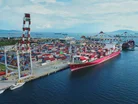
DP World and Ichijo Komuten are expanding a key Japan-Philippines trade corridor as rising demand for prefabricated housing drives the need for faster, more resilient supply chain models across Asia-Pacific.
The strengthened partnership centres on a new weekly maritime service operated by CMA CGM, connecting Sendai in Japan with major Philippine ports.
The route enhances access to terminals in Manila and Batangas, enabling faster and more reliable movement of prefabricated housing materials.
Marking the first regular international shipping connection between Sendai and the Philippines in eight years, the service is designed to reinforce cargo flows tied to Ichijo’s operations, which manufacture housing components in the Philippines for export to Japan.
By integrating direct shipping links with end-to-end logistics capabilities, DP World is aiming to reduce transit times and improve visibility across the supply chain.
Its partner terminals act as key gateways, supported by inland transport and marine services that help ease congestion and streamline delivery from port to production sites.

This expanded route underpins Ichijo’s broader supply chain ecosystem in the Philippines, where local manufacturing and procurement operations play a central role in producing prefabricated housing components for export.
These components are then shipped back to Japan to meet growing housing demand across the Asia-Pacific region.
DP World also supports domestic logistics in Japan, ensuring cargo moves efficiently from origin points to regional ports ahead of export.
Together, these capabilities create a more seamless connection between origin and destination markets, an increasingly important factor as construction supply chains seek greater predictability and speed.
Integrated supply chains
The initiative reflects a wider industry shift towards distributed manufacturing models, where production is strategically located across regions to balance cost, scalability and resilience.
By combining global network reach with local expertise, DP World and Ichijo aim to deliver more consistent material flows and support time-sensitive construction timelines.
This focus on integrated, high-performance supply chains is mirrored in DP World’s broader global operations.
In India, the company has demonstrated growing terminal capacity at its facility in Cochin, which set a new benchmark for single vessel handling.
The terminal processed more than 8,000 TEUs from the arrival of the MSC Ilaria, the highest volume ever handled in a single vessel call at the port.
The 366-metre ultra large container vessel, with a capacity exceeding 16,000 TEUs, highlights the increasing scale of global shipping and the corresponding need for ports to handle larger vessels efficiently.
This milestone reflects continued infrastructure investment, including new ship-to-shore cranes, electrified yard equipment and expanded yard capacity of around 1.4 million TEUs.
These upgrades are improving productivity, enabling faster turnaround times and supporting more efficient cargo handling across key trade routes.
Critical role in global trade
Located close to major international shipping lanes and cargo hubs in southern India, the Cochin facility plays a critical role in regional and global trade.
Its connectivity across coastal and international networks, combined with an integrated free trade warehousing zone, strengthens its position as a strategic gateway for EXIM flows.
Alongside expanding capacity and connectivity, DP World is also embedding sustainability into its operations, an increasingly important dimension of modern supply chain strategy.
The company’s recent Gold rating from EcoVadis places it among the top 1% of transportation companies assessed globally.
Glen Hilton, CEO and Managing Director for Asia Pacific at DP World, says the company is focused on delivering measurable impact across its regional operations: “In Asia Pacific, we’re focused on practical shifts that deliver measurable impact.
“At Laem Chabang in Thailand, electric internal transfer vehicles are already reducing emissions, with full fleet electrification targeted by 2030.
“In Australia, the planned rail extension at Port Botany will cut congestion and road-based emissions.
“And in the Philippines, Batangas Integrated Port now operates on 100% renewable energy.
“These initiatives reflect a broader approach for us as a company, embedding sustainability into how we design, build and operate supply chains.
“The opportunity now is to scale this further, working closely with customers and partners to accelerate the transition to lower-carbon trade.”
As global trade corridors evolve, DP World’s approach, linking route expansion, port capacity and sustainability, highlights how supply chain leaders are building more connected, scalable and future-ready logistics networks across Asia-Pacific.


Executives
Glen Hilton
CEO & Managing Director Asia Pacific